
Count down the days to your big day.
A printable countdown for any target date — wedding, vacation, birthday, retirement. One numbered box per day from today to the target.
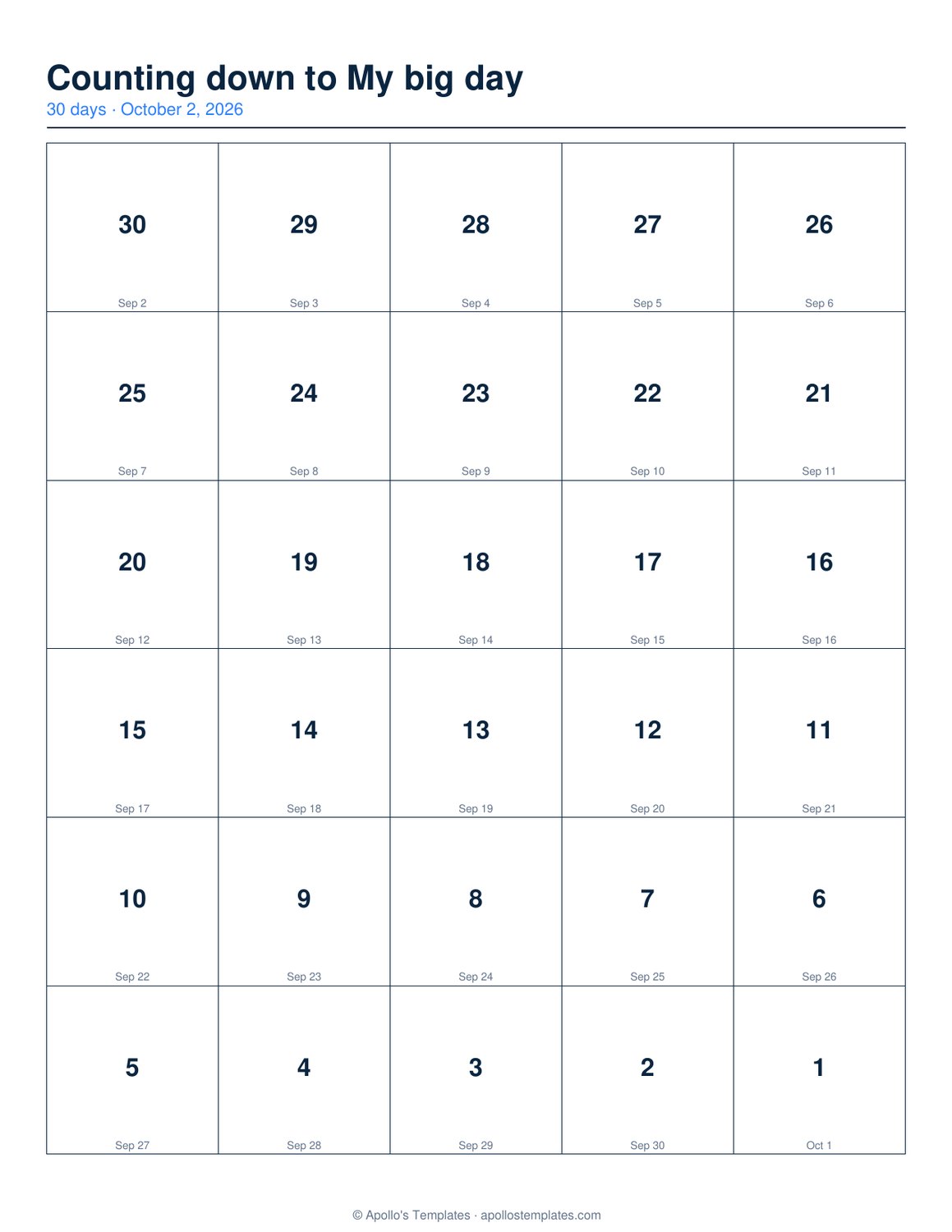
Printable countdown calendar for weddings, vacations and big days
Enter the date and a title and the calendar numbers every day between now and then, one box per day, so you cross one off each morning. It's the classic vacation countdown for kids, a wedding countdown for the fridge, a retirement countdown for the office, or a due-date countdown — see the pregnancy & baby hub for the rest of that set.
Christmas countdown and advent-style calendars
For December the advent calendar gives you the 24 numbered boxes to cut and fold; this countdown handles any date and any length. Both are free printable PDFs with nothing to install.
Tips for the best result
Pick the right level of granularity. 30-day countdowns suit one daily-cross-off ritual. 365-day countdowns suit a weekly check-in (color in 7 days at a time). Pick the rhythm that matches your patience.
Put it where the audience is. A wedding countdown belongs in the bedroom (the couple sees it daily). A kid's vacation countdown belongs at kid eye-level on the fridge. The visibility IS the feature.
Color, not just X. Coloring a cell takes longer than crossing it off — that 5 extra seconds is the daily ritual the calendar exists to create.
Save the finished calendar. A fully-colored countdown is a visible record of the wait. Tuck it into the wedding album, the baby book, the trip scrapbook.