





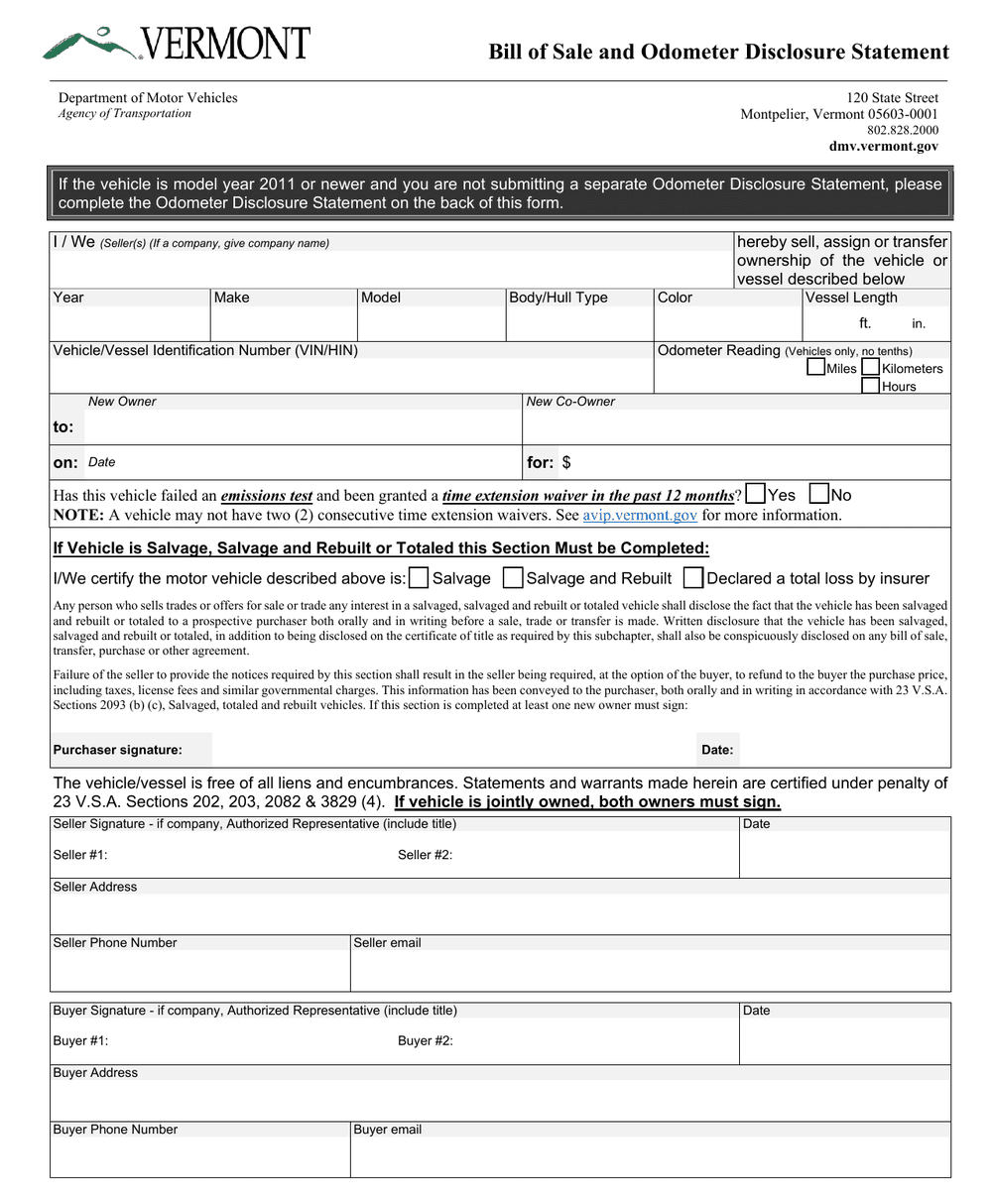
Vermont Bill of Sale Form
Vermont is one of the states where the bill of sale genuinely matters: it's required for registration, it feeds the tax calculation, and for older vehicles sold without a title it anchors the ownership chain until the state issues one. Here's the whole picture — official form included.
Required — and doing double duty.
How 2024 changed Vermont titles.
The old rule is also why Vermont was famous among collectors — the “Vermont loophole” let out-of-staters mail-register old vehicles to conjure an ownership document from a bill of sale alone. That door closed on July 1, 2023: the DMV now requires proof of a genuine Vermont connection, and the 2024 title change removed the rest of the machinery behind it.
Vermont checks your price against the book.
Not legal advice. Facts verified against Vermont DMV sources in July 2026 — see the state links in our 50-state requirements table.
Vermont specifics, answered.
Is a bill of sale required in Vermont?
Yes. Vermont requires a bill of sale to register a privately purchased used vehicle and to compute the Purchase & Use Tax. The official Form VT-005 combines the bill of sale and the odometer disclosure statement into a single document.
Why doesn't my older Vermont vehicle have a title?
Because it predates Vermont's 2024 title-law change. Under Act 165, the old rolling 15-year exemption is frozen: only vehicles that were already more than 15 years old on January 1, 2024, were registered in Vermont, and have not changed hands since remain title-less. The moment one of those vehicles is sold, the new owner receives a Vermont title at registration — so every sale today produces a title, whatever the vehicle's age. The sale itself still runs on the signed bill of sale plus the seller's registration certificate.
Will Vermont tax the price I actually paid?
Only if it's the higher number. Vermont's 6% Purchase & Use Tax is charged on the greater of your actual purchase price or the J.D. Power (NADA) clean trade-in book value — so writing a low price on the bill of sale does not lower the tax on a private sale.
Does the famous 'Vermont loophole' still work for out-of-staters?
No. Vermont closed it effective July 1, 2023. Non-residents can no longer mail-register an old vehicle to obtain an ownership document without a Vermont connection — the DMV now requires proof of ties to Vermont, and even certification from your home state that you aren't required to register there.
Build the right form for what you're selling.
The Vermont rules above apply to whatever you are selling. Pick the item type to get a form with the right identifying fields on it.