
Apollo's Templates
HomeCalendarsTeacher Lesson Planner
Calendars

Lesson Plan Template

Teacher lesson planner

A weekly lesson planner — period by period, day by day.

Rows are class periods, columns are the days of the week. Drop in lesson topics, objectives, or reading assignments for each block.
PDF · US Letter landscape · one week per page · fillable
Sample output
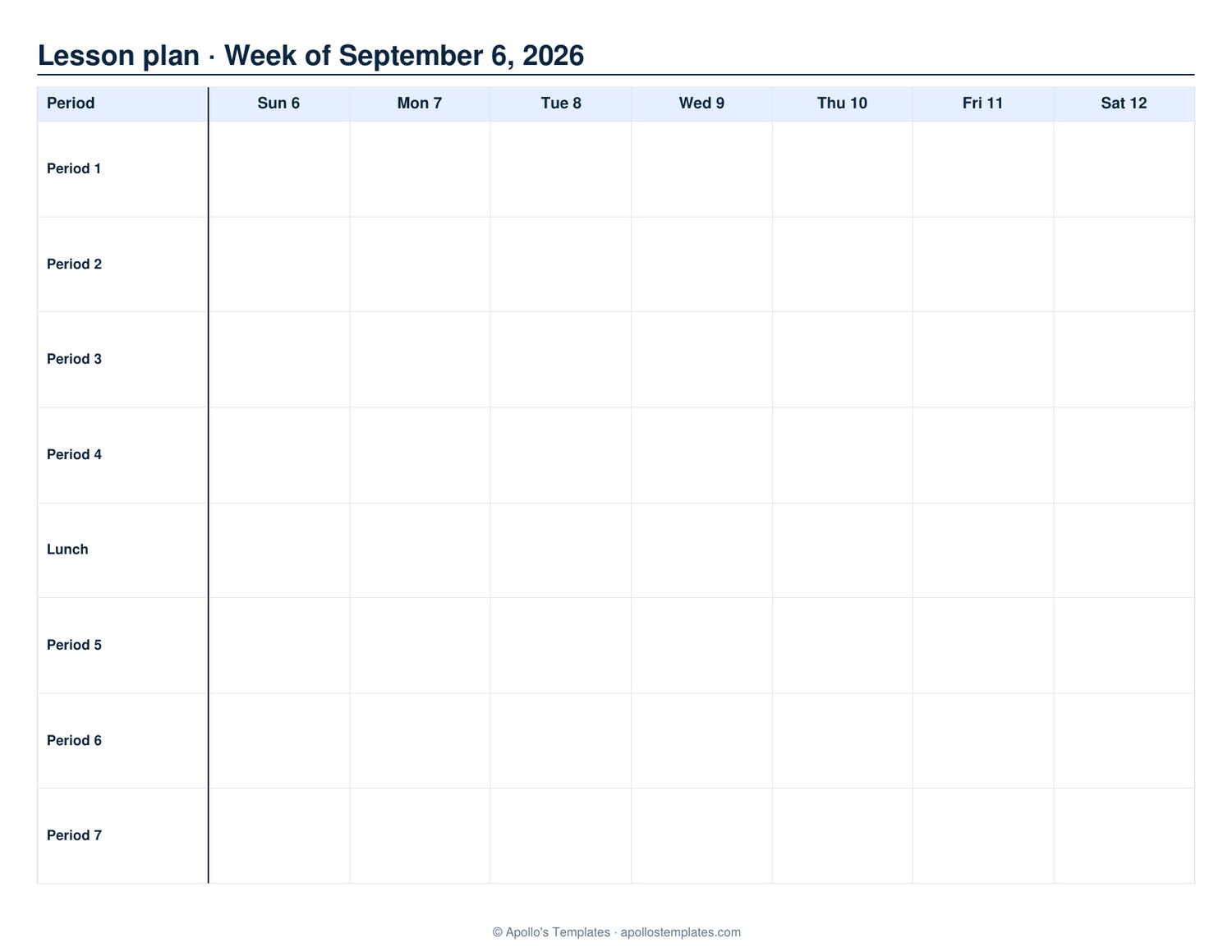
Weekly lesson plan sheet with class-period rows down the left and Monday-to-Friday columns
Class periods down the left, school days across — a week of lessons on one page. The generator above builds yours from the options you choose.

Weekly lesson planner template for teachers

One row per period or class, one column per school day: type objectives, activities and materials into the fillable cells, or print and handwrite. Generate a semester of weeks at once and slip them into a lesson plan book. Works for elementary, secondary and college schedules.

Lesson planning for homeschool, Sunday school and tutoring

For a subject-by-day layout the homeschool planner fits better, and the classroom attendance sheet records who was in class. Everything is a free fillable PDF — no Word, Excel or teacher-store login.

Tips for the best result

Color-code by subject for multi-subject teachers. Helpful for elementary or middle-school teachers running 4+ subjects — turn the planner into a color-coded weekly map.

Pencil first, ink Friday. Lessons move. Pencil during the week; ink the actual delivered plan on Friday. The inked version becomes documented evidence of what you taught (useful for evaluations or future-year planning).

Three-hole-punch into a teacher binder. Bind the year of weekly planners with monthly attendance sheets and the academic-year calendar — that's your complete classroom binder.

Reference standards in the cells. If your district maps lessons to standards, write the standard ID in the cell ("MAT.4.NBT.5"). Saves time during evaluation conversations.

Track student attendance
Classroom Attendance
Monthly attendance grid — students down, school days across. Pairs with the weekly lesson planner.
Open
Year-at-a-glance
Academic Calendar
12 months across two calendar years — for at-a-glance planning of breaks, holidays, and term boundaries.
Open

Frequently asked questions

How is this different from the Homeschool Planner?
Same grid shape, different row labels. The Lesson Planner has rows for class periods (Period 1, Period 2, ..., Period 7) — built for a middle/high-school teacher running the same subject across multiple periods. The Homeschool Planner has rows for subjects — built for one teacher covering multiple subjects with one or two students. Pick whichever matches your reality.
Does this work for elementary teachers?
Yes, with adapted row labels. Elementary teachers usually have a single class but multiple subjects per day — relabel the rows as Reading, Writing, Math, Science, Social Studies, etc. (the Homeschool Planner is actually closer to this pattern, but either works).
How many class periods fit on the sheet?
Up to 7 named period rows comfortably — covers the most common middle/high-school schedules. For block scheduling (3-4 longer periods per day), you'll have empty rows; the planner still works, just leaner.
What should I write in each cell?
Conventionally: lesson topic (1-2 words), the standard or learning objective being addressed, key activity, and assessment if any. Cells are sized for shorthand — the detailed lesson plan lives elsewhere (curriculum binder, LMS). The grid is for at-a-glance week-level visibility.
Should I print one a week, or batch a quarter?
Print weekly. Lesson plans shift constantly based on student pace, snow days, assemblies — a printed quarter goes stale by week 3. Print Sunday for the week ahead and write in pencil so adjustments are quick.
What about substitute teacher plans?
Print a blank version pre-filled with class names and times — leave on the desk so a sub can see the day's structure at a glance. Pair with day-specific lesson handouts for a complete sub kit. The Classroom Attendance sheet is also useful in the same kit.
Updated through September 2026