
Free Nursing Cover Letter Templates
Nurse managers screen applications the way they run a unit: license first, certifications second, then whether your experience fits their patient population and their schedule holes. These three templates carry a letter built in that order — active license and BLS/ACLS in the first line, unit type and typical assignment in the middle, and shift availability stated plainly, because for a hiring manager staring at a night-shift gap, availability is the whole conversation.
Clinical credibility, three ways.
Sidebar in scrubs blue with a strengths rail for skills-forward applications, Formal in wine for Magnet hospitals and conservative systems, Contemporary in jade for clinics and outpatient. Same license-first nursing letter inside each.
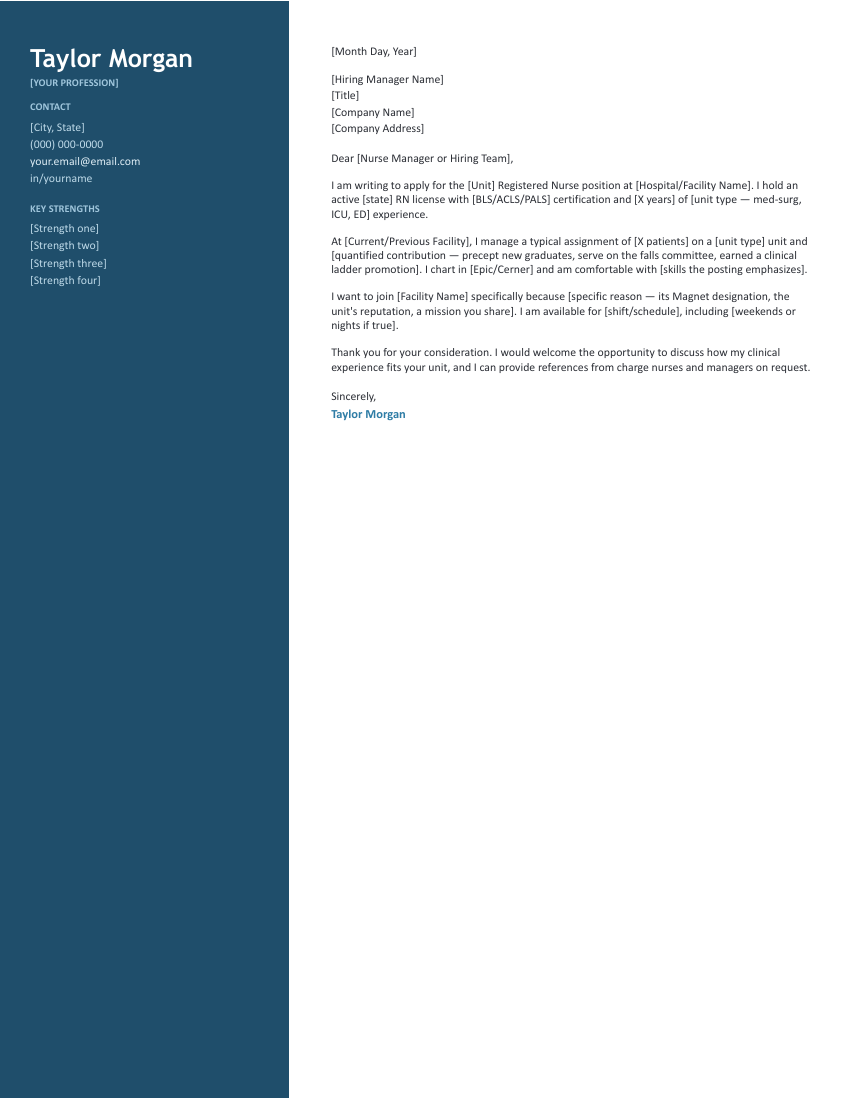
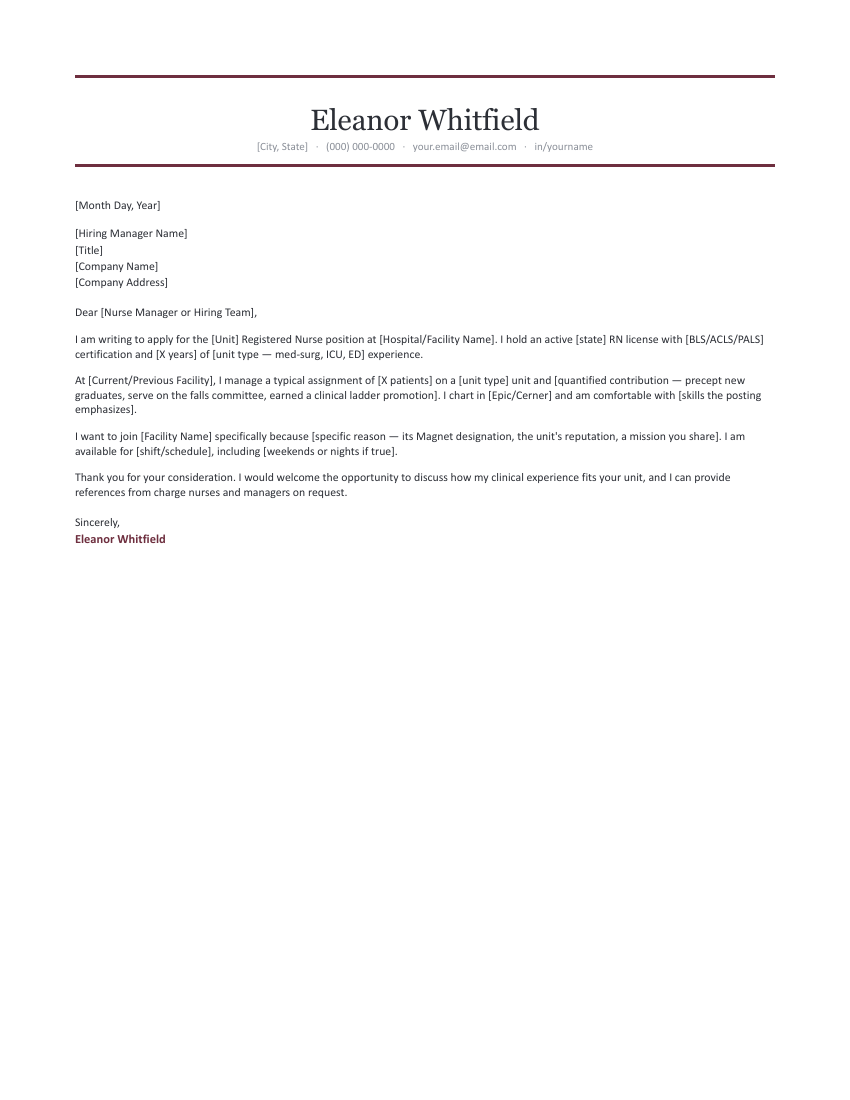
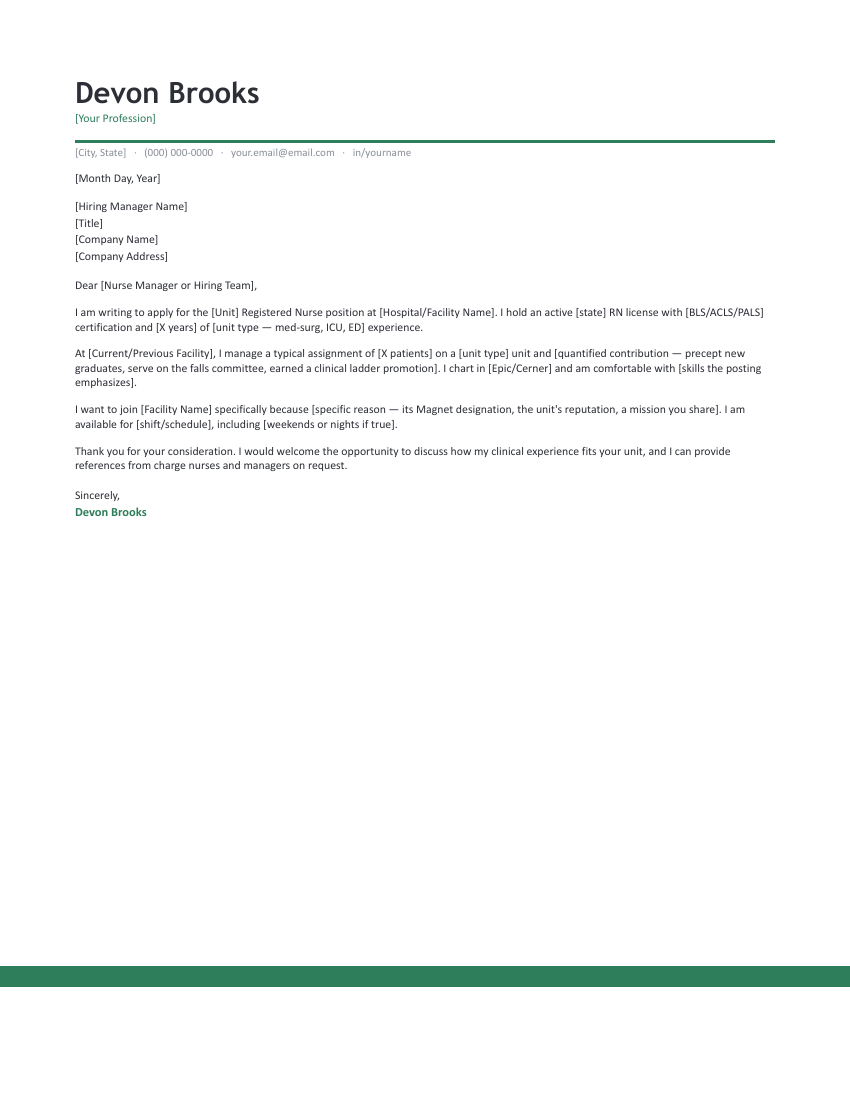
Nursing cover letter example \u2014 the letter inside the template.
CONTACT
[City, State]
(000) 000-0000
your.email@email.com
in/yourname
KEY STRENGTHS
[Strength one]
[Strength two]
[Strength three]
[Strength four]
[Month Day, Year]
[Hiring Manager Name]
[Title]
[Company Name]
[Company Address]
Dear [Nurse Manager or Hiring Team],
I am writing to apply for the [Unit] Registered Nurse position at [Hospital/Facility Name]. I hold an active [state] RN license with [BLS/ACLS/PALS] certification and [X years] of [unit type — med-surg, ICU, ED] experience.
At [Current/Previous Facility], I manage a typical assignment of [X patients] on a [unit type] unit and [quantified contribution — precept new graduates, serve on the falls committee, earned a clinical ladder promotion]. I chart in [Epic/Cerner] and am comfortable with [skills the posting emphasizes].
I want to join [Facility Name] specifically because [specific reason — its Magnet designation, the unit's reputation, a mission you share]. I am available for [shift/schedule], including [weekends or nights if true].
Thank you for your consideration. I would welcome the opportunity to discuss how my clinical experience fits your unit, and I can provide references from charge nurses and managers on request.
Sincerely,
Taylor Morgan
How nurse managers actually read applications.
A nurse manager reading applications is solving a staffing puzzle: license, competencies, and schedule, in that order. The letter that gets an interview answers the puzzle directly:
- License and certs, first line. State, RN, compact status if you have it, BLS/ACLS/PALS. Recruiters filter before managers read — make the filter’s job instant.
- Your unit, in numbers. Patient ratios, acuity, the EHR, the devices and drips. “Med-surg, five patients, Epic” is a complete clinical sentence — managers can place you on their unit from it.
- One contribution beyond the assignment. Precepting, charge shifts, committee work, a unit-level improvement. It signals you’ll be part of the unit’s fabric, not just its schedule.
- Availability, stated plainly. Shift, weekends, start date. Managers hire against specific holes in a schedule — the letter that names its availability answers their first practical question.
For residencies and competitive units, add one honest sentence about why this patient population — it’s the question every panel asks, and the letter that answers it early reads as self-aware rather than coached.
Fill it in.
- Open a template in Google Docs or download the Word file.
- First line: state license + certifications. Middle: unit type, ratios, EHR, one contribution.
- State your shift availability plainly — it’s the manager’s first practical question.
- Pair it with a matching nursing resume and export both as PDFs.
Nursing cover letter FAQ
What should a nursing cover letter include?
Do nurses actually need a cover letter?
How do I write a new grad nursing cover letter?
How do I show I fit a specific unit?
Should I explain employment gaps or why I'm leaving my current hospital?
How do I write a new grad nurse cover letter?
Should a nursing cover letter mention patient ratios and EHR?
Nursing & RN cover letter templates · Updated September 2026