






Hawaii Bill of Sale
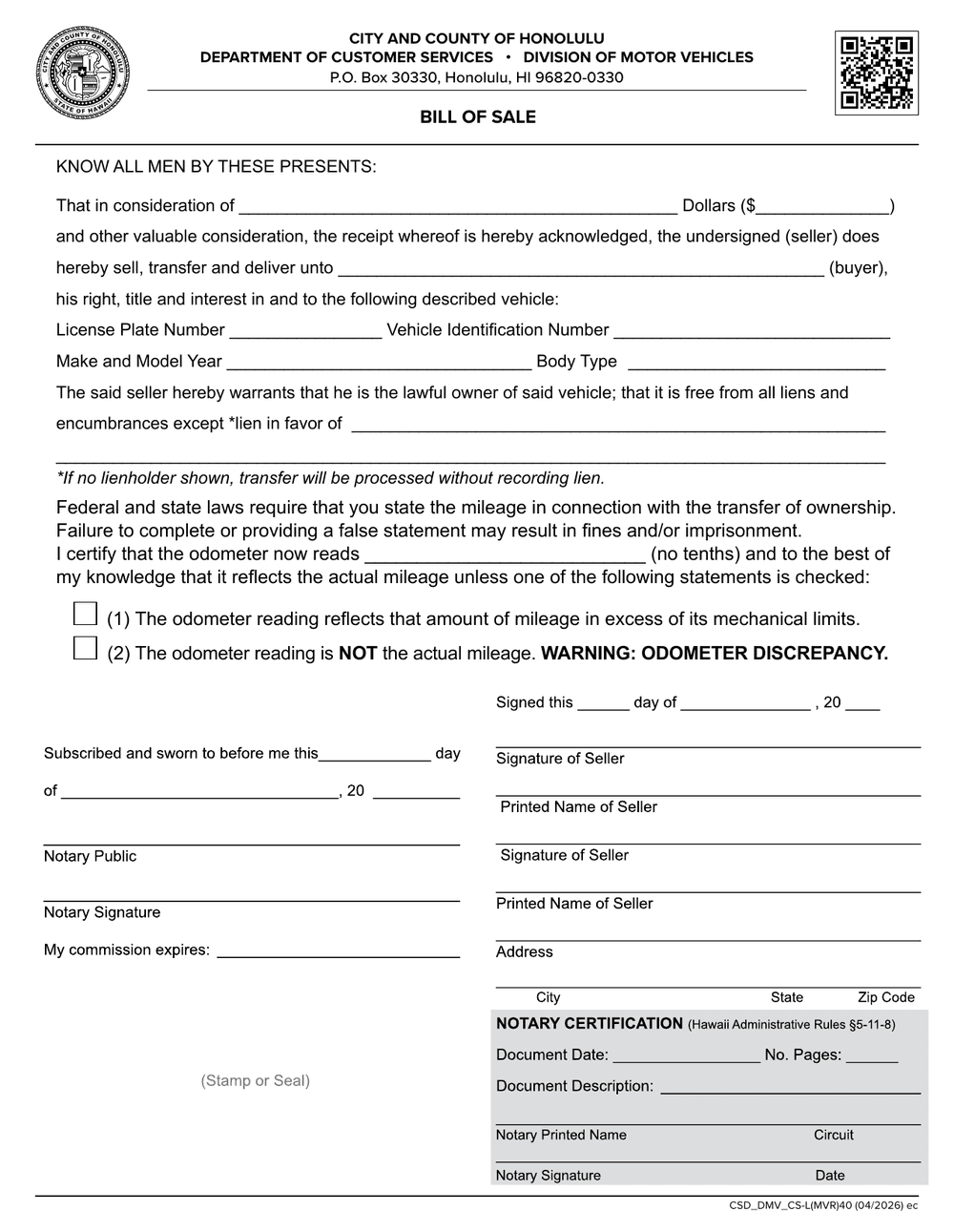
Four counties, four rulebooks, one 30-day deadline — Hawaii handles vehicle transfers island by island. Honolulu's official bill of sale, the notary case, and the safety-check handoff, all here.
Your county sets the paperwork; the state sets the clock.
Hawaii specifics, answered.
Why does Hawaii vehicle paperwork depend on your island?
Because Hawaii has no state DMV — vehicle registration is run by the four counties (Honolulu, Maui, Kauai, and Hawaii County), each with its own forms and counter practices. The state sets the 30-day transfer deadline and the $50 penalty; the counties decide the paperwork details.
When does Honolulu require a notarized bill of sale?
In one specific case: when the person selling isn't the owner shown on the title (an intervening unrecorded sale). Then Honolulu's CS-L(MVR)40 bill of sale must be notarized to bridge the gap. For a routine sale where the titled owner signs, the notary isn't required.
What happens with the safety inspection at a Hawaii sale?
The current periodic safety inspection certificate transfers with the vehicle — the seller hands it over with the title, and the buyer needs it (or a fresh inspection) to complete registration. It's a routine part of the island handoff, alongside the keys.
What does a Hawaii transfer cost in taxes?
Hawaii doesn't levy a special vehicle sales tax on private transfers — the recurring cost is the county weight tax built into annual registration, computed from the vehicle's weight. Transfer fees themselves are modest; the $50 late penalty for missing the 30-day window is the number to avoid.
Not legal advice. Verified against Hawaii county DMV sources in July 2026 — official links in our 50-state requirements table.
Build the right form for what you're selling.
The Hawaii rules above apply to whatever you are selling. Pick the item type to get a form with the right identifying fields on it.