
A reusable blank calendar template.
A printable monthly calendar with day-of-week labels but no dates filled in — you write the month and dates yourself. Reuse it any month of any year.
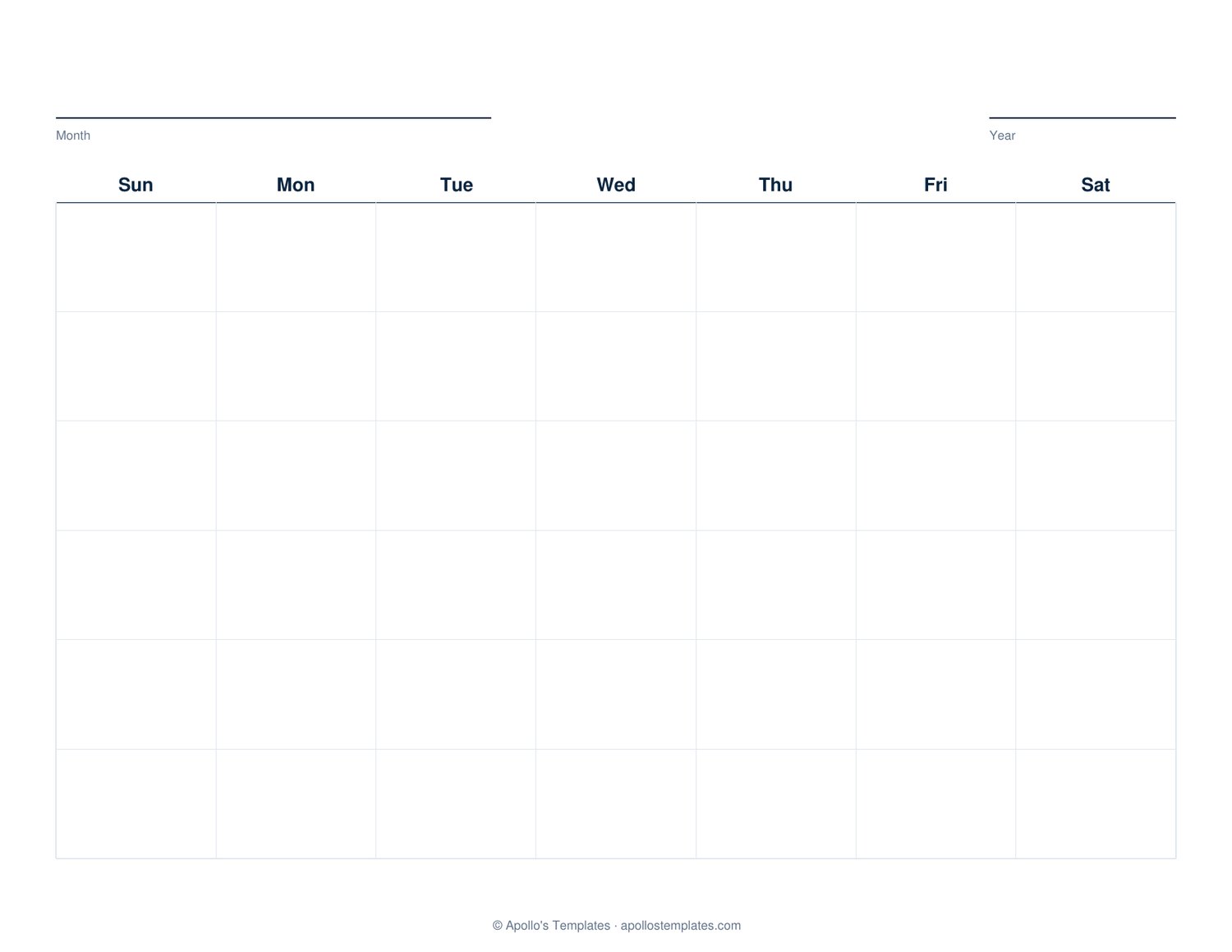
Blank monthly calendar template — printable and undated
This is the undated version of a monthly calendar: the seven day-of-week headers are printed and the date cells are left empty. Print one and it works for any month of any year; type into it and it becomes a reusable fillable PDF. Pick a Sunday or Monday week start and a 5- or 6-row grid — six rows covers every month, five is tighter when you already know the month fits.
Blank calendar for classrooms, bullet journals and dry-erase boards
Teachers hand out a blank calendar template so students write in the month and dates; planners and bullet journalers use it as a monthly spread; laminated, it becomes a dry-erase wall calendar. If you would rather have the dates already filled in, the monthly calendar template does that for any month with US holidays marked. Print at 100% on Letter or A4 — see how to print calendars if anything comes out scaled.
Tips for the best result
Reusable year after year. Because nothing is dated, the same printout works for any month of any year — just write the month name and the dates by hand.
5 rows vs 6 rows. Most months fit in 5 rows; some (like a 31-day month that starts on a Saturday) need 6. Six rows is the safe default.
Great for classrooms. Teachers love blank calendars for lesson planning and letting students fill in dates themselves.
Laminate for dry-erase. Take the printout to any office-supply store for $1-2 lamination — write with a dry-erase marker, wipe, repeat.
Print on regular paper. Standard 8.5 × 11" US Letter works fine.