
Apollo's Templates
HomeCalendarsChore Chart
Calendars

Chore Chart

NEW
Weekly chore chart

A weekly chore chart for the whole household.

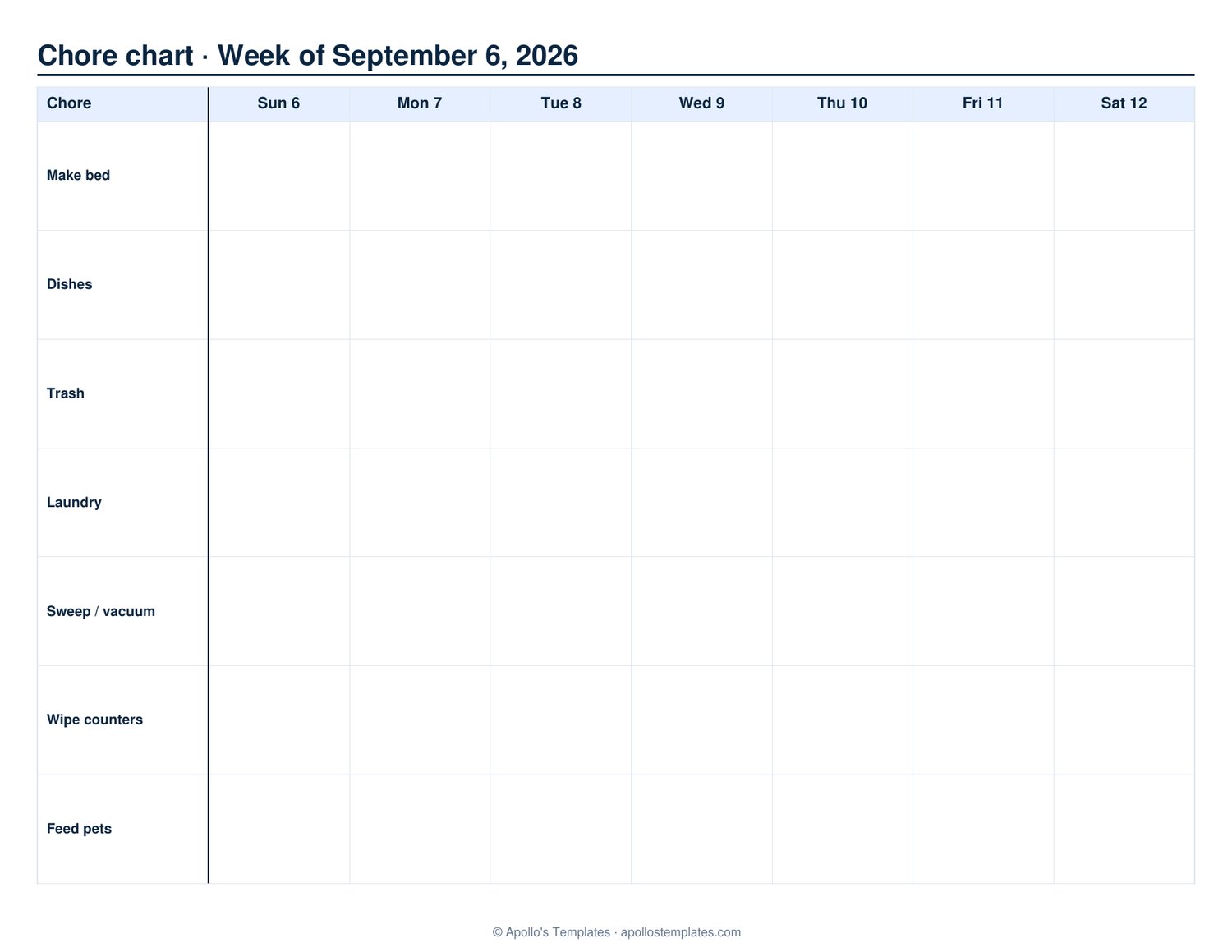
Rows are chores, columns are days. Kids tick off the cell when a chore's done, or write the assigned family member's name in each cell.
PDF · US Letter landscape · one week per page · fillable

Tips for the best result

Stickers for younger kids. Sticker-per-completed-chore is wildly motivating for ages 5-8. Star or smiley stickers, picked out with the kid, are pure dopamine.

Initial-and-date for older kids. Around age 9-10, stickers stop being motivating. Switch to the kid initialing each completed cell — gives them ownership.

End-of-week rewards beat daily ones. A reliable Saturday treat for hitting the week's chores beats a chocolate after every checkmark — and matches how adult work pays.

Display where the chores happen. Kitchen for kitchen chores, kids' rooms for self-care chores. One sheet far from the action gets ignored.

Coordinate the whole household
Family Calendar
Weekly grid with rows per family member — pair with the chore chart for full household visibility.
Open
Track other behaviors too
Habit Tracker
Same monthly grid format for tracking habits — reading, brushing teeth, kindness, screen-time limits.
Open

Frequently asked questions

What chores should I include?
Match age and routine. Younger kids (5-8): make the bed, put toys away, feed pet, clear own dishes. Older kids (9-13): unload dishwasher, take out trash, sweep, fold laundry. Teens: cook one meal/week, mow lawn, clean own bathroom. Shared-household sheets work for adults too — keep it to chores that recur weekly.
How many chores per child is reasonable?
Research and parenting consensus lands on 2-4 daily chores for kids 5-12. Add one or two weekly bigger chores (e.g. clean bathroom Saturday) for ages 9+. Too many chores per day = sheet ignored. Two reliable chores is more powerful than five inconsistent ones.
Should chores be tied to allowance?
Parenting research is mixed. The case for: kids learn that work earns money. The case against: it makes routine household contributions feel like paid labor — kids learn to expect payment for things adults do unpaid. A common middle path: routine self-care chores (own bed, own dishes) are unpaid; extra chores (yard work, big projects) earn allowance.
How do I handle missed chores?
Two common approaches: (1) consequence-based (missed chore = no screen time / lose privilege), (2) make-up-based (missed chore today = do tomorrow). Stick with whichever you pick — inconsistent enforcement is worse than either approach.
Should multiple kids share one chart, or each have their own?
One shared chart per kid usually works better — each kid's name is the row group, chores nested. Kids can see only their own row, which reduces the "why does she have fewer chores" friction. The exception: shared-household chores (trash, dishwasher) where you want one rotating column.
How long until kids do chores without being asked?
Honest answer: 6-12 months of consistent prompting before chores become automatic. Most parenting fails happen at month 2-3 when the novelty wears off and consistency lapses. Power through that stretch and the rest gets easier.
Updated through May 2026