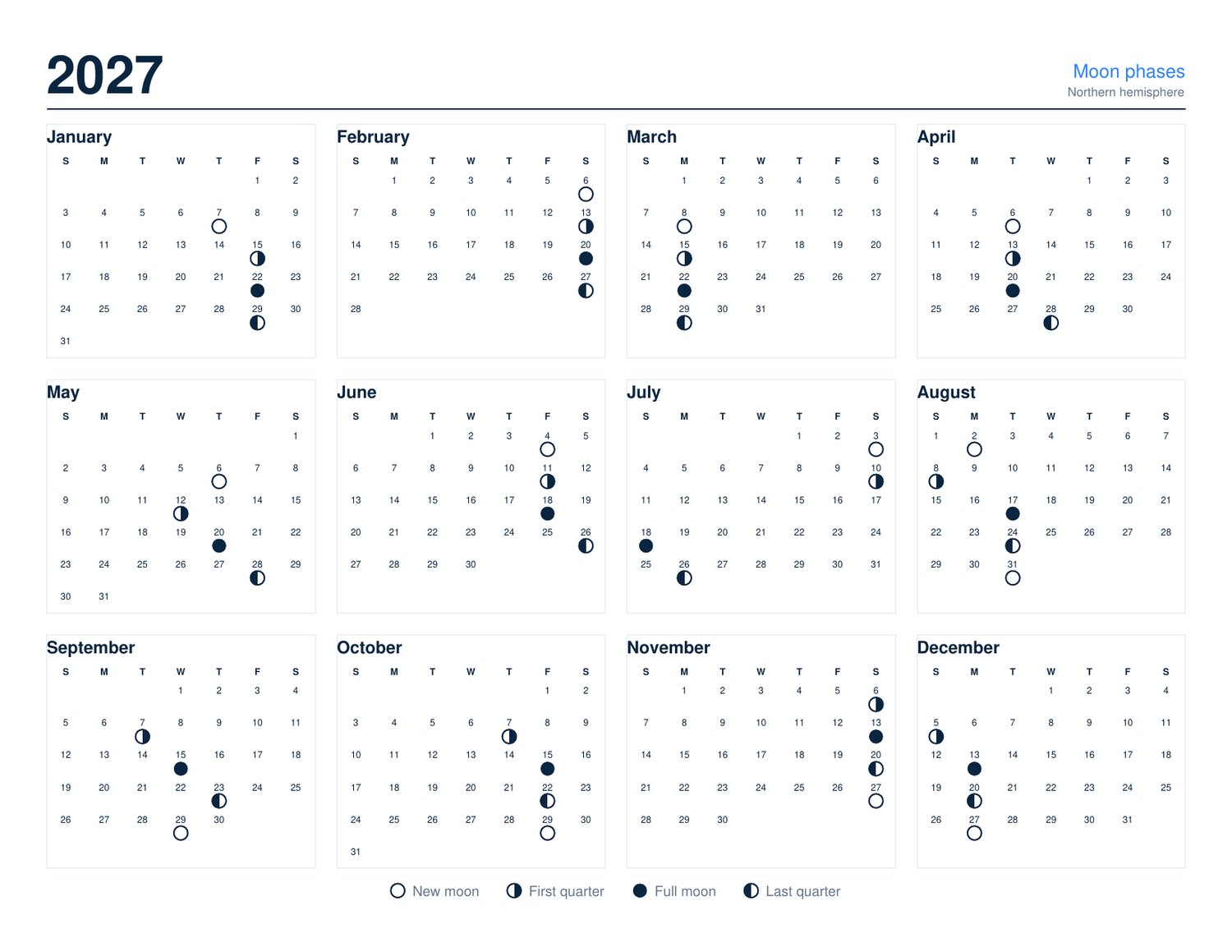
All 12 months on one landscape page with new moon, first quarter, full moon, and last quarter marked on the correct dates. Great for gardeners, fishermen, astronomy fans, and pagan observers.
Why this matters: the moon’s phase is identical worldwide, but the lit side of a quarter moon is mirrored south of the equator. Pick your hemisphere so the icons match what you’ll actually see in the sky. (Your calendar dates auto-adjust to your browser’s local timezone — no other setting needed.)
1-page PDF · US Letter landscape · 4 quarter-phases marked
Sample output
Sample
Sample shows 2027. Pick any year above; the phases are computed for the year you choose. The generator above builds yours from the options you choose.
Moon phases calendar 2027 — full moons, new moons and quarters on one page
Pick the year and the calendar draws each principal phase — new moon, first quarter, full moon, last quarter — on the day it happens, for all twelve months on a single page. The dates are computed for the year you choose, so 2027 is as accurate as 2026, and the same page serves as a full moon calendar for gardeners, photographers and anyone who plans by the lunar cycle.
Northern or southern hemisphere — the crescent faces the right way
Most printable moon calendars only show the northern-hemisphere view. Flip the hemisphere switch and the crescents are mirrored for Australia, New Zealand, South Africa and South America, so what you print matches the sky. Pair it with the year at a glance template if you also want a plain wall calendar.
Tips for the best result
Pair with a wall calendar. The moon-phase calendar makes the most sense as a reference page printed alongside a regular monthly calendar — let the moon page show you the rhythm, the monthly page hold your plans.
Pick the year you actually need. Phases shift dates each year (the lunar cycle is ~29.5 days, not 30), so a moon calendar prints exactly for the year selected — you can't reuse it the following year.
Lunar gardening rule of thumb. Sow above-ground crops between new moon and full moon (waxing). Sow root crops between full moon and new moon (waning). Skip planting on the day of the full or new moon itself if you follow the strictest tradition.
For photographers. Full moon nights are too bright for Milky Way photography — pick a date within ±5 days of new moon for the darkest skies.
The four primary phases — new moon (●), first quarter (◐), full moon (○), and last quarter (◑) — are marked on the correct dates. The intermediate phases (waxing crescent, waxing gibbous, waning gibbous, waning crescent) aren't marked individually but are implied by the days between primary phases.
How accurate are the dates?
Each phase is computed as an exact instant with the standard astronomical algorithm (Meeus, Astronomical Algorithms, chapter 49), accurate to within a few minutes, and checked against the US Naval Observatory tables. That instant is then placed on the date it falls in your own time zone (your browser sets it), which is how almanacs report phases: a full moon at 03:12 UTC on the 14th prints on the 13th for US readers. Exactly one icon per phase, 49 or 50 a year.
Why would I want a moon-phase calendar?
Most common uses: (1) gardeners following lunar planting traditions (sow above-ground crops on a waxing moon, root crops on a waning moon); (2) hunters and anglers tracking solunar tables; (3) photographers planning Milky Way or moonrise shots; (4) families with kids learning astronomy; (5) people who track moon phases for sleep, wellness, or spiritual reasons.
Does it show eclipses or supermoons?
Not currently — only the four primary phases per month. Eclipses occur when the moon's path crosses Earth's shadow (lunar eclipse) or vice versa (solar eclipse), and they don't happen every month. For eclipse dates, NASA's eclipse pages are the authoritative source.
Can I use it for years past 2027?
The generator runs from 2025 forward through several years out. As newer years approach, the year selector extends. The astronomy doesn't change — moon phases are predictable thousands of years in advance.
What about Islamic, Jewish, or Hindu lunar calendars?
This is a Western Gregorian-month calendar with moon phases overlaid — useful as a reference for lunar dates, but it's not formatted as an Islamic Hijri calendar, Hebrew calendar, or Hindu Panchangam. For those, you'll want a calendar designed specifically for the tradition you observe.