




Career guide · resumes
How to Write a Resume
Eight steps from blank page to submitted application. Nothing here is theory — it's the same structure built into every template on this site, written out so you know why each piece is where it is. Budget an honest two hours for the first draft and ten minutes per application after that.
The eight steps
From blank page to PDF.
1
Start from a layout built for your field
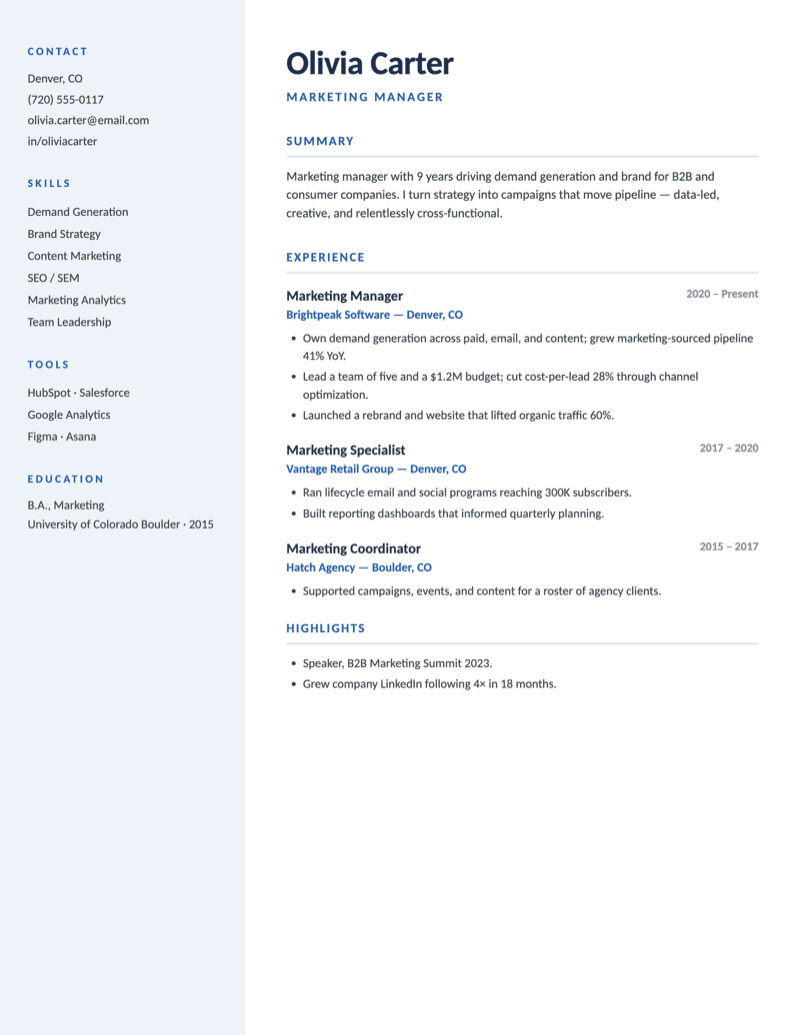
A resume isn’t one document type — it’s fifty. A nurse’s leads with license and certifications, a truck driver’s with CDL class and safe miles, an engineer’s with stack and projects. Pick a template from your field’s category and the structure already puts the right things first — that’s half the tailoring done before you type a word.
2
Keep the header lean
Name, city & state, phone, a professional email, and a LinkedIn or portfolio link if it’s strong. That’s it — no street address, no photo, no date of birth. Recruiters need to reach you and place you geographically; everything else in a header is wasted vertical space.
3
Lead with what your field screens for
Every field has a two-second screen: the license for regulated work, certifications for IT, quota numbers for sales, scope for management. Put yours at the top — in a badge row, a summary line, or the first section — not buried on line 30. If you’re not sure what your field screens for, read three job postings and note what appears in every single one.
4
Write experience as quantified results
The pattern for every bullet: action verb + what you did + a number. “Resolved 40+ tickets a day with a 92% first-contact resolution rate” outworks a paragraph of adjectives. Can’t remember exact figures? Honest approximations (“100+ covers a night”) are standard practice — invented precision is not.
5
Give skills their own scannable section
Applicant tracking systems match exact strings, and so do skimming humans. Name your tools the way the posting does — “QuickBooks Online,” “Epic,” “Jira Service Management,” not “accounting software” or “ticketing systems.” A tight skills block is also where a keyword-checking recruiter’s eye lands first.
6
Place education and certifications by weight
Fresh out of school, education sits high and carries detail — relevant coursework, a GPA above ~3.5, honors. Five years in, it drops to two lines at the bottom. Certifications follow the opposite curve: the more regulated your field, the higher they belong (see step 3).
7
Tailor it to each posting
One master resume, lightly retargeted per application: rewrite the summary line, swap two or three bullets to answer that posting’s emphasized requirements, and check your skills block against its vocabulary. Ten minutes. Blasting one identical resume everywhere is the single most common reason qualified people hear nothing back.
8
Keep it to one page and send a PDF
One page, nearly always — cut the oldest role before you shrink the font below 10.5pt. Export a PDF named
FirstLast-Resume.pdf (the filename gets read too), keep the editable file as your master, and pair it with a matching cover letter so the packet reads as one application.Sticking points
Resume writing FAQ
How long should a resume be?
One page for almost everyone with under 15 years of experience — hiring managers spend well under a minute on a first pass, and a second page dilutes your best material. Senior executives and academics are the exceptions (two pages and full CVs respectively). If you're fighting for space, cut the oldest role or trim bullets on jobs older than ten years before shrinking fonts or margins.
Should I use a resume objective or a summary?
A summary — two or three lines stating what you are, your strongest proof, and what you're aiming at. Objectives ('Seeking a challenging position where I can grow…') describe what you want from the employer, which no screener cares about at this stage. The one exception: career changers can use a hybrid line that names the pivot explicitly, because otherwise the resume confuses the reader.
How do I handle employment gaps?
Don't hide them with tricks — recruiters spot year-only date ranges instantly and assume the worst. If the gap had substance (caregiving, education, freelance work, recovery), one honest line in place is stronger than silence: 'Family caregiver, 2023–2024.' For gaps under six months, most screeners don't blink. The cover letter is the better place for a fuller sentence of context if it needs one.
How far back should my work history go?
Ten to fifteen years, or your last three to five roles — whichever tells the stronger story. Older experience either drops off or compresses into a one-line 'Earlier career' entry. Going back further mostly adds age signal and pushes your best material down the page. The test for every old role: does it add a qualification the recent ones don't?
Should I put 'references available upon request' on my resume?
No — it's assumed, and the line spends space saying nothing. Prepare a separate references document with three or four people who've agreed to speak for you, and bring it to interviews or send it when asked. The only time references belong on the resume itself is when a posting explicitly instructs it.
What if I have almost nothing to put on a resume?
You have more than you think — coursework, group projects, volunteering, sports, caregiving, informal work like babysitting or yard work all demonstrate the reliability and effort first employers actually screen for. Frame each with the same verb + result pattern ('Coordinated a 4-person project to an A'). Our entry-level and high-school templates are structured around exactly this, and the no-experience cover letter makes the same argument in prose.
How to write a resume — step-by-step guide · Updated July 2026
Put it to work
Start from a template, not a blank page.
Step one
Resume Templates by Field
50+ categories, each pre-structured around what that field screens for — the guide's step 1, done.
First resume
Entry-Level Resume Templates
Layouts built for thin work history — pairs with the 'almost nothing to put on it' answer above.
Next guide
How to Write a Cover Letter
The companion guide — four moves, 250–400 words, and when the letter actually matters.