
Recent Graduate Cover Letters
The new-grad letter has one move to master: stop apologizing for what you haven't done and start arguing from what you just did. A fresh degree means current methods, recent projects with checkable results, and zero habits to unlearn — that's a pitch, not a confession. These six letters make it: degree and graduation date up front, internship and capstone evidence in the middle, start-date availability at the close.
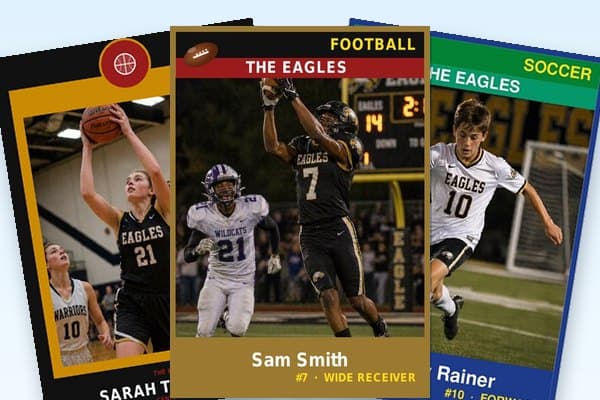
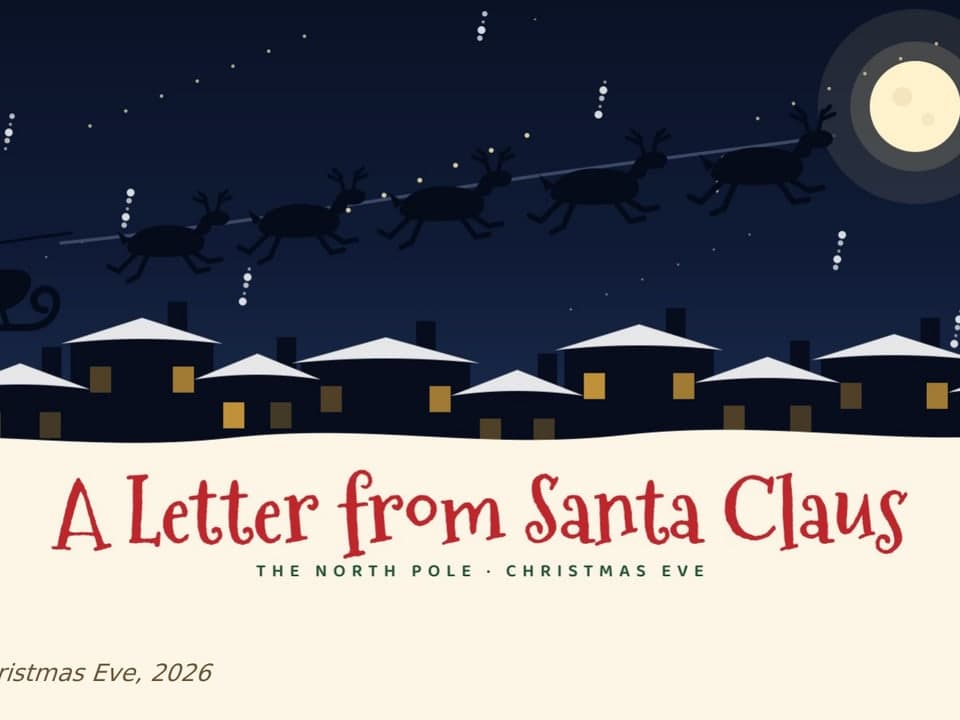
Three designs, two colors each.
Banner for confidence, Two-Tone for modern industries, Monogram for personal-brand polish. Each carries the same new-grad argument: degree up front, project evidence in the middle, start date at the close.
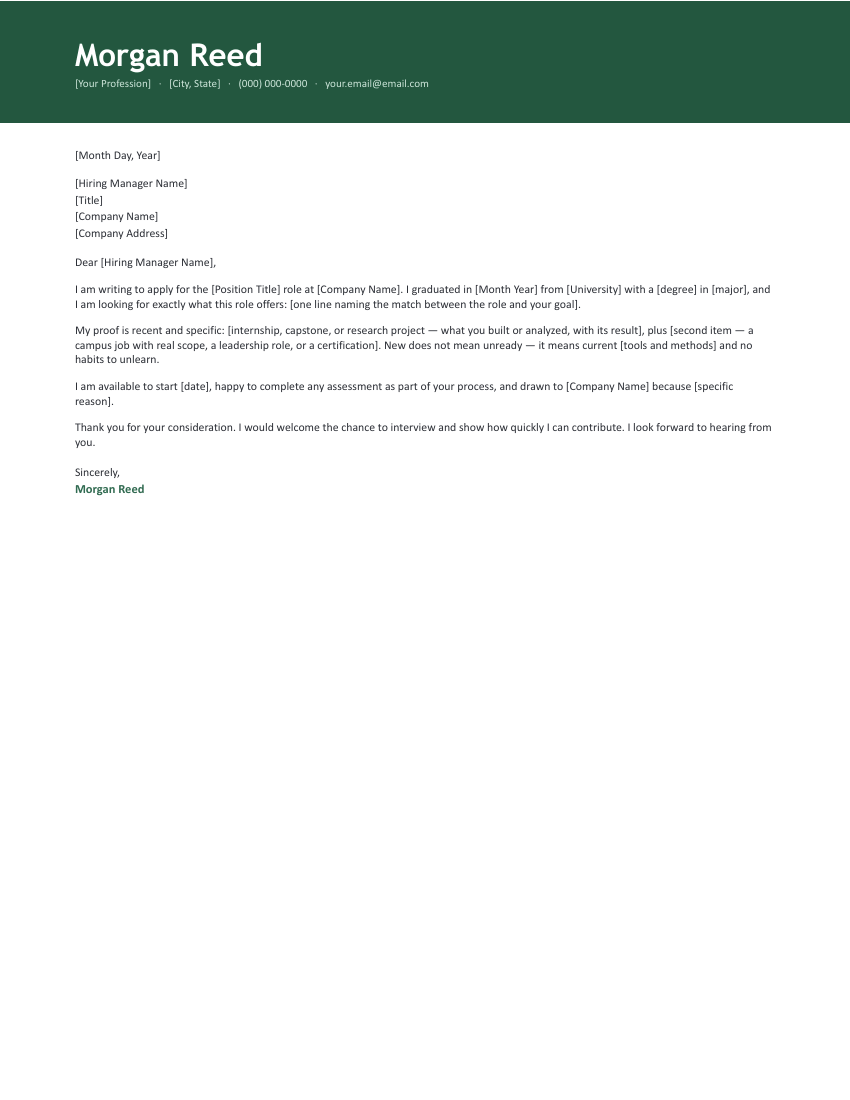
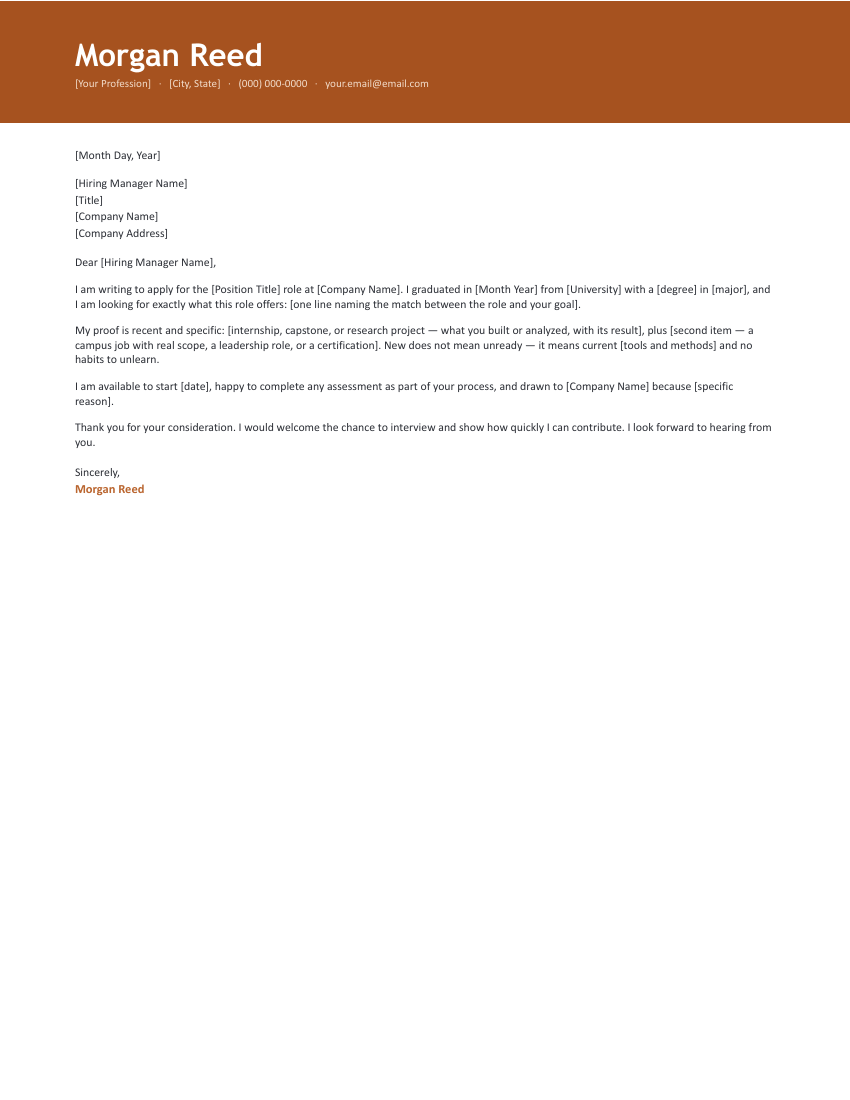
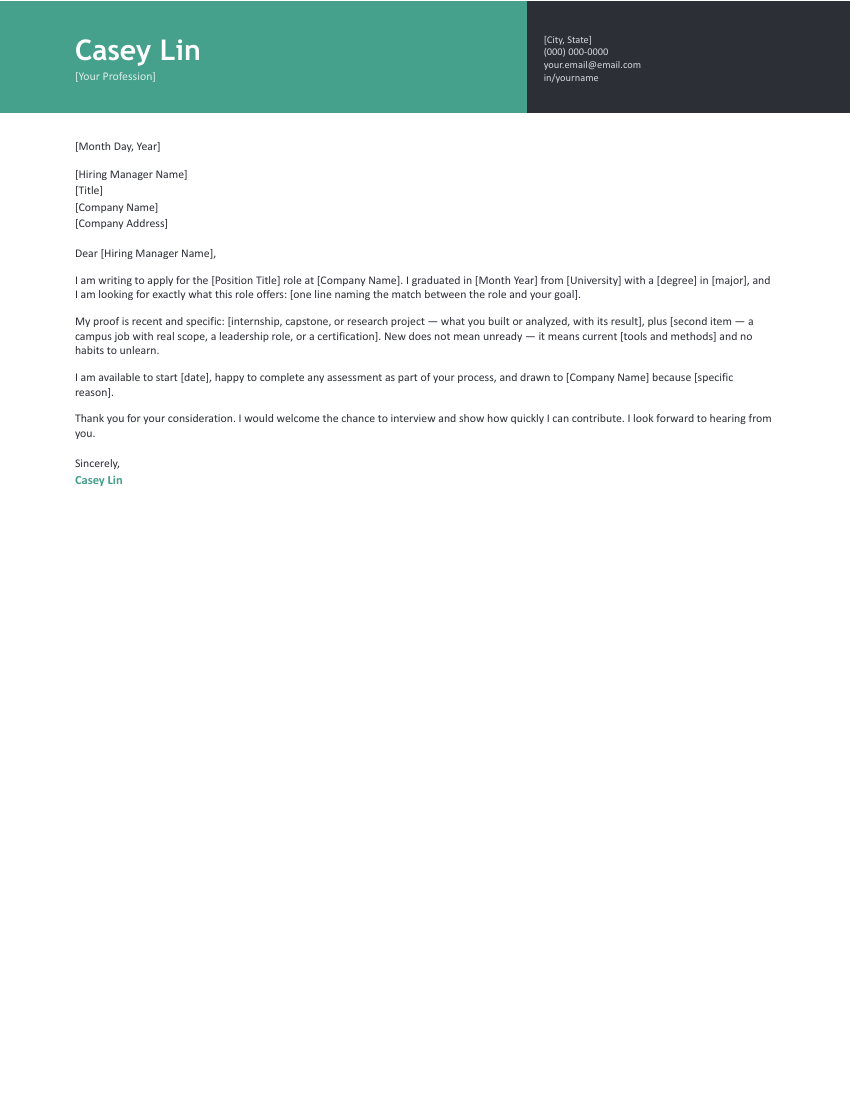
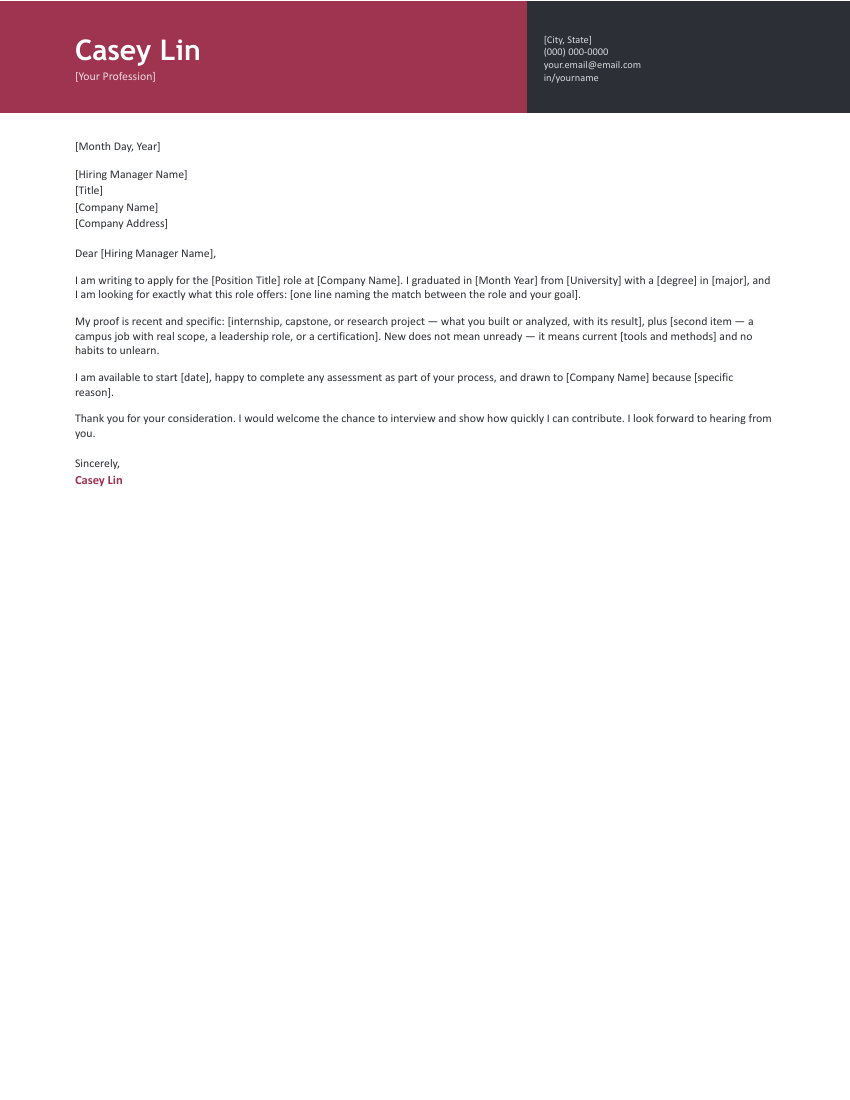
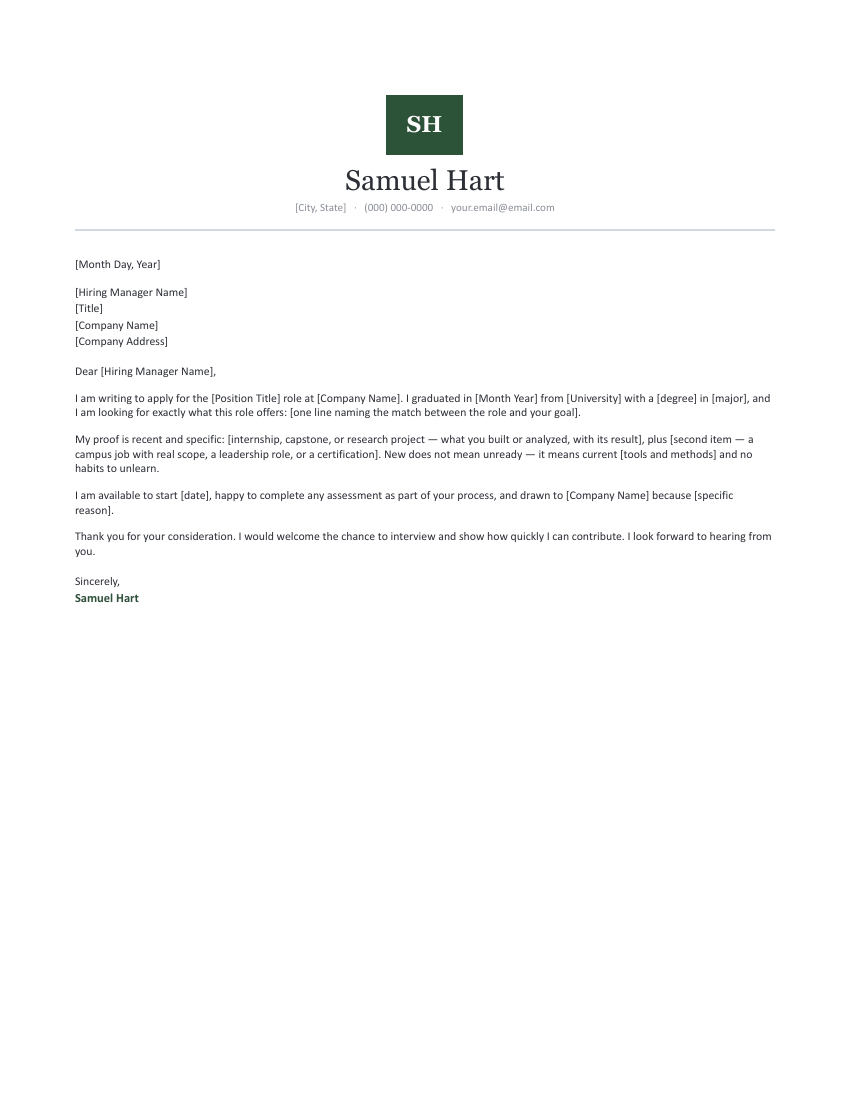
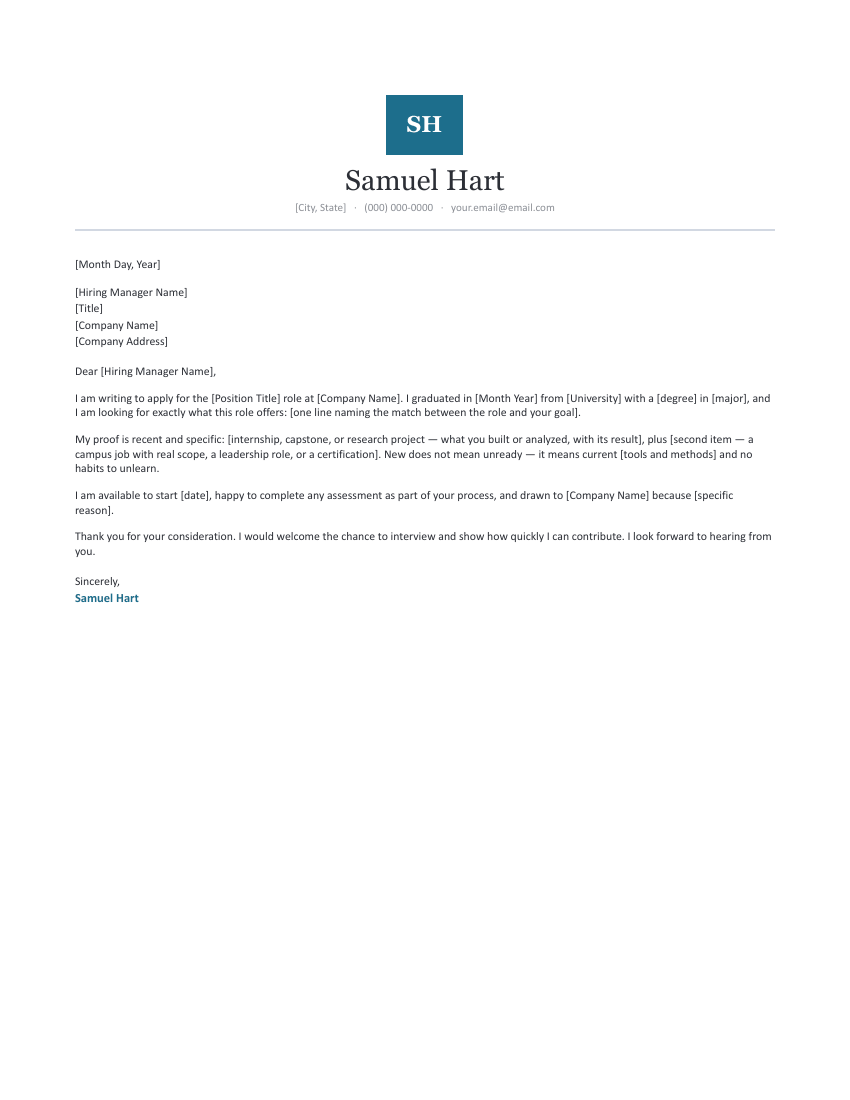
Recent graduate cover letter example \u2014 the letter inside the template.
[Month Day, Year]
[Hiring Manager Name]
[Title]
[Company Name]
[Company Address]
Dear [Hiring Manager Name],
I am writing to apply for the [Position Title] role at [Company Name]. I graduated in [Month Year] from [University] with a [degree] in [major], and I am looking for exactly what this role offers: [one line naming the match between the role and your goal].
My proof is recent and specific: [internship, capstone, or research project — what you built or analyzed, with its result], plus [second item — a campus job with real scope, a leadership role, or a certification]. New does not mean unready — it means current [tools and methods] and no habits to unlearn.
I am available to start [date], happy to complete any assessment as part of your process, and drawn to [Company Name] because [specific reason].
Thank you for your consideration. I would welcome the chance to interview and show how quickly I can contribute. I look forward to hearing from you.
Sincerely,
Morgan Reed
From student to candidate in three moves.
The difference between a student letter and a candidate letter is framing, not material. Three moves make the switch:
- Date the degree, then move on. “I graduated in May 2026 from [University] with a B.S. in [major]” — one sentence of credentials, then straight to evidence.
- Convert coursework to results. Every project gets a verb and a number — built, analyzed, organized, grew — with the outcome attached. School evidence described precisely reads as work.
- Sell the upside plainly. Current tools, recent training, no habits to unlearn — the honest advantages of new. Employers hiring entry-level are buying trajectory; show them slope.
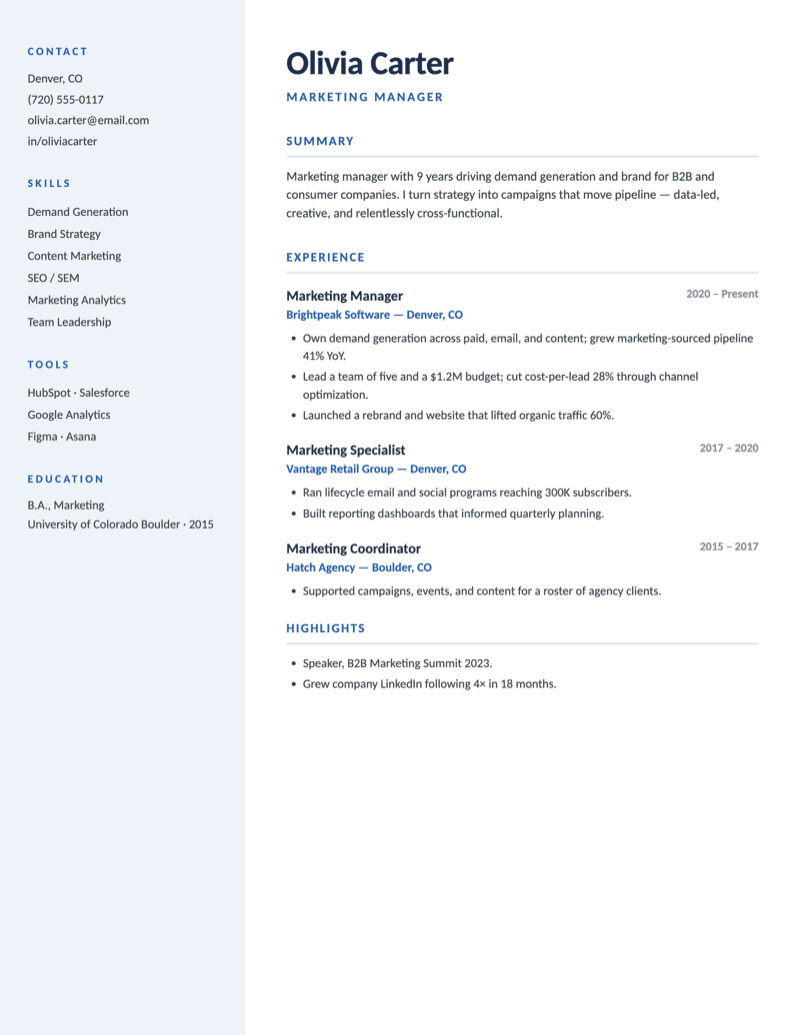
Pair it with the matching resume: our college student and entry-level layouts are built for the same thin-history, high-slope argument.
Fill it in and send.
- Fill the degree line first — school, major, graduation month — then don’t mention school again except as evidence.
- Pick your two best project results (internship, capstone, research, club) and write them with verbs and numbers.
- State your start date — new grads who answer the availability question read as ready.
- Export a PDF and pair with a skills-forward resume.
Recent Graduate Cover Letters FAQ
Should a recent graduate even send a cover letter?
What goes in a cover letter when my only experience is school?
Do I put my GPA in the cover letter?
How do I make my degree sound different from everyone else's?
I graduated months ago and still haven't landed anything — do I address the gap?
Recent graduate & new grad cover letter templates · Updated September 2026