



Returning to the Workforce Cover Letters
The returner's letter has a job no other cover letter has: retire the gap as a topic in one confident sentence, so the rest of the page can be about what you bring. These six letters do exactly that — they name the break plainly (no apology, no mystery), show what stayed sharp during it, answer the availability question employers hesitate to ask, and then argue from a track record that didn't expire. For stay-at-home parents, caregivers, and every other version of stepping back in.
Three designs, two colors each.
The Olive sidebar leads with a strengths rail (strongest for longer breaks), the Mauve formal resumes an established professional identity, and the Cocoa banner walks back in like you never doubted it. Each carries the same spine: own the gap in a line, evidence what stayed sharp, answer availability up front.
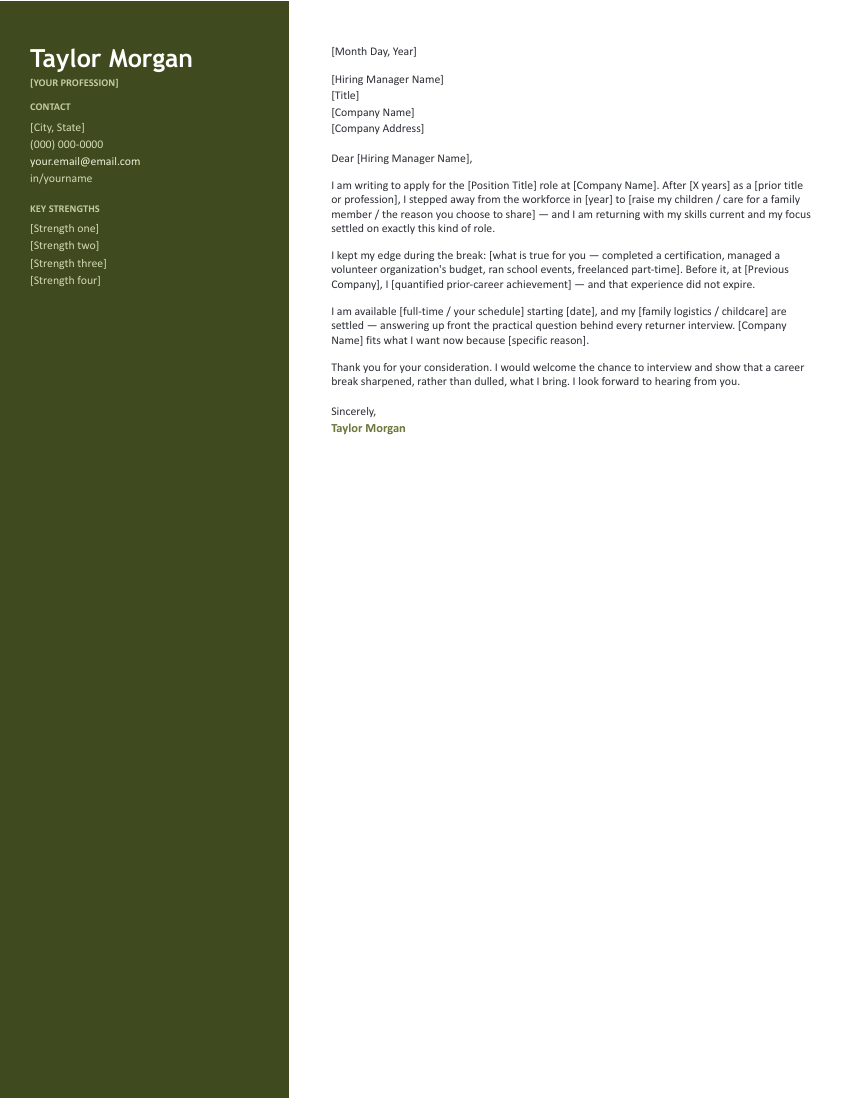
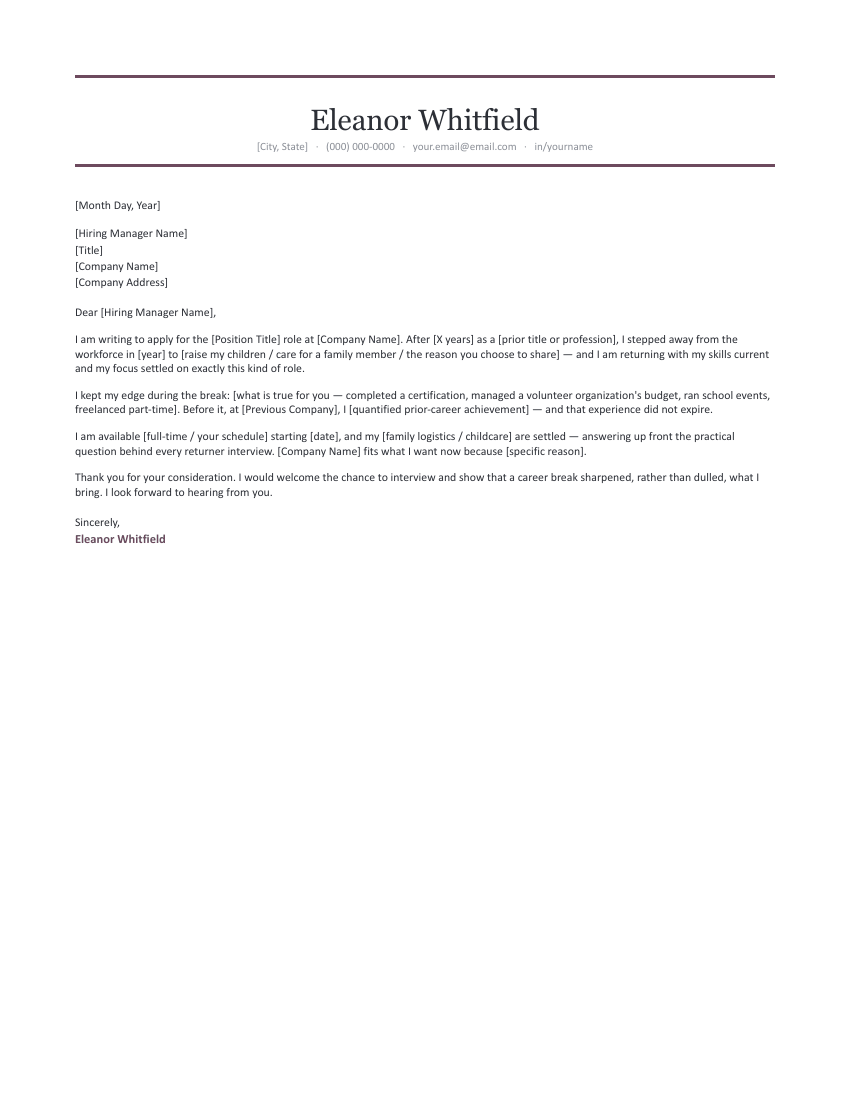
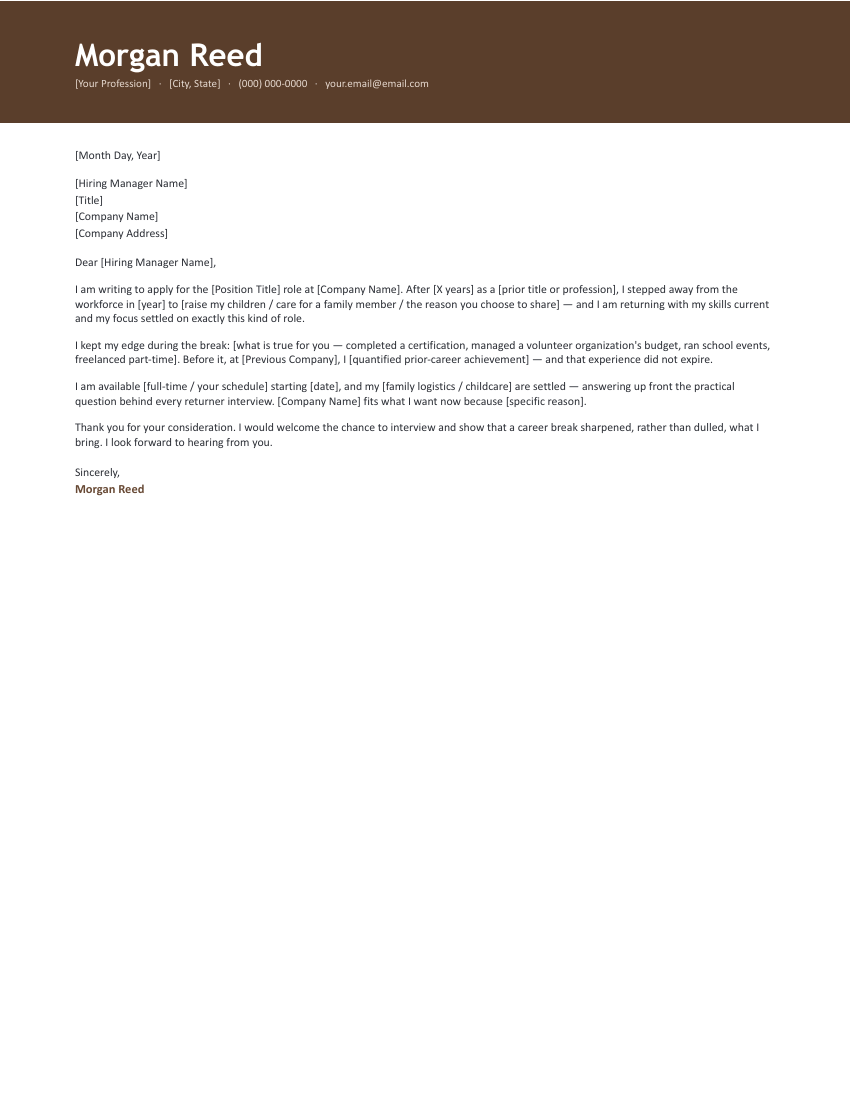
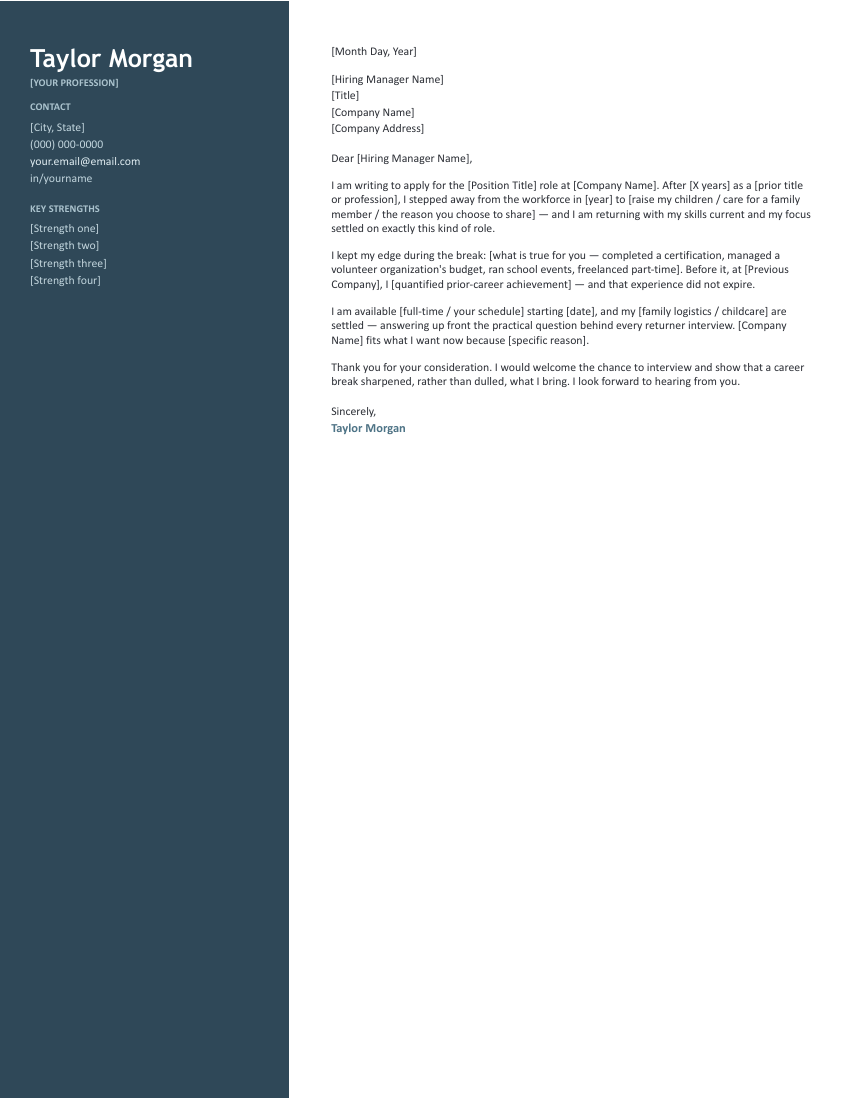
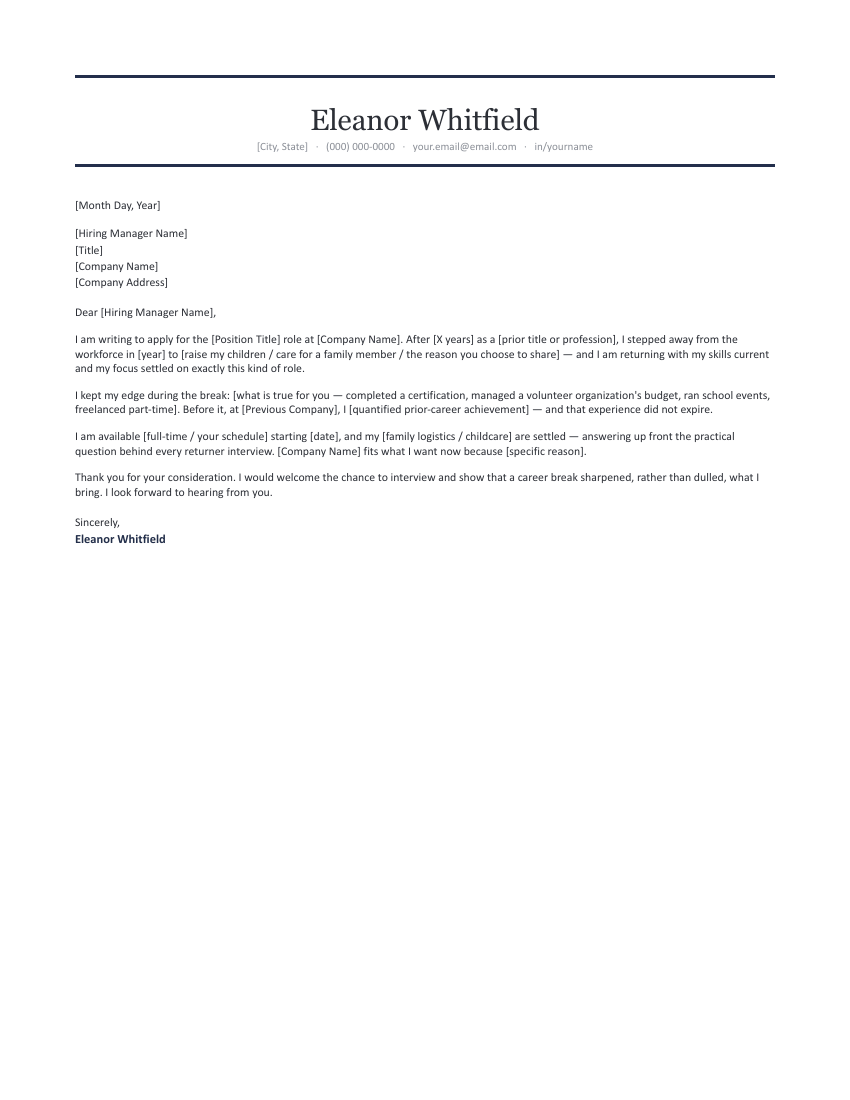
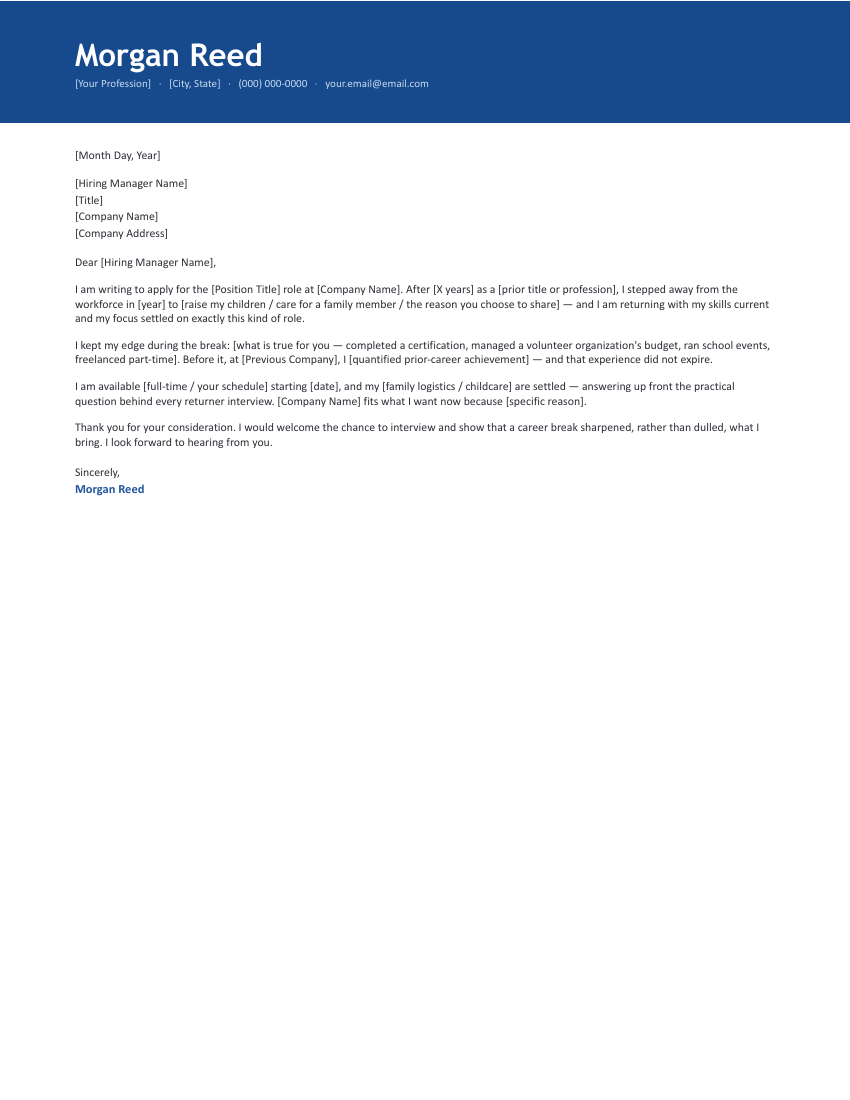
Returning to work cover letter example \u2014 the letter inside the template.
CONTACT
[City, State]
(000) 000-0000
your.email@email.com
in/yourname
KEY STRENGTHS
[Strength one]
[Strength two]
[Strength three]
[Strength four]
[Month Day, Year]
[Hiring Manager Name]
[Title]
[Company Name]
[Company Address]
Dear [Hiring Manager Name],
I am writing to apply for the [Position Title] role at [Company Name]. After [X years] as a [prior title or profession], I stepped away from the workforce in [year] to [raise my children / care for a family member / the reason you choose to share] — and I am returning with my skills current and my focus settled on exactly this kind of role.
I kept my edge during the break: [what is true for you — completed a certification, managed a volunteer organization's budget, ran school events, freelanced part-time]. Before it, at [Previous Company], I [quantified prior-career achievement] — and that experience did not expire.
I am available [full-time / your schedule] starting [date], and my [family logistics / childcare] are settled — answering up front the practical question behind every returner interview. [Company Name] fits what I want now because [specific reason].
Thank you for your consideration. I would welcome the chance to interview and show that a career break sharpened, rather than dulled, what I bring. I look forward to hearing from you.
Sincerely,
Taylor Morgan
The three questions every returner letter must answer.
Strip away the nerves and a hiring manager reading a returner application has exactly three questions. The letter that answers all three — unprompted — wins:
- “What’s the story?” One confident sentence naming the break and its reason. Mystery reads worse than any truth.
- “Can they still do the work?” Evidence from during the break (certifications, volunteering with real scope, freelance) plus the strongest pre-break result. Skills age slower than returners fear.
- “Will life let them?” The unaskable question — answer it on your terms: start date, schedule, “logistics settled.”
The companion resume matters too: our skills-based layouts put capabilities above chronology, which is exactly the right shape when the timeline has a chapter break.
Fill it in and send.
- Open a template and write the gap sentence first — one line, plain, confident. The rest gets easier.
- Fill the evidence brackets: during-the-break proof with real scope, then your best pre-break result.
- State availability and start date on your terms — it answers the question they can’t ask.
- Export a PDF and pair it with a skills-forward resume from the library.
Returning to the Workforce Cover Letters FAQ
How do I explain a career gap for raising children or caregiving?
Does what I did during the break actually count for anything?
Should I address availability and childcare in the letter?
My skills feel dated — should I say so?
Is a returnship or contract role worth mentioning in the letter?
Returning to the workforce cover letter templates · Updated September 2026