
Free Career Change Cover Letter Templates
For a career changer, the cover letter isn't optional garnish — it's the one document that can explain what your resume can't. These three templates carry a letter built as a bridge: it names the pivot plainly in the first paragraph, translates your strongest achievement into the new field's vocabulary, and shows the concrete step you've taken to close the gap. No apologizing for the old career, no pretending the change is invisible. Open in Word or Google Docs and make the case.
Three pivot letters, matched to where you're headed.
Formal Serif for conservative destinations, Contemporary for tech and product, Bold Banner for people-facing fields. Inside each: the same deliberate transition structure — the pivot named once, transferable skills translated, gap-closing evidence shown.
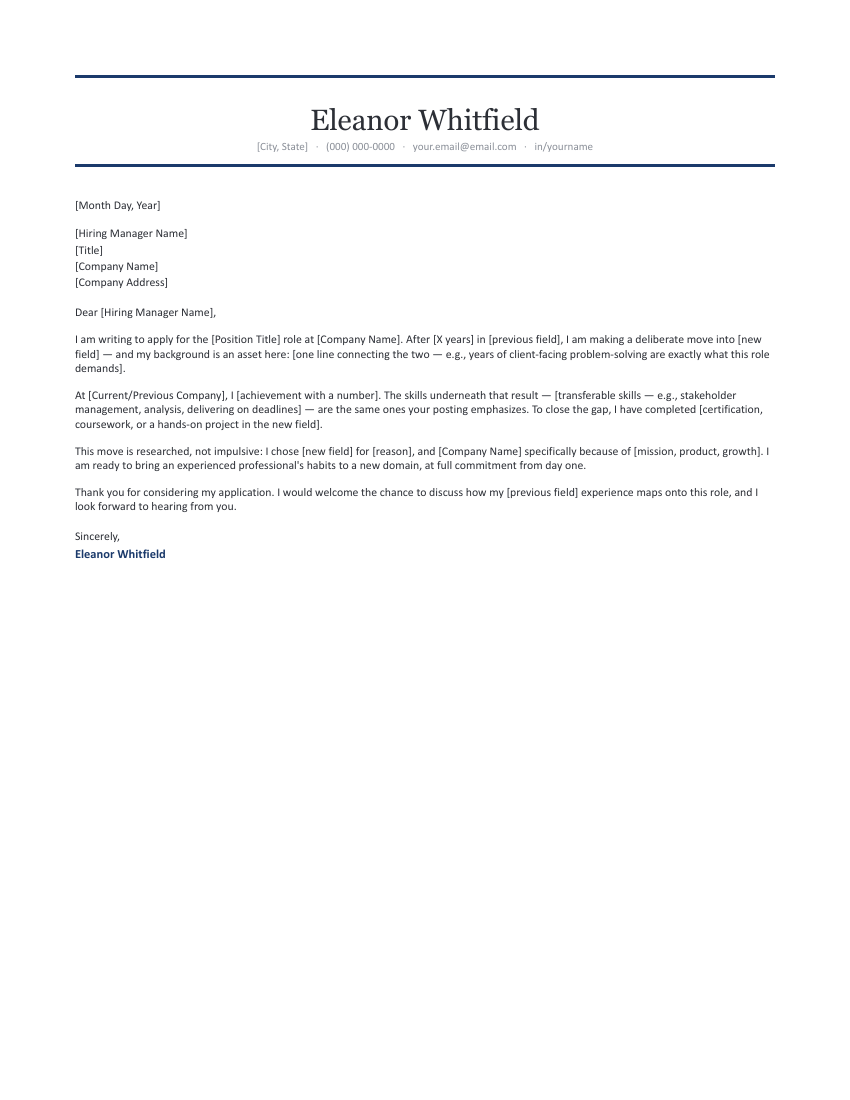
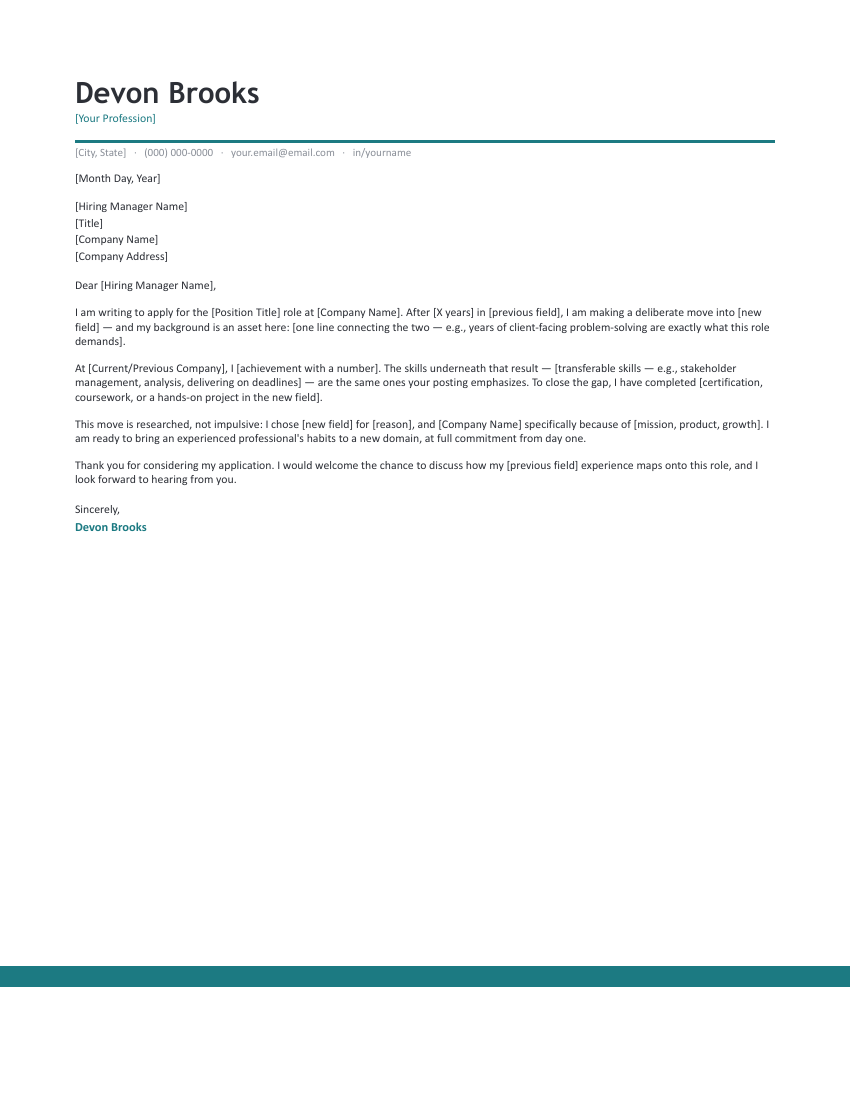
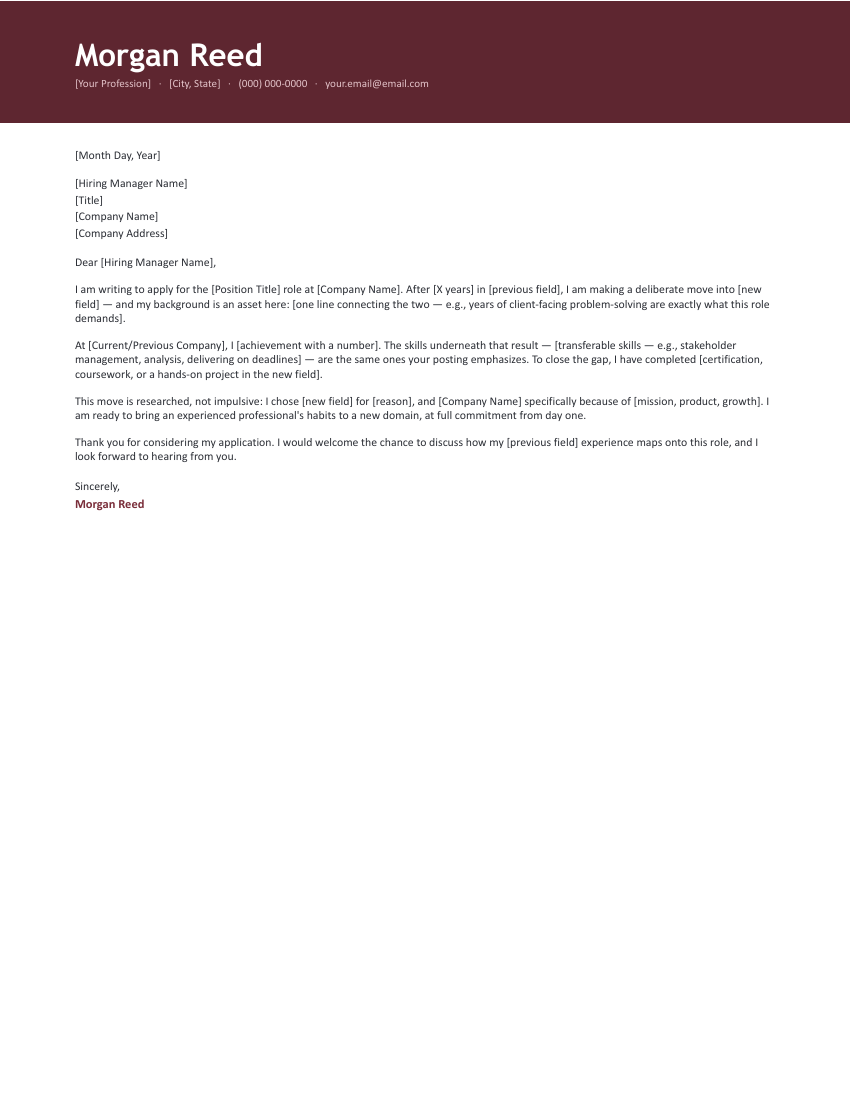
Career change cover letter example \u2014 the letter inside the template.
[Month Day, Year]
[Hiring Manager Name]
[Title]
[Company Name]
[Company Address]
Dear [Hiring Manager Name],
I am writing to apply for the [Position Title] role at [Company Name]. After [X years] in [previous field], I am making a deliberate move into [new field] — and my background is an asset here: [one line connecting the two — e.g., years of client-facing problem-solving are exactly what this role demands].
At [Current/Previous Company], I [achievement with a number]. The skills underneath that result — [transferable skills — e.g., stakeholder management, analysis, delivering on deadlines] — are the same ones your posting emphasizes. To close the gap, I have completed [certification, coursework, or a hands-on project in the new field].
This move is researched, not impulsive: I chose [new field] for [reason], and [Company Name] specifically because of [mission, product, growth]. I am ready to bring an experienced professional's habits to a new domain, at full commitment from day one.
Thank you for considering my application. I would welcome the chance to discuss how my [previous field] experience maps onto this role, and I look forward to hearing from you.
Sincerely,
Eleanor Whitfield
The three sentences every pivot letter must land.
Strip any successful career-change letter to its skeleton and you find the same three sentences. Everything else is supporting material:
- “This move is deliberate.” Named in the first paragraph, framed as pull toward the new field — mission, craft, trajectory — never push away from the old one. Hiring managers read complaints about a past industry as a preview of their own future reference call.
- “My track record transfers.” One quantified achievement from the old career, then the translation: name the skills underneath it in the new field’s vocabulary, mirroring the posting’s own language. Two or three skills, chosen from the posting — not a list of everything you’re good at.
- “I’ve already started.” The certification you finished, the course you took, the project you built, the volunteer work you did in the new domain. This is the credibility sentence — it converts you from “asking them to fund an experiment” to “professional mid-retool.”
A note on seniority: expect to interview one level below where you left off, and don’t litigate it in the letter. The letter’s job is the interview; the trajectory conversation happens after they’ve decided they want you.
Fill it in.
- Open a template in Google Docs or Word and fill the [brackets] — old field, new field, and the one-line bridge between them.
- Swap in your best quantified achievement, then rewrite its skills in the posting’s own vocabulary.
- Name your gap-closing step — certification, coursework, or project. If that bracket is empty, do the step before you apply.
- Export a PDF and pair it with a professional resume reworked for the new field’s keywords.
Career change cover letter FAQ
How do I write a career change cover letter?
How do I explain why I'm changing careers without sounding negative?
Which transferable skills should I highlight?
Should I address the career change directly or downplay it?
Is a cover letter more important for career changers than for other applicants?
What if I don't have any experience in the new field at all?
Career change & transition cover letter templates · Updated September 2026