
Free General Cover Letter Templates
Applying to many jobs doesn't mean sending a generic letter — it means building one strong letter where the parts that must change are impossible to miss. These three templates carry an all-purpose letter with exactly three swap spots per application: the role and source, the skills you're echoing from the posting, and one company-specific sentence. Fill the durable parts once, then retarget in ten minutes per application. Word or Google Docs, free.
One reusable letter, three industry-neutral looks.
Sidebar, Two-Tone, and Monogram — each neutral enough to send to any industry, each carrying the same swap-spot letter structure. Pick by taste; they're deliberately interchangeable.
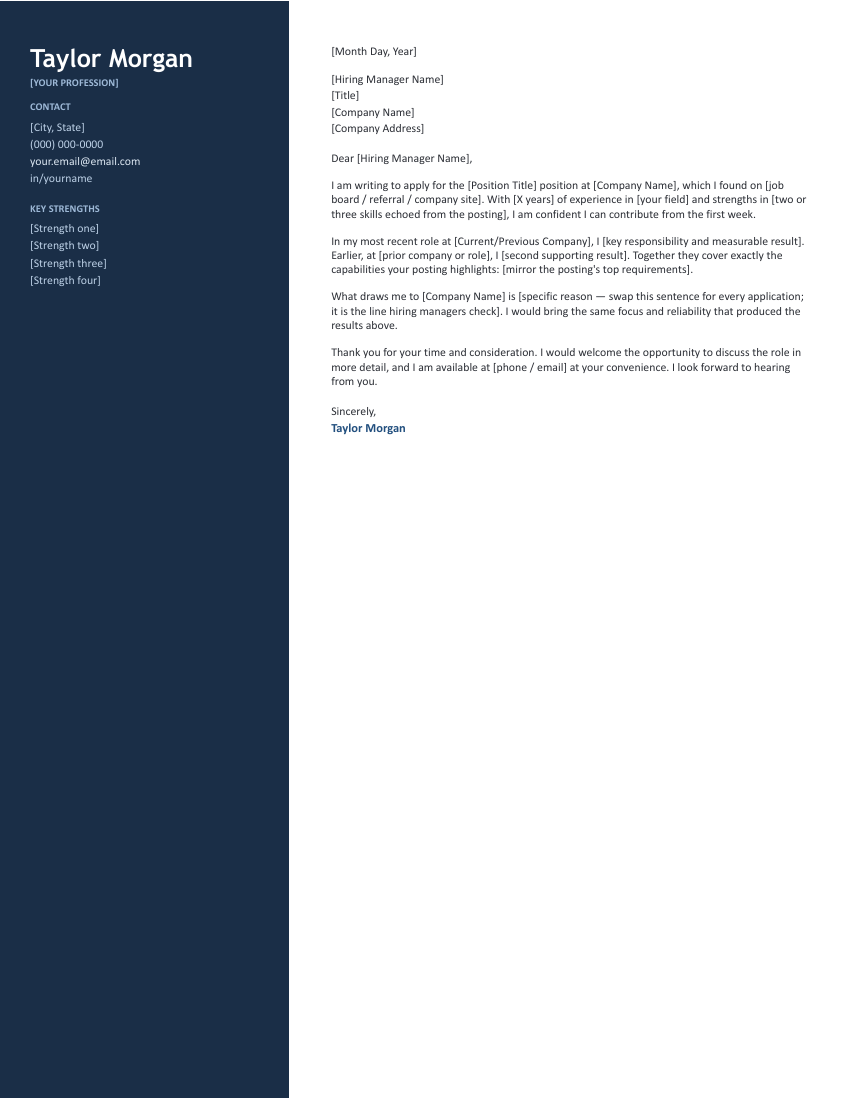
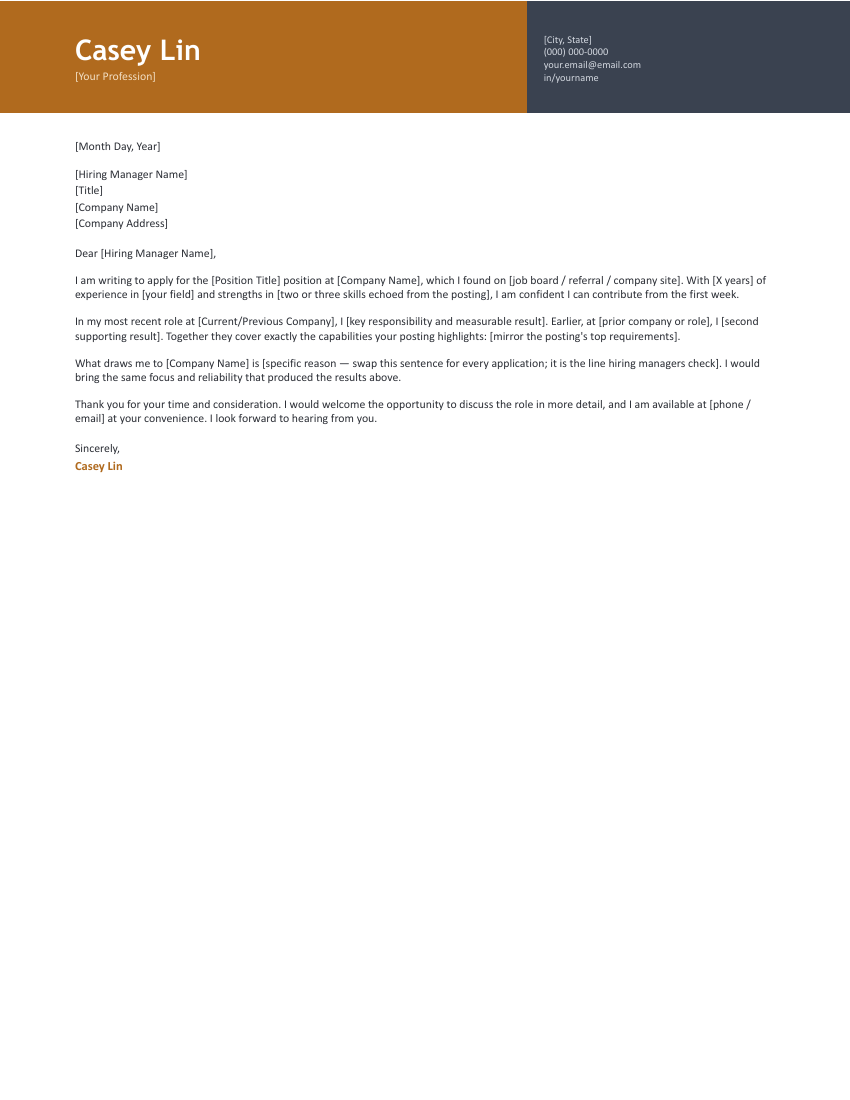
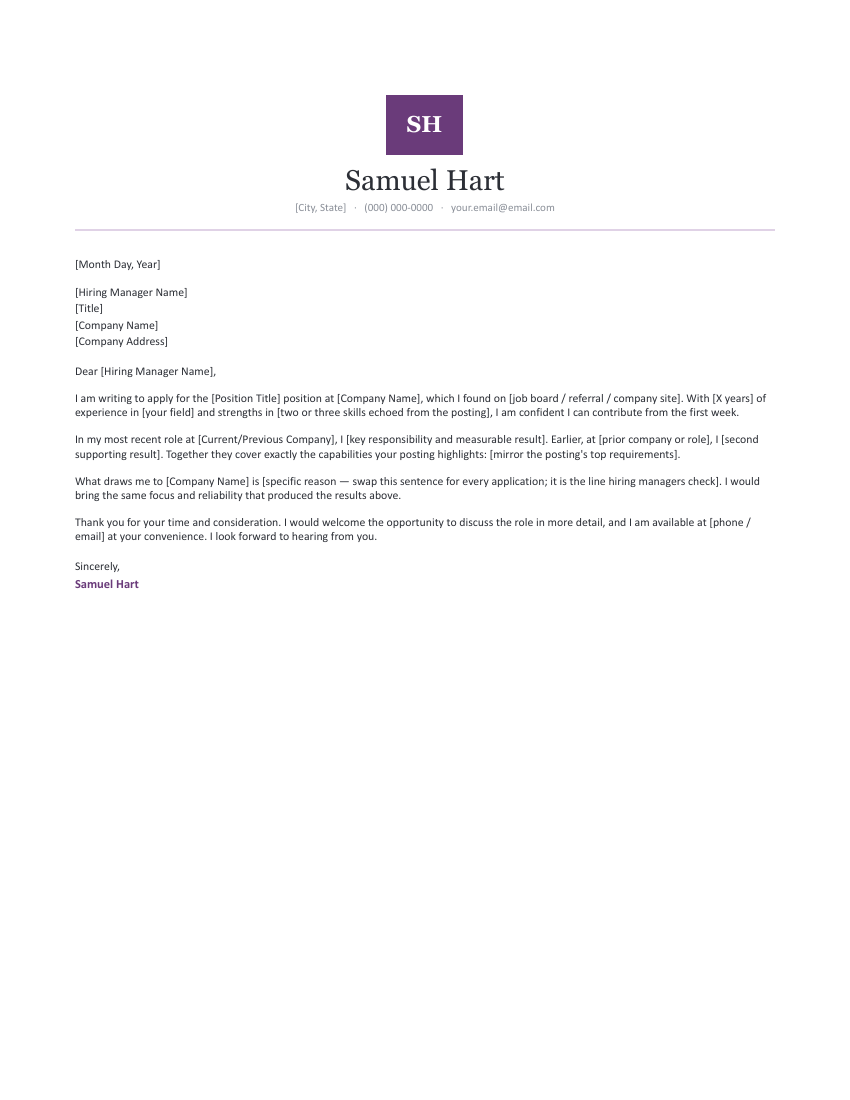
General purpose cover letter example \u2014 the letter inside the template.
CONTACT
[City, State]
(000) 000-0000
your.email@email.com
in/yourname
KEY STRENGTHS
[Strength one]
[Strength two]
[Strength three]
[Strength four]
[Month Day, Year]
[Hiring Manager Name]
[Title]
[Company Name]
[Company Address]
Dear [Hiring Manager Name],
I am writing to apply for the [Position Title] position at [Company Name], which I found on [job board / referral / company site]. With [X years] of experience in [your field] and strengths in [two or three skills echoed from the posting], I am confident I can contribute from the first week.
In my most recent role at [Current/Previous Company], I [key responsibility and measurable result]. Earlier, at [prior company or role], I [second supporting result]. Together they cover exactly the capabilities your posting highlights: [mirror the posting's top requirements].
What draws me to [Company Name] is [specific reason — swap this sentence for every application; it is the line hiring managers check]. I would bring the same focus and reliability that produced the results above.
Thank you for your time and consideration. I would welcome the opportunity to discuss the role in more detail, and I am available at [phone / email] at your convenience. I look forward to hearing from you.
Sincerely,
Taylor Morgan
Reuse without reading reused.
The difference between a smart master letter and a lazy generic one is which parts you let yourself reuse. The split that works:
- Write once, reuse freely: your experience summary, your two supporting results with numbers, your closing paragraph, and your contact block. These are facts about you — they don’t change per employer, and rewriting them every time is wasted effort.
- Swap every single time: the role title and company name (twice — opening and closing), where you found the posting, the two or three skill phrases echoed from the posting’s own text, and the one company-specific sentence. The templates keep these in [brackets] so nothing reusable hides anything swappable.
- The sentence that carries the letter: “What draws me to [Company] is…” — make it something you could not say to any other employer. This single line is what hiring managers subconsciously check for; it’s the difference between “applied to us” and “applied to everyone.”
The classic failure mode: the wrong company name surviving a swap. Proofread the brackets — just the brackets — as your final step before every send. It takes thirty seconds and it’s the whole ballgame.
Build your master letter.
- Copy a template into Google Docs — this is your master. Fill in the durable parts: summary, two results, closing.
- For each application, duplicate the master and touch only the [brackets]: role, company, source, skills echo, company sentence.
- Name each copy by employer (“Cover Letter — Acme”) so you can re-read what you sent before the interview.
- Proofread the brackets, export a PDF, and attach a matching resume.
General cover letter FAQ
What is a general cover letter?
Can I send the exact same cover letter to every job?
How do I make a general letter feel specific?
What's the difference between a cover letter and a letter of interest?
Should I keep a master cover letter on file?
General & all-purpose cover letter templates · Updated September 2026