
Military Resignation Letter Templates
Military resignation letters travel two directions. Resigning a commission is a regulated act \u2014 the binding request runs through your branch's official channels, and these templates carry the respectful letter of intent that accompanies it. And just as often, the letter needed is civilian: resigning a job to enlist, to report for training, because orders moved the household, or because a spouse's PCS made staying impossible. Both directions are covered on this page, each in the register it deserves.
The courtesy letter, in proper register.
Formal serif in army green and a monogrammed navy \u2014 both carrying the respectful statement of intent that accompanies formal separation.
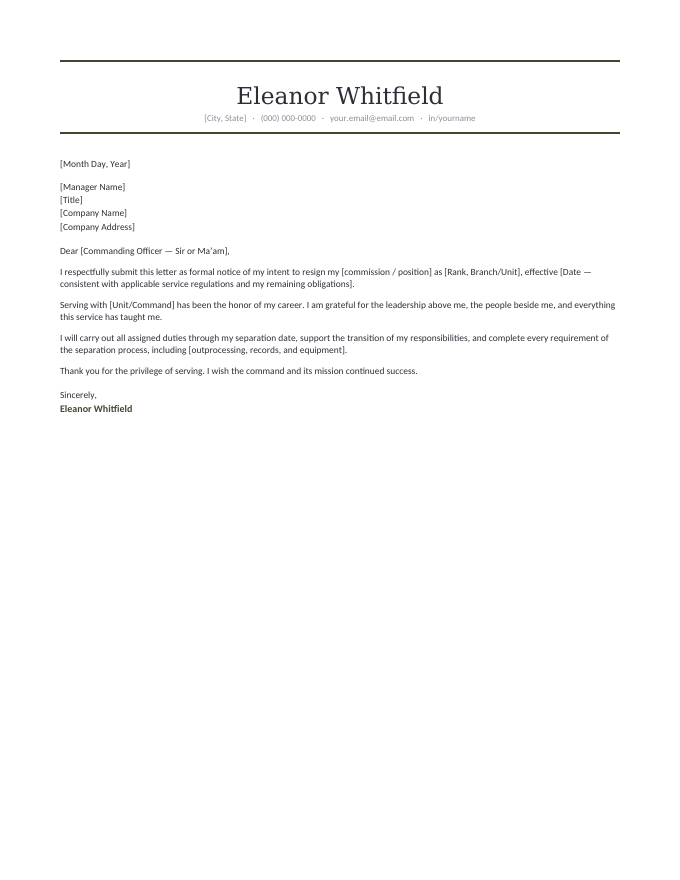
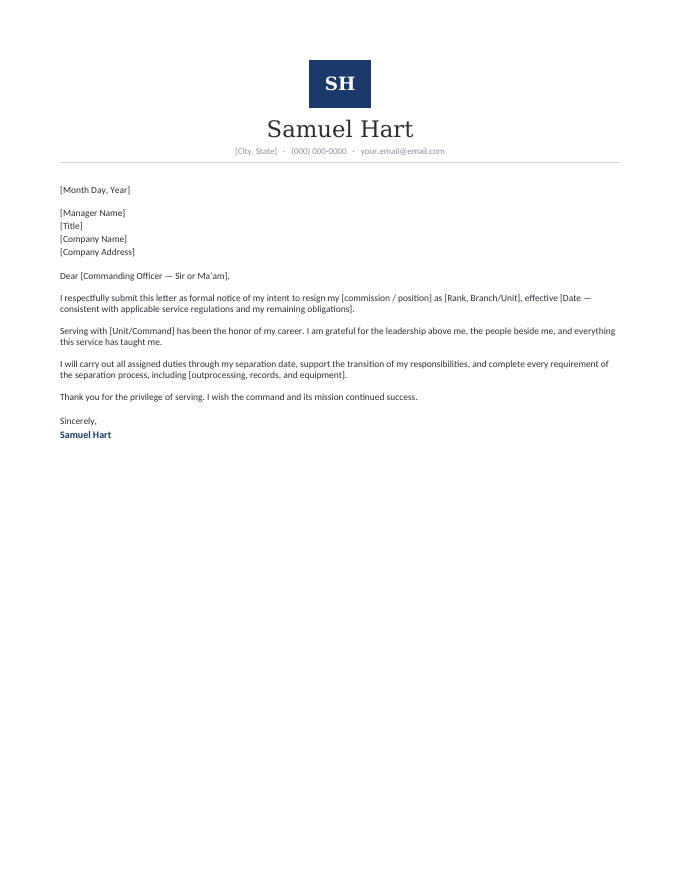
Military resignation letter sample — the letter inside the template.
[Month Day, Year]
[Manager Name]
[Title]
[Company Name]
[Company Address]
Dear [Commanding Officer — Sir or Ma’am],
I respectfully submit this letter as formal notice of my intent to resign my [commission / position] as [Rank, Branch/Unit], effective [Date — consistent with applicable service regulations and my remaining obligations].
Serving with [Unit/Command] has been the honor of my career. I am grateful for the leadership above me, the people beside me, and everything this service has taught me.
I will carry out all assigned duties through my separation date, support the transition of my responsibilities, and complete every requirement of the separation process, including [outprocessing, records, and equipment].
Thank you for the privilege of serving. I wish the command and its mission continued success.
Sincerely,
Eleanor Whitfield
What this letter is \u2014 and isn't.
Honesty first: no template resigns a commission by itself. Know the lay of the land —
- The binding request is regulatory — each branch has its own procedure and forms for an unqualified resignation or separation request, routed through your chain of command with its own timelines. Your S1/personnel office or JAG is the authority; start there.
- Obligations decide the timing — service commitments from your commissioning source, schooling, or bonuses determine when a resignation can take effect. The letter’s bracket acknowledges them rather than pretending otherwise.
- This letter is the professional wrapper — the statement of intent to your commander, the duties-through-separation commitment, and the thanks. It sets the tone the paperwork can’t.
- Register matters — respectful, unembellished, addressed properly. The military reads format as character more than any employer alive.
Leaving a civilian job with a military-adjacent culture — defense contractor, veteran-run shop? This letter’s register works there too, no regulations required.
Resigning a civilian job for military reasons.
Most people searching for a military resignation letter are actually leaving a civilian job for a military reason. The standard letters in this library handle every version of it — with one sentence adapted:
- Joining the military / leaving for basic training — use the professional two-weeks letter and say it plainly: “I am resigning to begin military service, reporting for training on [date].” Employers respect the sentence, and ship dates are usually known far enough out to give generous notice.
- Guard or Reserve activation is NOT a resignation — USERRA protects your civilian job through training and deployments. You notify your employer of service; you don’t hand in a letter your re-employment rights say you never owed. Resign only if you genuinely don’t want the job held.
- Military spouse relocation (PCS orders) — the personal-reasons letter with one added clause — “my spouse has received military orders to [location]” — is complete. Employers fast-track goodwill for exactly this sentence, and several states extend unemployment eligibility to spouses who resign for PCS moves.
- Orders arriving fast — when the report date leaves no room for notice, the immediate letter with the military reason named is the rare abrupt exit nobody holds against you.
In every case, the military reason is the one reason worth stating in the letter — it converts an ordinary departure into one employers actively want to support.
Doing it in order.
- Talk to S1/personnel or JAG first — confirm your obligations and the correct procedure for your branch.
- Inform your commander in person; this letter accompanies that conversation.
- Submit the official request through channels on the forms your branch requires.
- Serve fully to the date: duties, outprocessing, records, equipment — finished like you served.
Military resignation FAQ
Can an officer just resign like a civilian employee?
What's the difference between this letter and my official separation request?
How long does separating actually take?
Does this work for leaving a defense contractor or veteran-owned company?
What do I write when I'm leaving my job to join the military?
My spouse got PCS orders — how do I resign, and does it affect unemployment?
Military resignation letter templates · Updated September 2026