Apollo's Templates
HomeCareerResignation LettersImmediate
Effective today · Civil, no reasons required

Immediate Resignation Letter Templates

Sometimes the notice period loses to life: health, family, safety, or a situation that can't be worked through for two more weeks. When today has to be the day, the letter still matters — maybe more than ever, because it's the calm, dated record of an abrupt moment. These templates say it the right way: effective immediately, an apology for the short notice, a same-day handoff offer, and not one word you'll regret.

Eight letters, by reason

The hardest letter, written calmly.

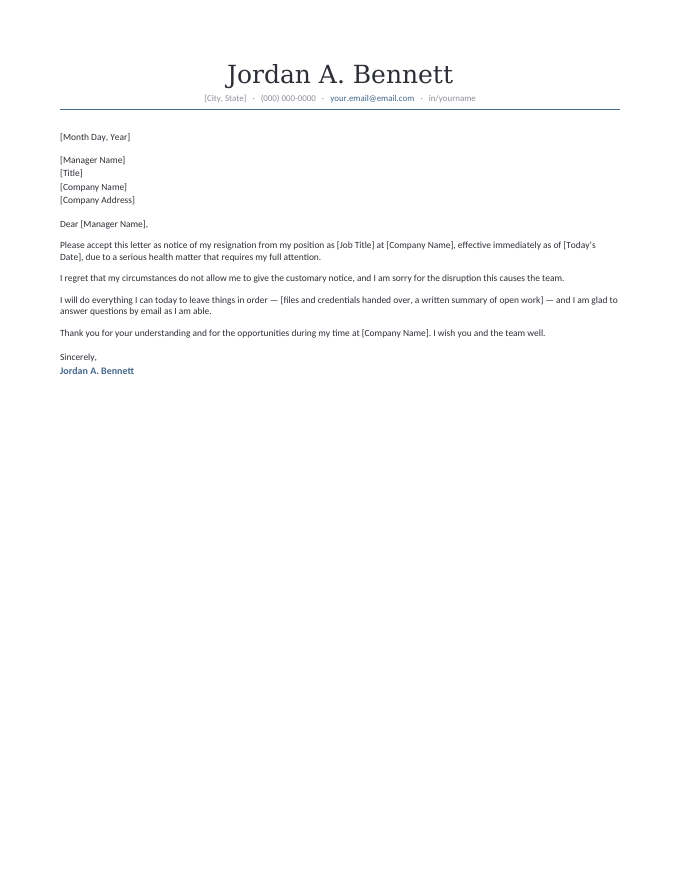
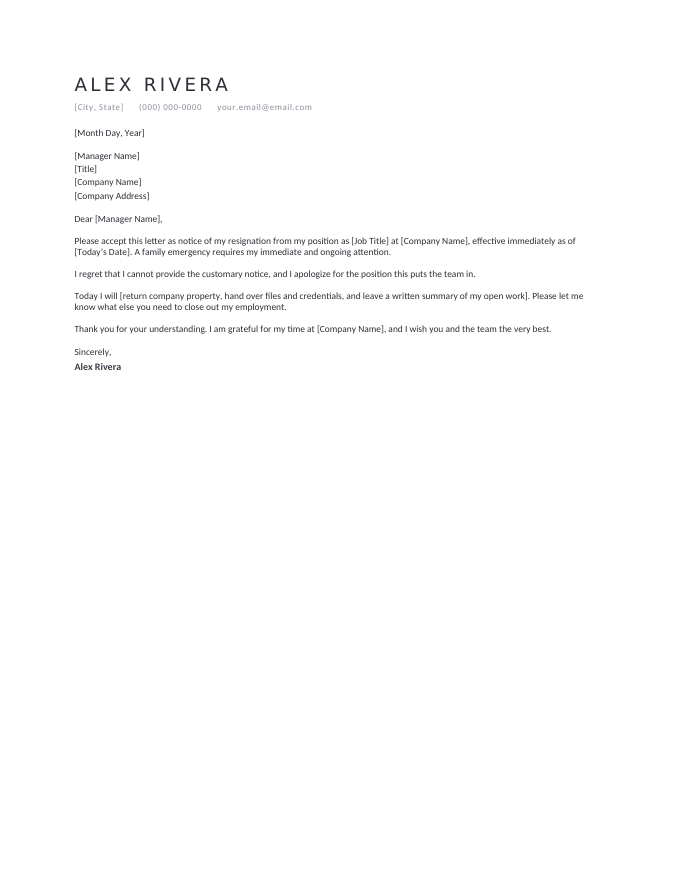
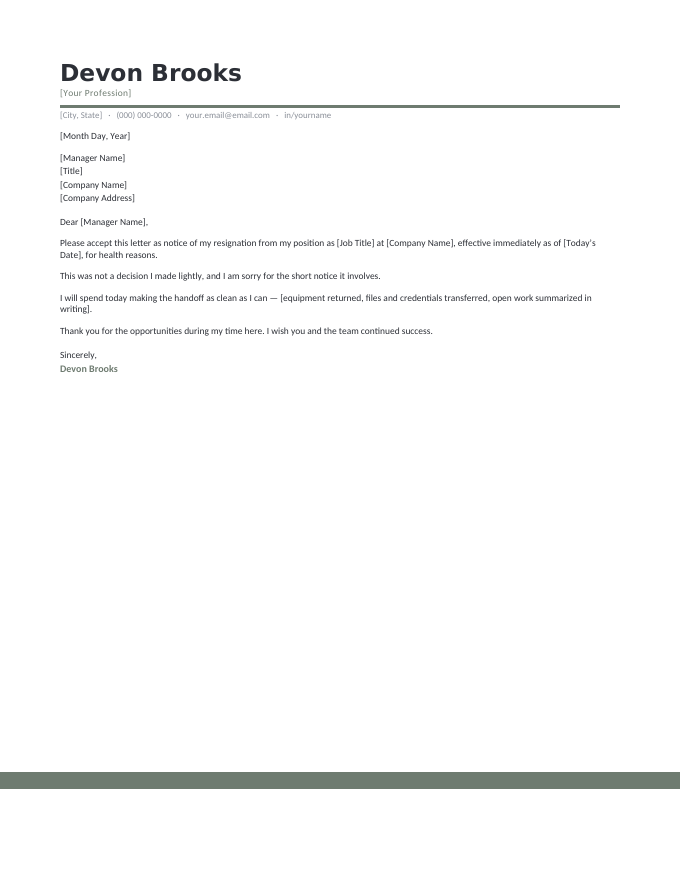
Three general effective-immediately letters, then five written for their reasons: a serious illness, a family emergency, health reasons (the calm phrasing for burnout and stress), the three-sentence no-notice short form, and an email version built to be pasted and timestamped. Every one is civil, dated, and complete — pick the letter that says exactly as much as you want on file.
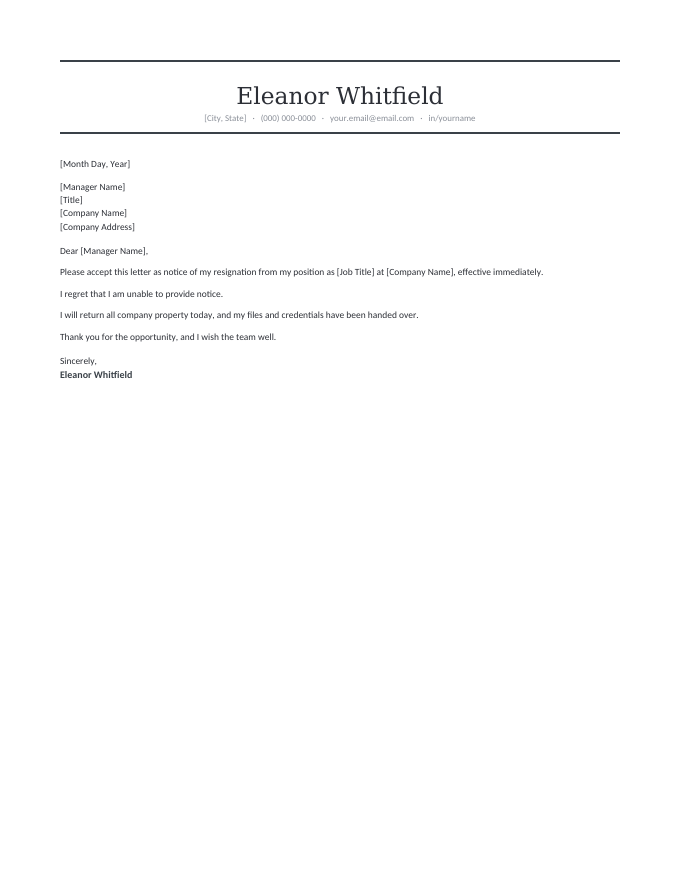
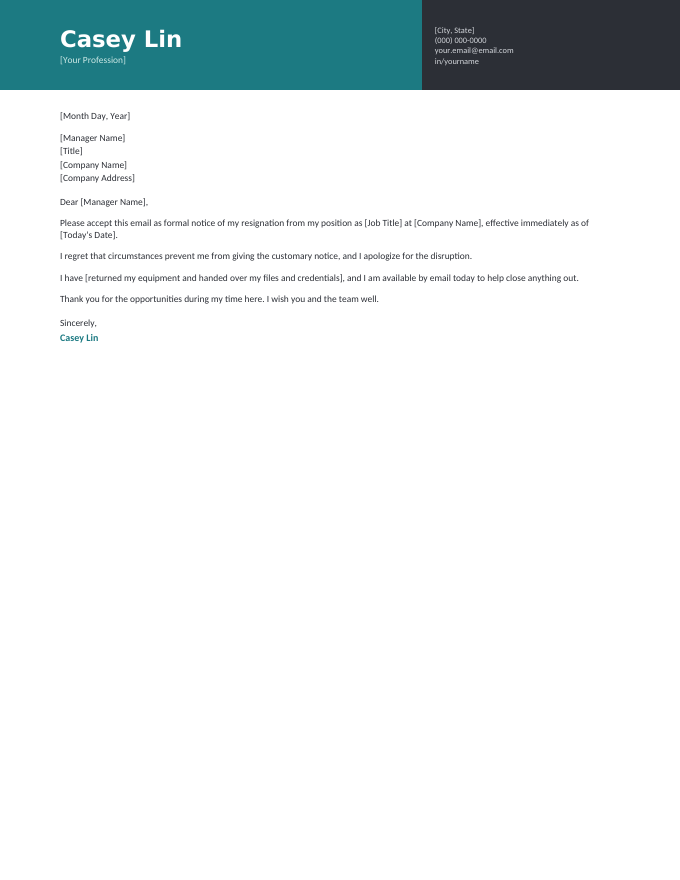
The letter, verbatim

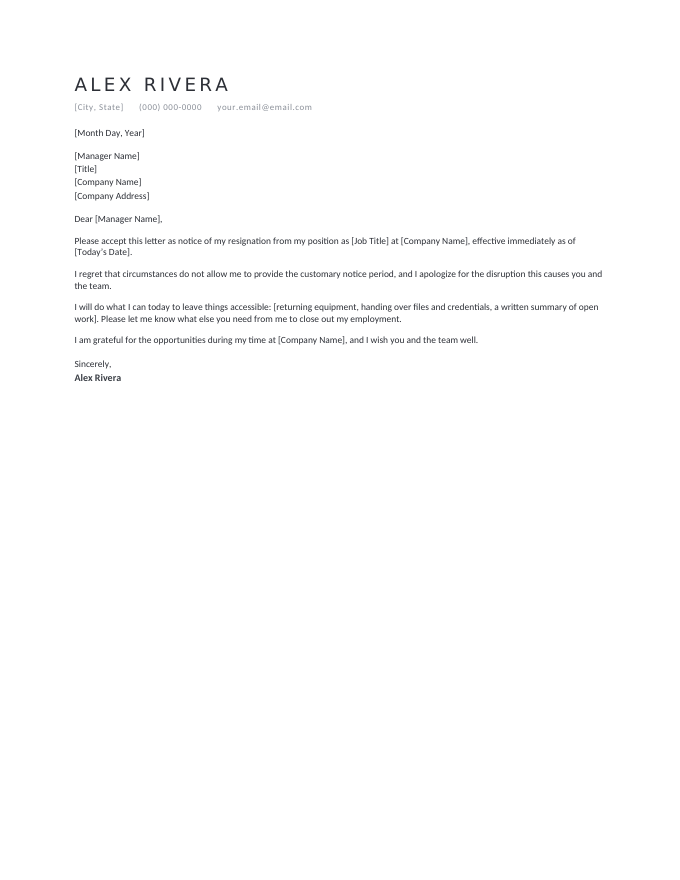
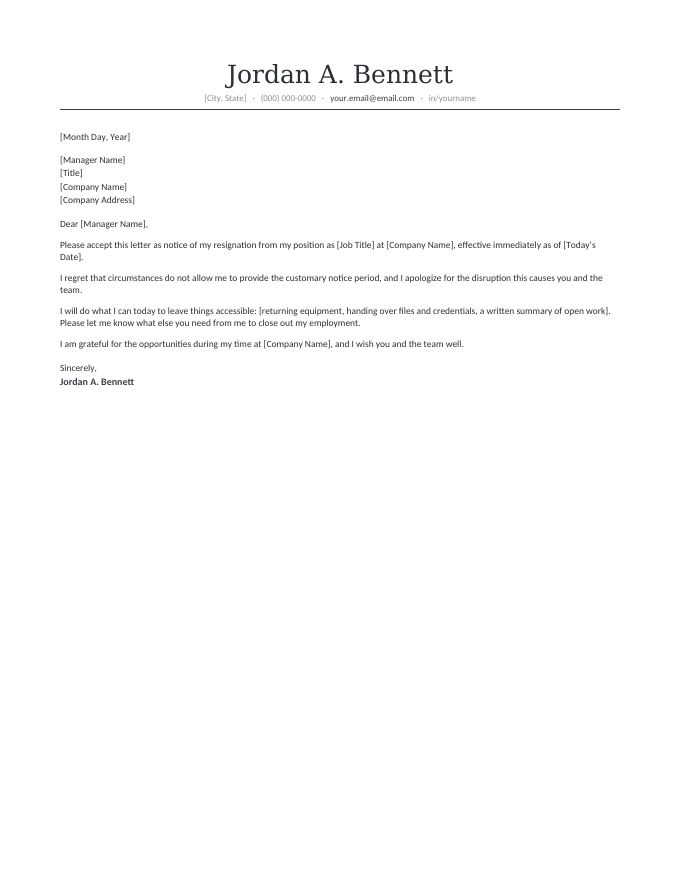
A sample immediate resignation letter.

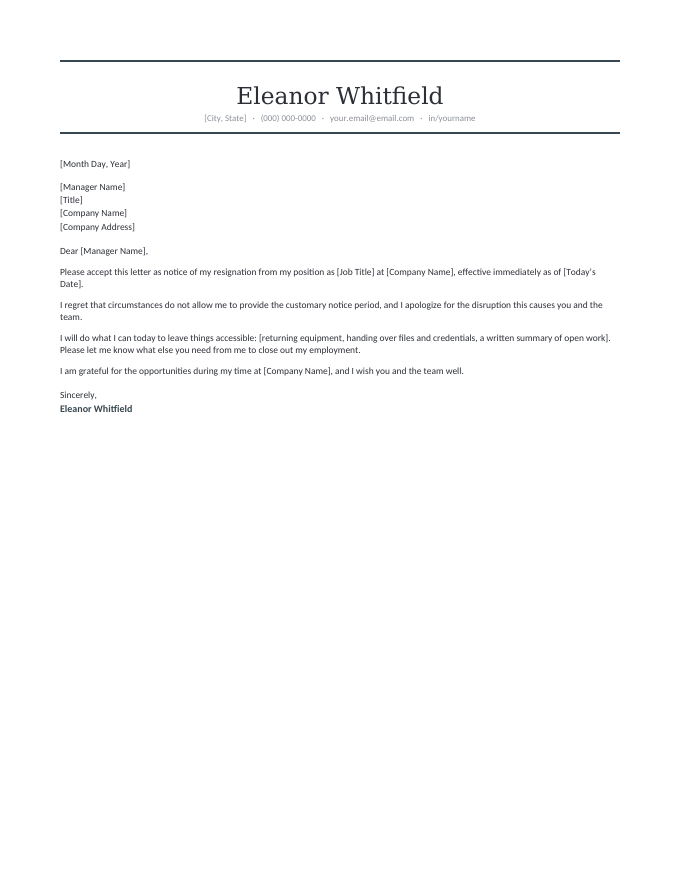
Dear [Manager Name],

Please accept this letter as notice of my resignation from my position as [Job Title] at [Company Name], effective immediately as of [Today’s Date].

I regret that circumstances do not allow me to provide the customary notice period, and I apologize for the disruption this causes you and the team.

I will do what I can today to leave things accessible: [returning equipment, handing over files and credentials, a written summary of open work]. Please let me know what else you need from me to close out my employment.

I am grateful for the opportunities during my time at [Company Name], and I wish you and the team well.

Sincerely,
[Your Name]

The effective-immediately letter with no notice, in full — it works printed, attached as a PDF, or pasted directly into an email when today has to be the day.

Eyes open

What an immediate exit costs, and how to shrink it.

An immediate resignation is a legitimate tool with real costs. Going in clear-eyed is what separates a clean emergency exit from a burned bridge:

  • The relationship cost is front-loaded — colleagues absorb your work with no warning. The letter’s apology and your same-day handoff are what soften it.
  • Policy may take a bite — PTO payout and rehire eligibility sometimes hinge on notice. Worth knowing, rarely worth two more weeks of the situation you’re leaving.
  • Contracts change the math — if you signed a notice clause, an abrupt exit is a breach, not just a discourtesy. Skim your agreement before you sign the letter.
  • The record is permanent — which is an argument for this letter, not against it: civil, dated, and complete beats a voicemail and a silent exit in every version of your future.

And if what’s driving you out is conduct — harassment, safety, something illegal — consider putting that on record with HR through its own channel. The resignation letter isn’t the place, but “I resigned with a clean letter and reported the problem properly” is the strongest position you can leave in.

Clean break, civil letter

Leaving today, properly.

  1. Fill the brackets — today’s date is the effective date; the letter says the rest.
  2. Tell your manager before the letter lands if you possibly can — even ten minutes’ warning is grace.
  3. Spend the last hours on the handoff: files, credentials, a written summary of what’s open.
  4. Ask HR — in writing — about your final paycheck, PTO payout, and benefits end date.
Hard questions

Immediate resignation FAQ

Is it legal to quit without notice?
Under at-will employment — the default for most U.S. jobs — yes: you may resign effective immediately, for any reason or none. The caveats are contractual, not criminal: an employment agreement with a notice clause can make a no-notice exit a breach with financial consequences, and some handbooks tie PTO payout or rehire eligibility to proper notice. Nobody can make you keep working; paper can make leaving abruptly cost something. Read yours first.
Do I have to say why I'm leaving immediately?
No. 'Circumstances do not allow me to provide the customary notice' is a complete explanation, and it's exactly what the template says. Health, family, safety, a hostile situation — none of it is owed to the file. If a reason would genuinely help (a medical situation HR should accommodate, conduct that should be reported), share it through the right channel: a conversation, HR, or a formal complaint — separate from the resignation letter, which should stay clean.
When is resigning on the spot the right call?
When staying costs more than leaving: your safety or health is at risk, the workplace is abusive, you're being asked to do something unethical or illegal, or a family emergency simply outranks the job. It is also, honestly, sometimes just necessary. What it shouldn't be is an impulse on a bad afternoon — an immediate resignation is irreversible and it travels with your name. If you can give even a few days' notice, that partial notice softens almost everything about what follows.
What happens to my final paycheck and benefits?
You must be paid for all time worked — state law sets the deadline, ranging from your last day to the next regular payday. Unused PTO payout depends on state law and company policy, and abrupt exits sometimes forfeit it where the policy conditions payout on notice. Health coverage typically runs through the end of the month, with COBRA after. Ask HR for all three answers in writing as part of your close-out — the letter's same-day handoff offer is a natural opening for that request.
Will quitting without notice hurt me later?
It can — some employers mark files 'not eligible for rehire' after a no-notice exit, and 'would you hire them again?' is a standard reference question. You limit the damage the way this template does: a civil, dated letter with an apology and a genuine same-day handoff offer, then a follow-through that leaves passwords, files, and a written summary behind. One abrupt-but-decent exit rarely defines a career; how you handle its last hours decides what gets remembered.
How do I resign immediately due to illness or a health issue?
Use this letter as written — 'circumstances do not allow the customary notice' covers a health crisis completely, and you owe no diagnosis to the file. Two additions serve you: tell HR (not necessarily your manager) that the reason is medical, because that single word can open doors the letter shouldn't — FMLA if you qualify and might want the job held instead, disability benefits, COBRA timelines, sometimes a medical exception to PTO-forfeiture policies. And before resigning at all, ask whether medical leave gets you what you actually need; resignation is irreversible, leave often isn't. When a family member's illness is the cause, the same playbook applies — FMLA covers caring for close family too.
Can I resign on the spot because of stress or burnout?
You can, and sometimes it's genuinely the right call — but burnout is the one immediate-resignation reason worth a 48-hour pause, because it responds to alternatives in a way emergencies don't: a leave of absence, intermittent FMLA where stress has a medical dimension, a transfer, or simply two weeks' distance while you serve normal notice with your evenings back. If the pause changes nothing, resign without apology beyond the letter's one sentence — health outranks any job — and consider the personal-reasons framing rather than naming burnout, which reads differently in a file than it feels in the moment.

Immediate resignation letter templates · Updated August 2026

Less drastic options

If today doesn't have to be the day.

The standard
Two Weeks' Notice Letters
If you can give the customary notice, it buys back most of what an abrupt exit costs.
Open
Short but noticed
Simple Resignation Letters
Five sentences with a normal notice period — minimal without being sudden.
Open
The library
All Resignation Letter Templates
Every version, plus what belongs in the letter and what never should.
Open