
Non-Profit Board Resignation Letters
Resigning a board seat is a governance act: your letter goes to the chair, takes effect the way the bylaws say resignations do, and lands in the minutes. These templates carry that letter \u2014 effective on a date or upon a successor's appointment, proud of the tenure's work, and concrete about the transition: records handed over, committee work completed, the Governance Committee supported as it fills the seat. Brief, warm, and board-book ready.
The letter the minutes will quote.
Classic navy and a burgundy formal serif \u2014 both carrying the bylaws-aware letter with the governance handoff written in.
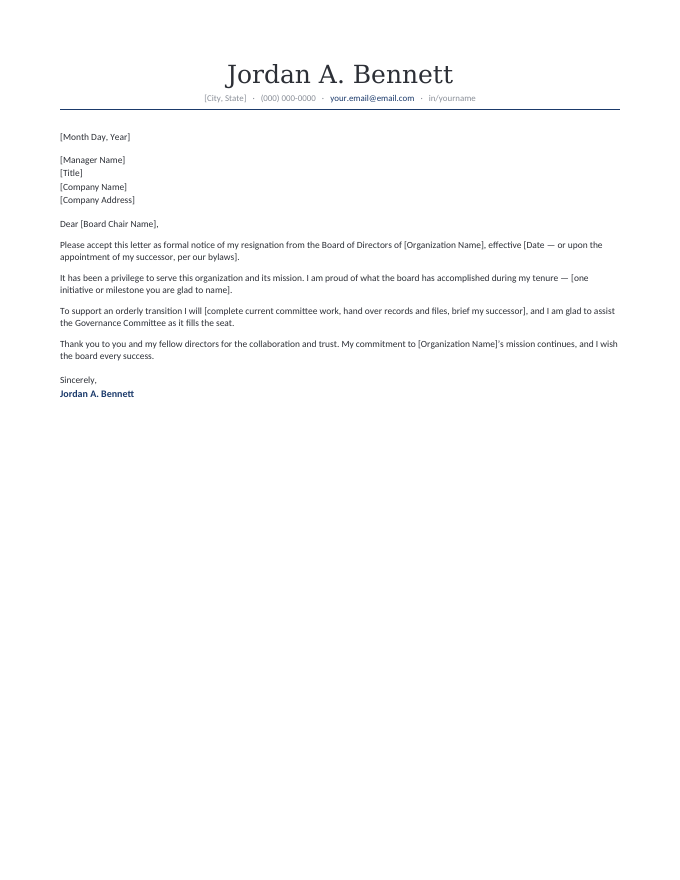
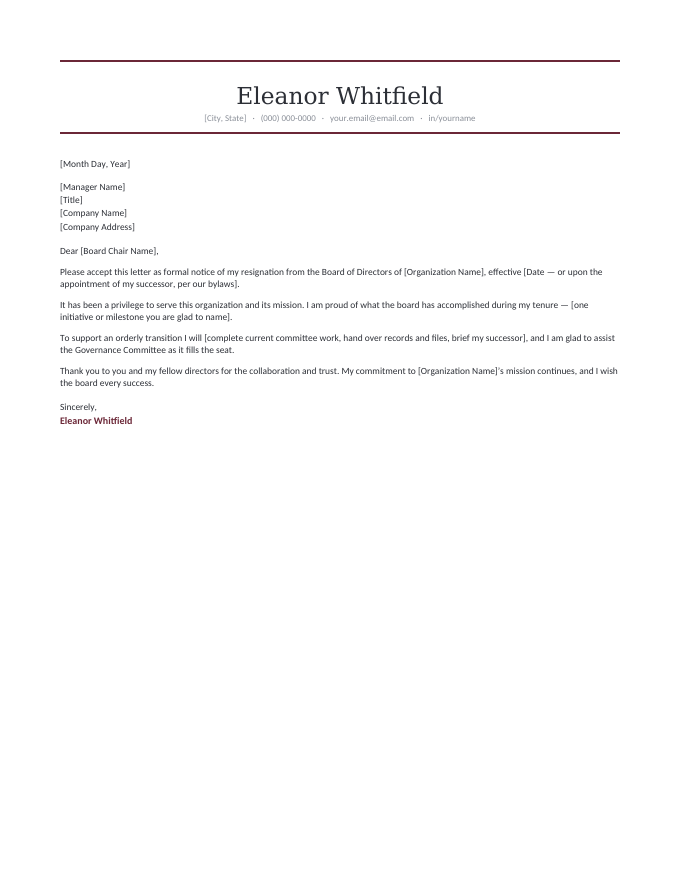
A sample non-profit board resignation letter.
Dear [Board Chair Name],
Please accept this letter as formal notice of my resignation from the Board of Directors of [Organization Name], effective [Date — or upon the appointment of my successor, per our bylaws].
It has been a privilege to serve this organization and its mission. I am proud of what the board has accomplished during my tenure — [one initiative or milestone you are glad to name].
To support an orderly transition I will [complete current committee work, hand over records and files, brief my successor], and I am glad to assist the Governance Committee as it fills the seat.
Thank you to you and my fellow directors for the collaboration and trust. My commitment to [Organization Name]’s mission continues, and I wish the board every success.
Sincerely,
[Your Name]
This sample serves directors, trustees, and volunteer board members alike — and trimmed of the governance clause, it works for committee seats too.
What makes a board resignation different.
A director’s exit has its own mechanics, and the letter should show you know them:
- The bylaws govern the effective date — many nonprofits accept resignation upon written notice to the chair; some specify board acceptance. The template’s bracket offers both patterns, including ‘upon the appointment of my successor’ when continuity matters.
- It’s a record — the letter enters the minutes and the corporate record. Two paragraphs, gracious and complete, is exactly the length that reads well there.
- Duties run until it’s effective — fiduciary obligations don’t fade during a transition. Votes you cast and confidences you hold stay governed until the date the letter names.
- The handoff is institutional memory — committee files, historical context, donor relationships you carried. Handing them over deliberately is the difference between a seat filled and a capability lost.
One caution: if you’re resigning over a governance concern — financial irregularity, legal exposure — document your objection properly before you go; a resignation doesn’t erase a director’s past responsibility. Counsel is cheap compared to the alternative.
Leaving the board properly.
- Check the bylaws for how resignations take effect, and phrase the bracket to match.
- Call the chair before the letter arrives — boards run on no-surprises.
- Hand over committee records and context; brief your successor if the timing allows.
- Stay a friend of the mission — donor, volunteer, ambassador — from outside the boardroom.
Board resignation FAQ
How does a board resignation legally take effect?
How much notice should a board member give?
Do I need to give a reason for leaving the board?
Does resigning end my liability as a director?
What happens if the entire board resigns?
How do I resign from a nonprofit or HOA board?
Non-profit board resignation letter templates · Updated September 2026