
Apollo's Templates
HomeBusinessExpense Report TemplatesCredit Card
Match every statement line

Credit Card Expense Report

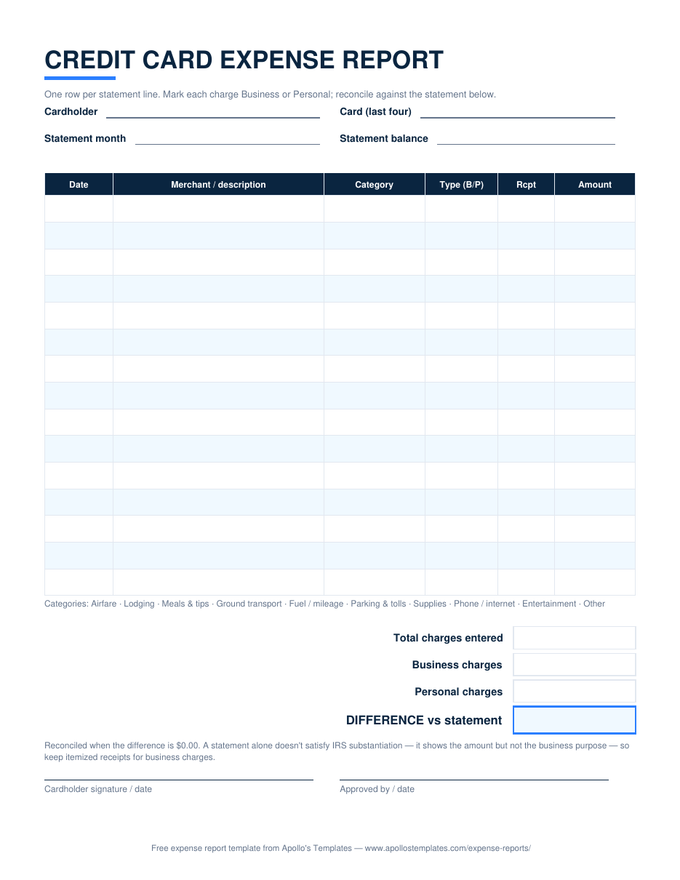
The month-end card ritual, structured: one row per statement line, a category for each, a Business-or-Personal dropdown that splits the totals automatically, a receipt column so substantiation gaps are visible, and a difference-vs-statement line that reads $0.00 exactly when every charge is accounted for. Works for a company card an employee reconciles or the owner's card that does double duty.

Three formats

The statement check, however you work it.
Worth knowing

Reconcile monthly, dispute on time.

The under-appreciated reason to reconcile every month rather than every quarter: billing-error disputes have clocks. US card protections generally require raising a billing error in writing within 60 days of the statement that contains it — a fraudulent or double-posted charge found during a quarterly cleanup can already be past the window. The monthly pass through this sheet is what surfaces those lines while the remedy still exists.

And a filing habit that makes audits boring: staple (or attach) the reconciled sheet to that month’s statement, receipts behind it, and file the bundle by month. One statement, one sheet, one stack of receipts — a year of card activity becomes twelve self-contained packets anyone can verify.

Cash, not card
Petty Cash Log
The same reconciliation discipline for the office cash box — running balance and over/short.
Open
Out-of-pocket instead
Expense Reimbursement Form
For expenses paid with personal money — card charges never belong on a reimbursement request.
Open
All formats
Excel Expense Templates
Every sheet in the library as an .xlsx with working totals.
Browse

Frequently asked questions

How does the reconciliation actually work?
Enter the statement balance once in the header, then one row per statement line: date, merchant, category, business or personal, receipt yes/no, amount. The sheet totals the charges and shows the difference against the statement — $0.00 means every line is accounted for. A nonzero difference means a charge isn't entered yet, a pending transaction hasn't posted, or (the one worth catching) there's a charge on the statement nobody recognizes. That last case is the entire reason monthly reconciliation exists.
Isn't the credit card statement itself enough of a record?
For reconciling the card, yes; for the IRS, no. A statement line proves an amount was paid to a merchant on a date — it doesn't show what was bought or why it was business, which is what substantiation requires. "AMZN Mktp $84.12" could be printer toner or a birthday present. That's why this sheet keeps a receipt column and a business-purpose-bearing description per line: statement for the money, receipt for the meaning. Keep both and the record is complete.
What's the right way to handle a personal charge on a company card?
Mark it Personal on this sheet — the split totals it automatically — and then follow your company's remedy, which is usually repaying the amount or having it deducted as agreed. What matters is that it's flagged the same month it happens; a personal charge that rides unnoticed for a year is how bookkeeping errors turn into trust problems. If personal charges are showing up regularly, that's not a spreadsheet issue — separate the cards.
Does this replace the expense reports employees file?
No — it's the other half. An expense report justifies spending from the spender's side (what I bought and why); this sheet verifies the card from the account's side (every statement line identified and split). In a small business the same person often fills both, and the monthly rhythm works like this: reconcile the card here, then any out-of-pocket, non-card expenses still go through the reimbursement form. Card charges never belong on a reimbursement request — the company already paid them.
Updated through August 2026