
Apollo's Templates
HomeBusinessExpense Report TemplatesPetty Cash
The cash box, balanced

Petty Cash Log Template

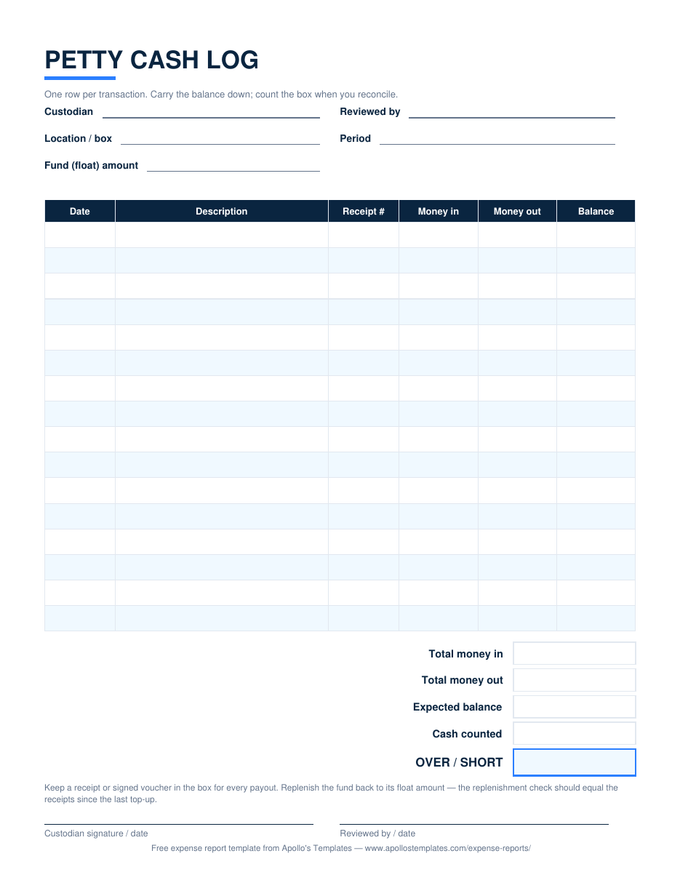
The imprest-method ledger for the office cash box: a fund amount in the header, one row per transaction — money in, money out, receipt number — and a balance column that carries itself down the page. At reconciliation time, count the cash, type the number, and the over/short line tells you instantly whether the box and the paper agree. Custodian and reviewer signature lines close out the period.

Three formats

The cash ledger, in the box or on screen.
Worth knowing

The imprest method is the whole trick.

A petty cash box that works runs on one rule: the float is fixed. Cash plus receipts in the box always equals the fund amount, and every replenishment tops the box back up to exactly the float — which means the replenishment check always equals the receipts collected since the last top-up. That single invariant is what makes the box auditable in thirty seconds instead of an afternoon, and it’s why this log asks for the fund amount before anything else.

The other habit that pays: one custodian. When exactly one person holds the key and signs the log, every discrepancy has a short list of explanations. A box everyone can reach into is a box nobody can reconcile.

Paid from a pocket, not the box
Expense Reimbursement Form
When someone covers a cost with their own money instead of petty cash.
Open
Where the receipts end up
Monthly Expense Report
Post the box's spending into the month's category summary at replenishment time.
Open
All formats
Excel Expense Templates
Every sheet in the library as an .xlsx with working totals.
Browse

Frequently asked questions

How does the running balance work in the Excel version?
Enter the fund (float) amount once in the header, then log each transaction — money out for purchases, money in for replenishments. Every row with activity shows the balance as of that row: fund plus everything in, minus everything out, top to bottom. Because the math runs cumulatively rather than row-referencing the cell above, a skipped or blank row never breaks the chain. Type the counted cash at the bottom and the over/short computes itself.
What does “over/short” mean, and what do I do about it?
It's the difference between what the box should hold (expected balance) and what it actually holds (cash counted). A few cents short usually means a rounding slip or an unlogged small payout; write it off in the ledger and move on. A recurring or growing shortage is the signal to tighten the voucher habit — no cash leaves the box without a receipt or signed slip. Overages are rarer and usually mean a purchase was logged but the change never made it back out.
How much should the petty cash float be?
Enough to cover two to four weeks of typical small purchases, and no more — common floats run $100 to $500. Too small and someone's driving to the bank weekly; too large and the box becomes a tempting internal-controls problem. The imprest method this log follows makes resizing easy: the float is one number in the header, and each replenishment simply tops the box back up to it. If you're replenishing more than monthly, raise the float.
What counts as proper documentation for a petty cash payout?
A receipt whenever one exists, and a signed petty cash voucher when one doesn't (tips, parking meters, the occasional receipt-less vendor). Each payout row here has a receipt-number column so the paper in the box matches the ledger line by line. At replenishment time, the receipts plus vouchers should equal the money spent since the last top-up — that bundle is what the reviewer signs off on, and what the bookkeeper posts to the actual expense accounts.
Updated through August 2026