Apollo's Templates
HomeBusinessExpense Report TemplatesFor Taxes
Records that hold up

Expense Report Templates for Taxes

A deduction is only worth what you can substantiate. These are the sheets built around what the IRS actually asks for — amount, date, place, and business purpose on every line, receipts behind the ones that need them, and a year-end page that hands your preparer ten numbers instead of a shoebox. Below the templates: the accountable-plan rules in plain language, what qualifies, and how long to keep it all.

Tax-time sheets

Four templates, one paper trail.

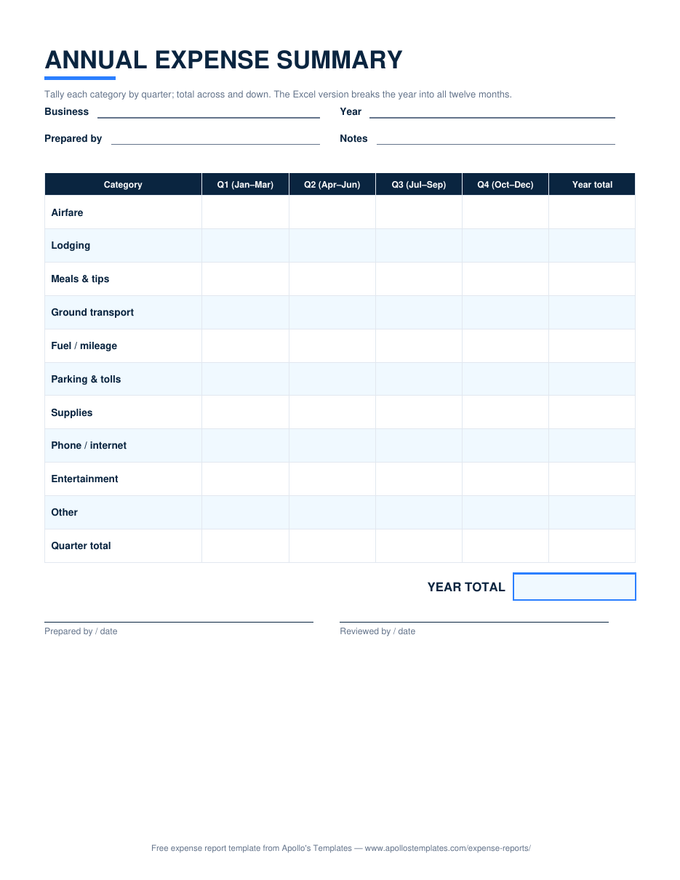
Annual summary — the preparer's page
Twelve months by category with quarter and year totals. This is the single page that turns a shoebox into a return.
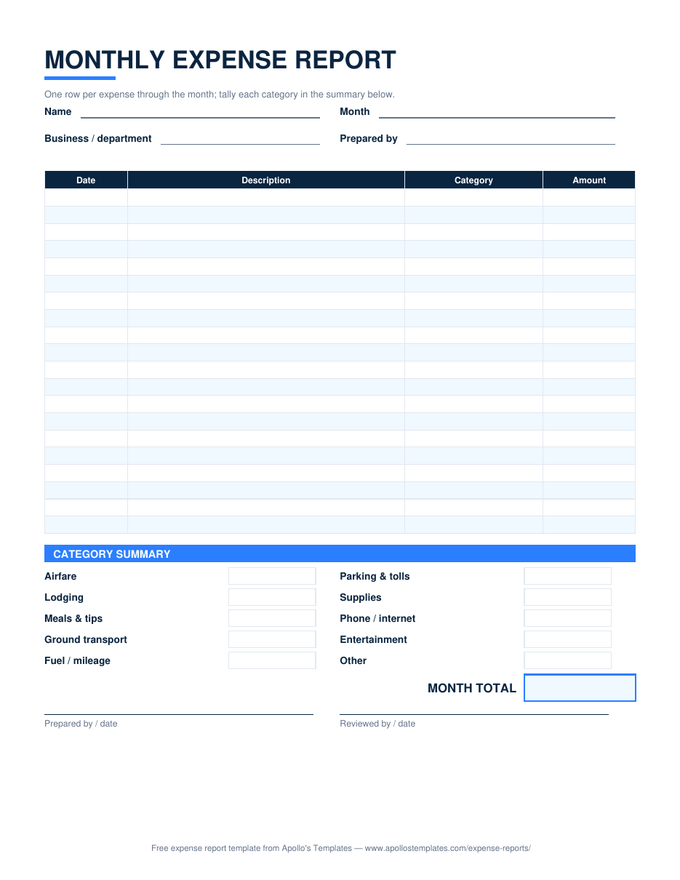
Monthly — where the year comes from
Log expenses as they happen with a category on each; the summary block feeds the annual page directly.
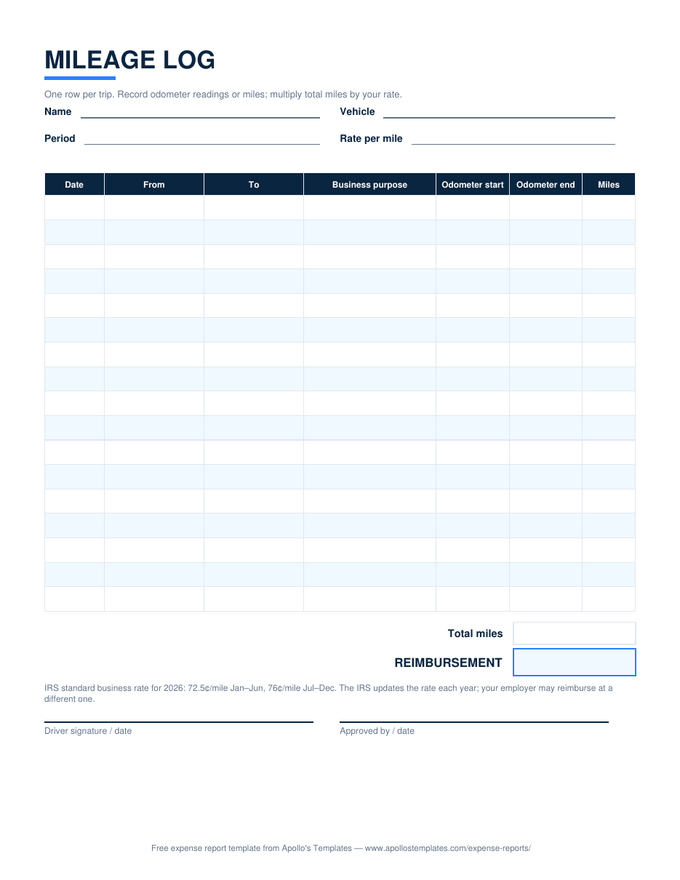
Mileage — the contemporaneous log
The deduction the IRS scrutinizes hardest, and the one a timely log defends best.
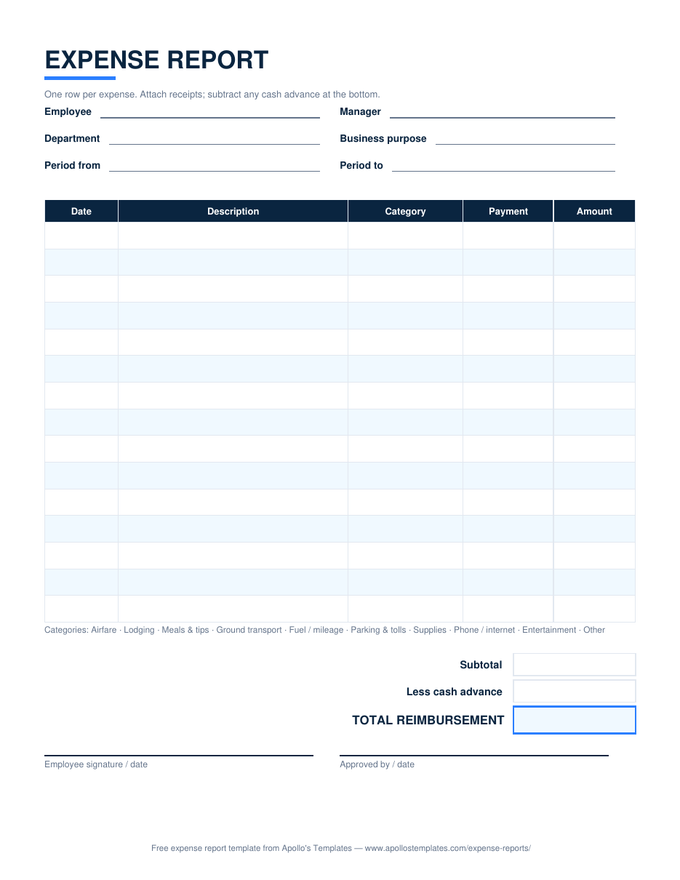
Accountable-plan reimbursements
Date, purpose, category, amount, and the cash-advance reconciliation — the substantiation an accountable plan requires.
The rules, plainly

Three habits that keep reimbursements tax-free.

The IRS calls it an accountable plan, which sounds like a document you file. It isn’t — it’s three habits, and reimbursements stay untaxed only while all three hold:

Business connection.The expense has to be incurred doing the organization’s work. That’s the description field, and “client lunch — Acme contract renewal” survives scrutiny in a way that “lunch” does not.

Substantiation in reasonable time. Amount, date, place, purpose — with receipts for lodging and anything $75 or more, submitted within about 60 days. An expense surfacing a year later has already failed the test.

Return of excess.Advance money that exceeded actual expenses goes back, which is exactly what the “less cash advance” row on our standard report documents. Fail any of the three and the IRS can reclassify every reimbursement as wages — taxable to the employee, payroll-taxable to the employer, for money that was only ever a repayment. Reference: IRS Publication 463. This page describes the rules; it isn’t tax advice, and your accountant is the authority on your situation.

The year on one page
Annual Expense Summary
Category by month with quarter totals — what your preparer works from.
Open
The scrutinized deduction
Mileage Log
Contemporaneous trip records at the IRS standard rate.
Open
For owner-operators
Small Business Expense Reports
The short list of sheets a small business actually needs, in order.
Open

Frequently asked questions

What does the IRS actually require an expense record to show?
Four things per expense, and they're the same four whether you're a corporation or a sole proprietor: the amount, the date, the place, and the business purpose. Receipts are documentary evidence on top of that — required for every lodging expense and for any other single expense of $75 or more, though most businesses sensibly keep them for everything. The business purpose is the field people skip and the one examiners ask about, which is why every template here has a description column and not just an amount.
What is an accountable plan, and why does it matter so much?
It's the arrangement that makes reimbursements tax-free rather than taxable wages, and it's three requirements rather than a document you file: expenses must have a business connection, must be substantiated within a reasonable time (the IRS safe harbor is 60 days), and any excess advance must be returned. Meet all three and the money doesn't appear on a W-2 or get payroll taxes withheld. Miss any of them and the IRS can treat every reimbursement you paid as wages — which costs the employer payroll tax and the employee income tax on money they were only ever paid back.
Which expenses can a business deduct?
The standard is expenses that are ordinary and necessary for your trade — deliberately broad, covering supplies, software, professional fees, insurance, business travel, 50% of business meals, and vehicle costs. The reliable failures: personal expenses recorded as business, commuting between home and your regular workplace, and entertainment, which lost its federal deduction in 2018 (business meals survived it — a distinction worth getting right, since a category called "Entertainment" on a report is often really meals). Describe, don't guess: IRS Publications 463 and 535 are the references, and your accountant is the authority on your situation.
How long do I need to keep expense records?
Three years from the filing date covers the ordinary IRS statute of limitations, which is the practical floor for records behind a deduction; six or seven years is common practice, and records tied to property or assets should live until the asset is disposed of plus the statute. The failure mode isn't usually discarding records — it's thermal receipt paper fading to blank within a year or two. Scan or photograph receipts when they arrive, file the image by month with the report, and retention takes care of itself.
Does a mileage log really need to be kept as you drive?
It needs to be "contemporaneous" — made at or near the time of each trip — and this is the deduction most likely to be examined precisely because it's the easiest to invent afterward. A log filled in weekly from a calendar and odometer photos qualifies comfortably. A year of miles estimated in March does not hold up, and taxpayers lose that argument routinely. The bar is genuinely low: date, destination, business purpose, miles, written down while you still remember. Our mileage log is exactly that record.
Updated through August 2026