What's the IRS mileage rate right now?
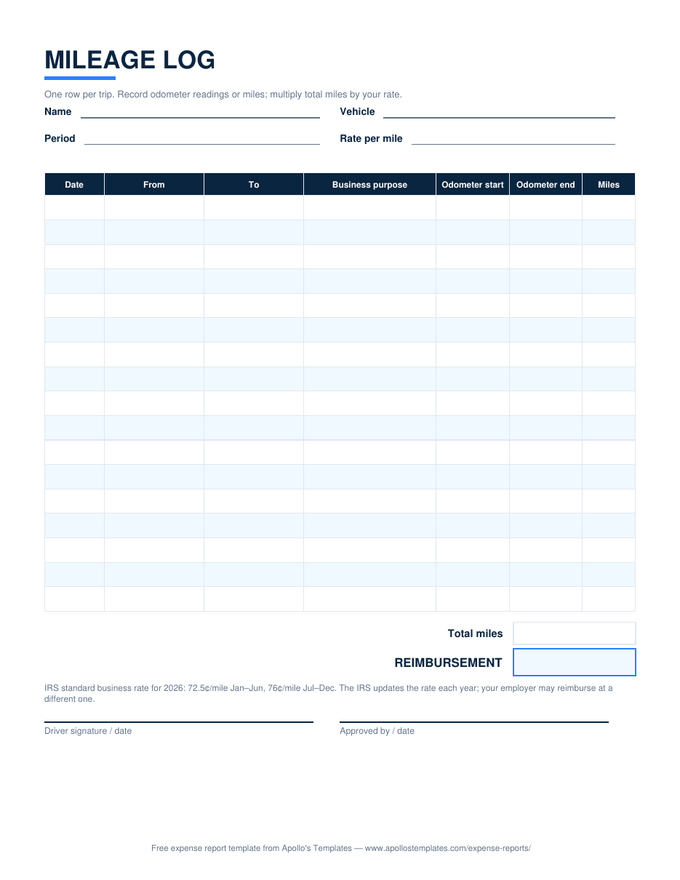
2026 is a split year: 72.5 cents per business mile for miles driven January through June, and 76 cents for miles driven July through December — the IRS raised it midyear as fuel costs climbed, the first midyear change since 2022. The Excel sheet ships with the current-half rate prefilled in an editable cell, so a log that spans the split just needs two copies (or two rate columns). The IRS announces each new year's rate in December; update the cell once and the math follows.
Do I have to record odometer readings, or can I just write miles?
Either works. The Excel sheet computes miles from the odometer columns when both readings exist — and if you'd rather enter miles directly (you know the office-to-client run is 23 miles), type the number straight into the Miles cell over the formula. Odometer readings make a stronger audit record because they anchor each trip to the vehicle's actual meter, but a consistent point-to-point log with dates and business purposes is accepted practice.
Which drives actually count as business miles?
Driving between workplaces, to client sites, to the bank or supplier on business, to a temporary work location, and airport runs for business travel all count. The big exclusion is commuting: home to your regular workplace is personal, every day, no matter what you listen to on the way or what's in the trunk. For a home-based business, the calculus shifts — if your home office is your principal place of business, drives from home to clients generally do count. Log the business purpose per trip and the line stays defensible.
Does the standard rate cover gas, or do I claim that too?
It covers gas — and depreciation, insurance, maintenance, oil, tires, registration. The per-mile rate is the IRS's all-in estimate of what operating a vehicle costs, which is exactly why you can't claim mileage and fuel receipts for the same drive. The alternative is the actual-expense method: track every real vehicle cost and deduct the business-use percentage. More paperwork, sometimes a bigger number for expensive vehicles; for most people reimbursing ordinary driving, the standard rate wins on simplicity.
Why does the IRS care that a mileage log is “contemporaneous”?
Because mileage is the easiest deduction to invent after the fact, so the IRS gives weight to records made at or near the time of each trip. A log filled in weekly from a calendar and odometer photos qualifies; a year of miles reconstructed in March does not hold up if examined. The practical bar is low — date, destination, purpose, miles, written down while you still remember — and this sheet is exactly that record, on paper or in your Drive.