Apollo's Templates
HomeBusinessTimesheet TemplatesBabysitter
The fridge-door payroll

Babysitter & Nanny Timesheet Template

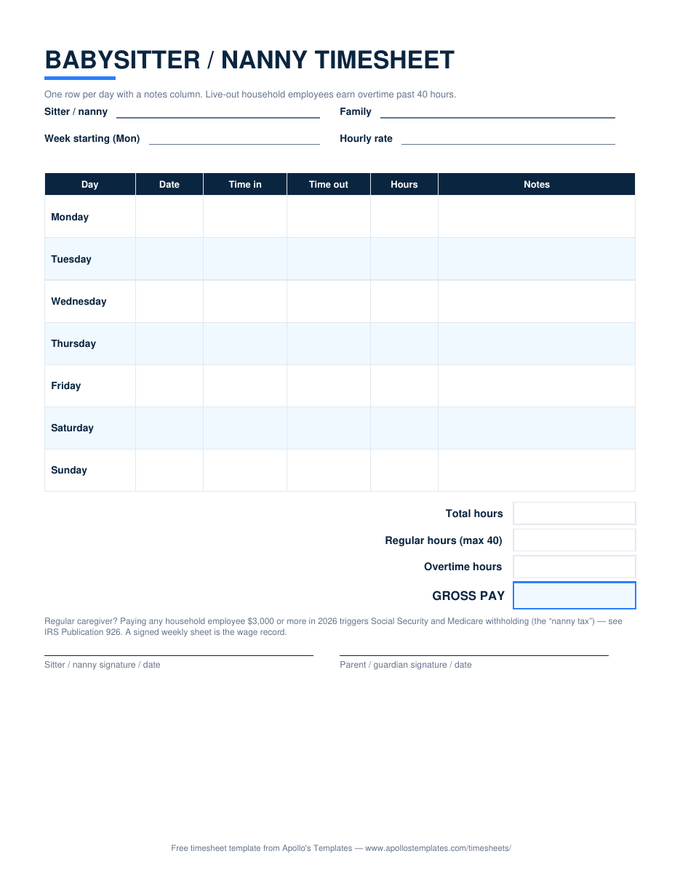
In-home childcare runs on trust and memory — this sheet upgrades the memory half. One row per day: time in, time out, hours, and a notes column wide enough for what actually happened. The Excel version totals the week, splits overtime past 40 hours (yes, live-out nannies earn it), and prices the agreed rate; the PDF lives on the fridge and gets signed by both adults at Friday handoff.

The childcare week

One download, three formats.

Worth knowing

The $3,000 line most families don't know exists.

A family with a regular nanny is, in the IRS’s eyes, an employer. Cross $3,000 in wages to one caregiver in 2026and Social Security and Medicare withholding applies to all of it; pay $1,000 in any quarter and federal unemployment tax joins in. None of this is exotic — it’s a Schedule H at tax time — but it runs entirely on wage records, and “we usually paid her about $200 a week” is not a wage record. Fifty-two signed sheets are. Source: IRS Publication 926.

Worth saying plainly: paying above the table protects the caregiver too — Social Security credits, unemployment eligibility, a verifiable income history for apartments and loans. The timesheet is the least glamorous part of doing childcare employment right, and also the foundation of it.

Care work, documented
Home Health Aide Timesheet
The other in-home care sheet — visit services, miles, and the client signature pair.
Open
Fill it from a phone
Google Sheets Timesheets
The sitter logs times in a shared Sheet; the family sees totals build.
Open
For the fridge
Printable Timesheets
The whole library as print-ready blank PDFs, this sheet included.
Browse

Frequently asked questions

Do babysitters really earn overtime?
Nannies and regular sitters generally do. Household employees who don't live in the home are covered by federal overtime — hours past 40 in a week pay 1.5× — which is why this sheet runs the same split as our workplace timesheets instead of a flat total. Live-in caregivers are the main exception (minimum wage still applies, overtime doesn't, federally). The Saturday-night-only sitter never gets near 40 hours, so for occasional sitting the split simply never activates.
What's the “nanny tax,” and when does it apply?
The shorthand for household-employment taxes. If a family pays any one household employee $3,000 or more in cash wages during 2026, Social Security and Medicare withholding applies — and once crossed, it applies to every dollar that year, not just the excess. There's also a federal unemployment threshold of $1,000 in any quarter. A regular after-school nanny crosses these fast; the occasional date-night sitter typically doesn't. The rules live in IRS Publication 926, and a signed weekly sheet like this one is the wage record the math gets built on.
Why do both the sitter and the parent sign?
Because in-home childcare has no time clock and no supervisor — the parent's signature is the verification, the sitter's is the claim, and together the sheet becomes an agreed record instead of a remembered one. That matters most exactly when nobody expects it to: totals disputed weeks later, a nanny-tax filing that needs wage documentation, or simply two tired adults with different recollections of when Tuesday ended. Sign it weekly at handoff; it takes ten seconds.
What belongs in the notes column?
Whatever the next adult needs to know, plus anything that affects pay: late-arrival adjustments, an agreed bonus for extra kids, mileage if the sitter drove the kids somewhere, who supplied dinner. Families running a regular arrangement also use it as the handoff log — naps, meds given, homework done — which turns the timesheet into the week's childcare record. If pay-affecting notes become routine, agree on the rules in advance and let the sheet just record them.
Updated through August 2026