Apollo's Templates
HomeBusinessTimesheet TemplatesGoogle Sheets
Straight to your Drive

11 Google Sheets Timesheet Templates

Every timesheet in the library as a one-click Google Sheets copy — no download, no import, no file to email around. Click, make a copy, and the sheet lives in your own Drive with the formulas running: daily hours from clock times, the overtime split, gross pay from your rate. Fill it in from a phone at the end of a shift or share one copy with the whole crew.

Copies, not downloads

Eleven sheets, one click each.
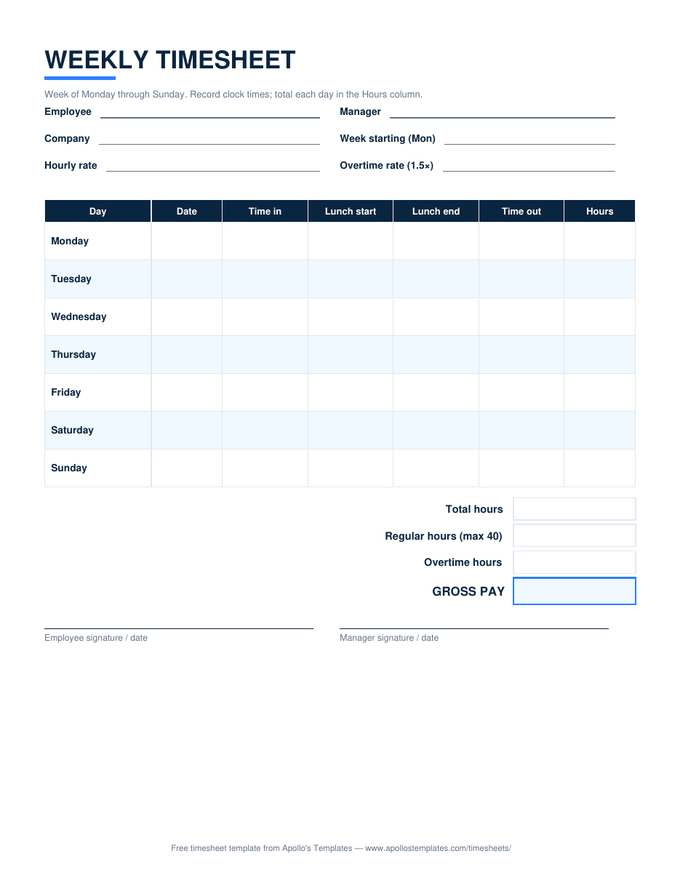
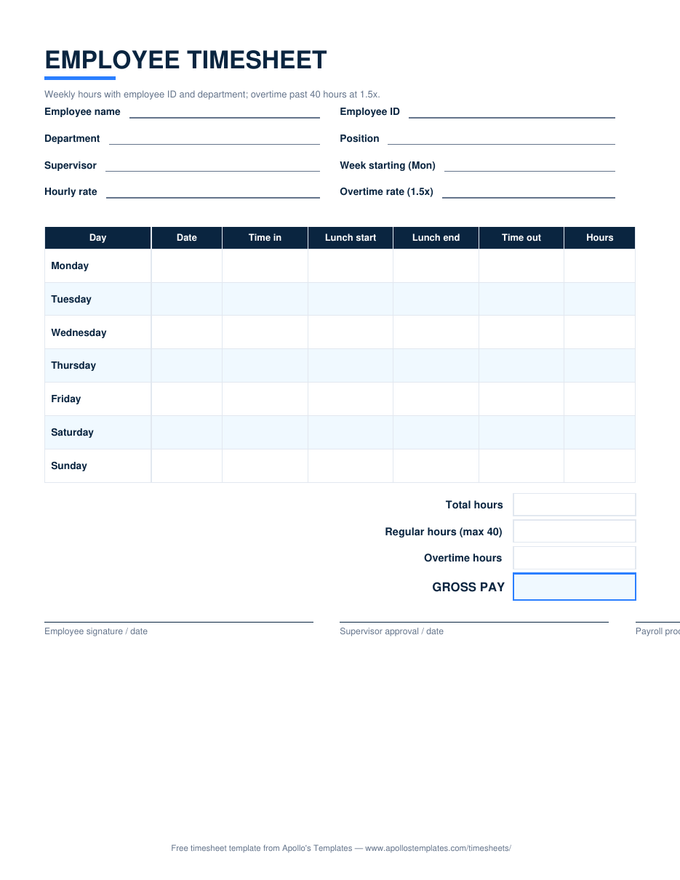
Weekly timesheet with daily in, out, and lunch columns, an automatic 40-hour overtime split, and gross pay

Weekly — with lunch columns

The standard weekly sheet: daily totals, the 40-hour overtime split, gross pay from your rate.
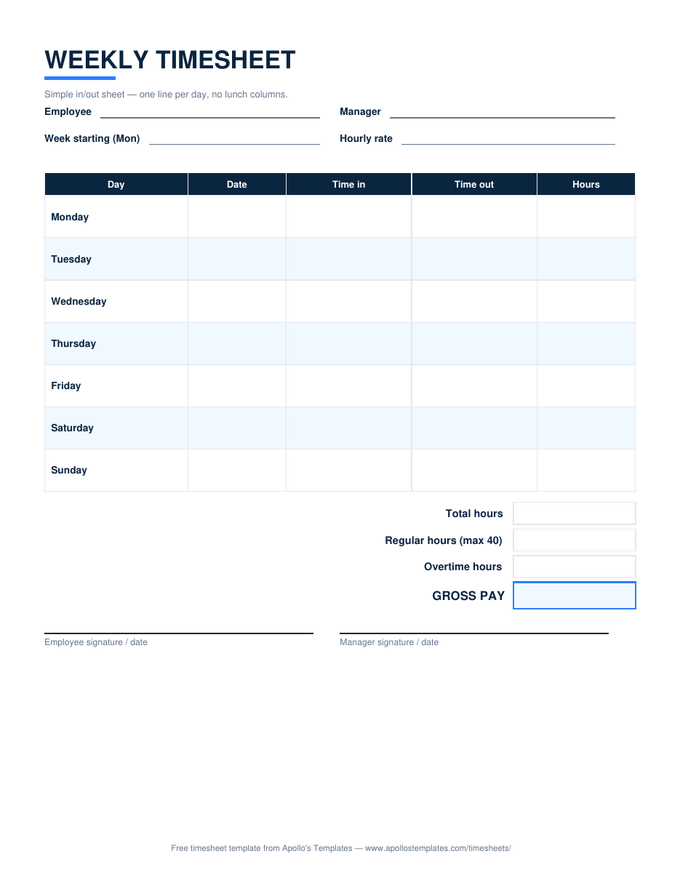
Simple weekly timesheet with one row per day, daily hours, and a week total — no overtime or pay columns

Weekly — simple in/out

In, out, hours — the fastest sheet to fill in from a phone at the end of a shift.
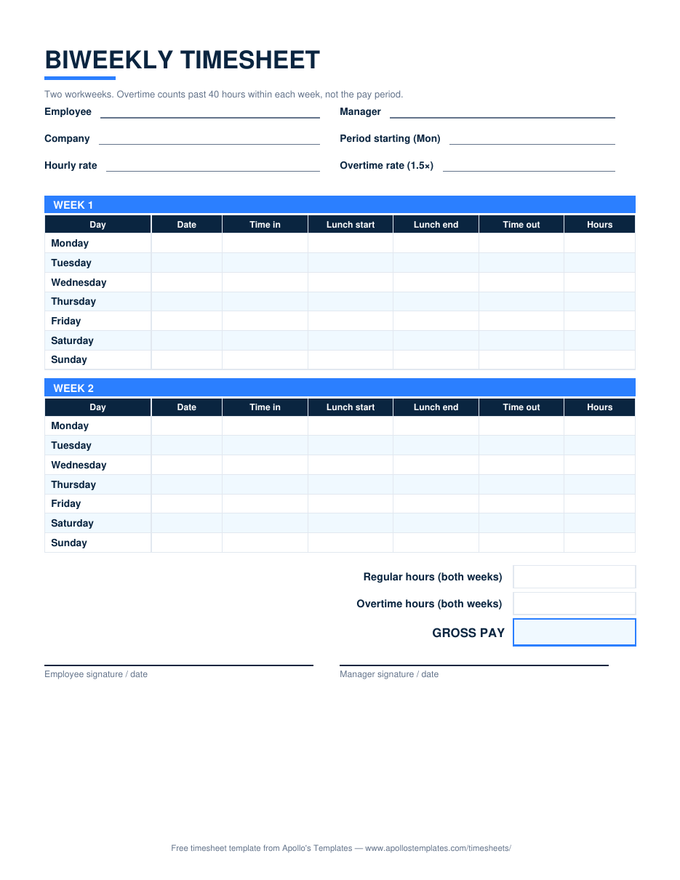
Biweekly timesheet with two week blocks, lunch-break columns, per-workweek overtime subtotals, and period pay

Biweekly — two week blocks

Both workweeks split their own overtime before the period totals — share one copy per pay period.
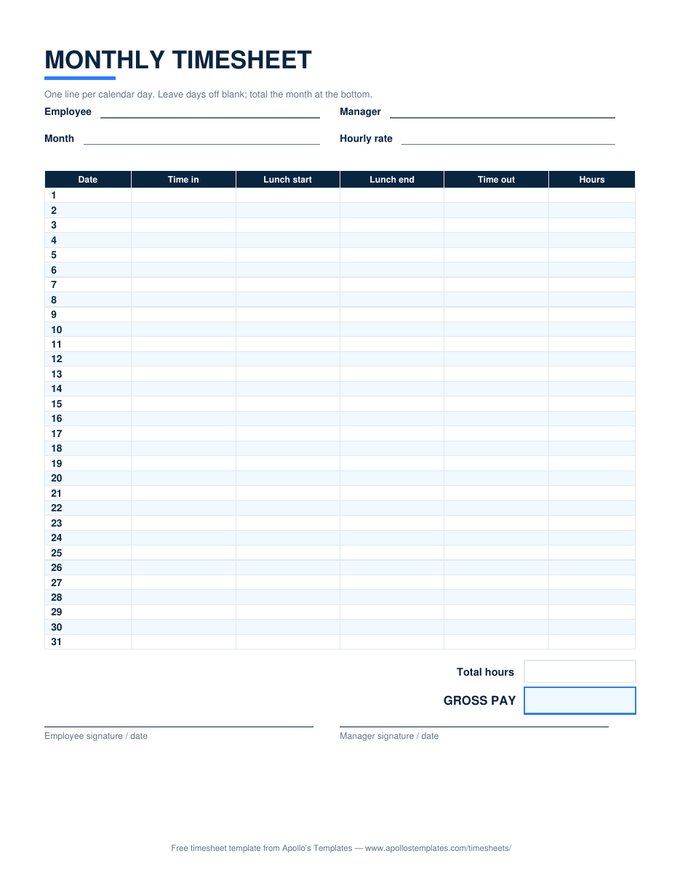
Monthly timesheet with 31 dated rows on one page, self-adjusting for short months, plus totals and gross pay

Monthly — 31 self-dating rows

A month of time tracking on one screen — enter the first date and the rows date themselves.
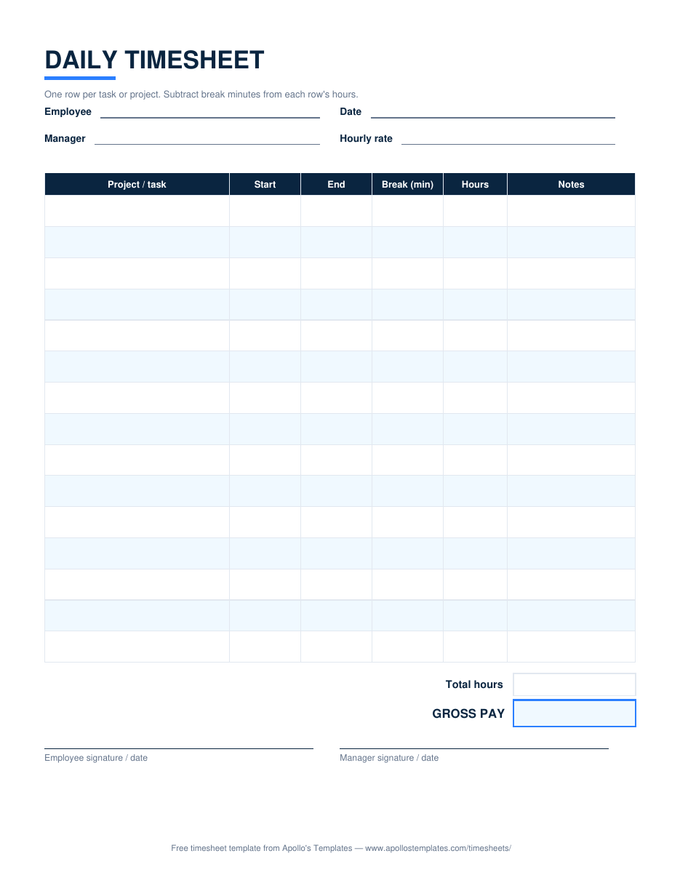
Daily timesheet with per-task rows for start, end, break minutes, computed hours, and notes

Daily — per-task time log

Task rows with start, end, and break minutes — the time log for freelance billing from anywhere.
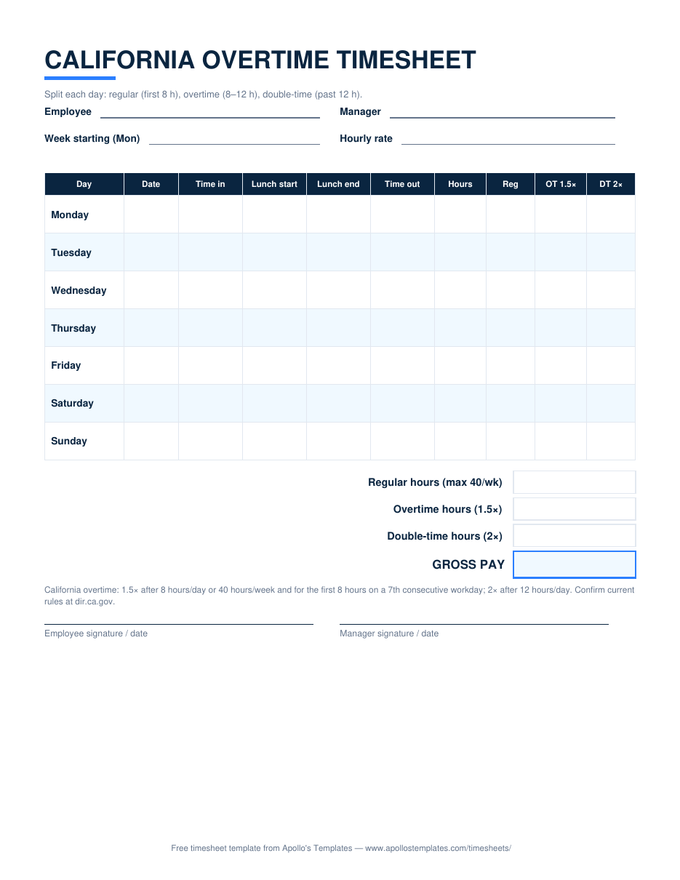
California overtime timesheet with daily regular, time-and-a-half, and double-time splits plus the weekly cap

California — daily OT & double-time

The three-tier daily split plus the weekly cap, calculating live in your Drive.
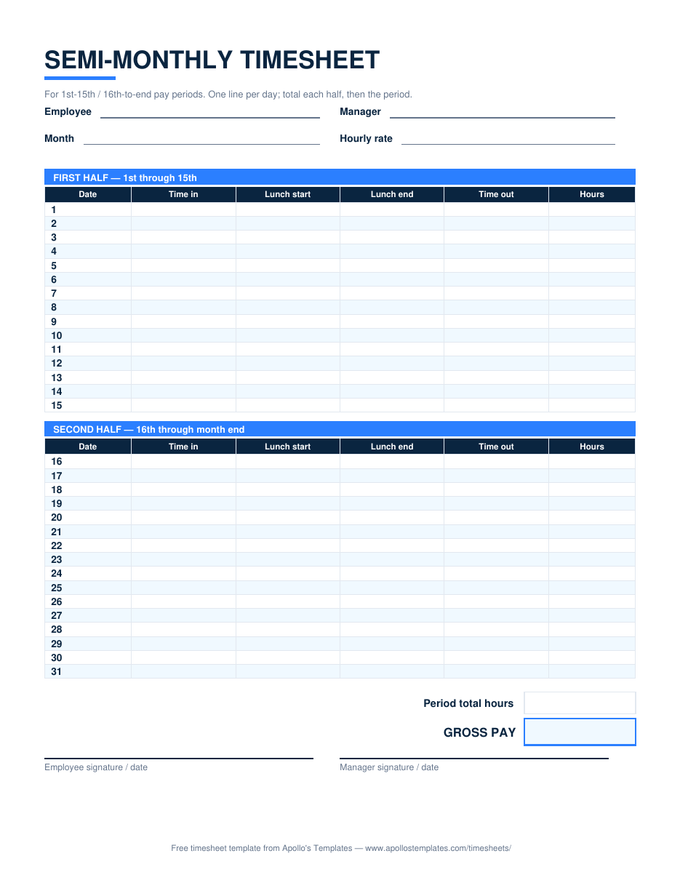
Semi-monthly timesheet with self-dating 1st-to-15th and 16th-to-end blocks and hours and pay totals

Semi-monthly — 1st–15th / 16th–end

Both half-month blocks date themselves in your Drive — for twice-a-month paydays.
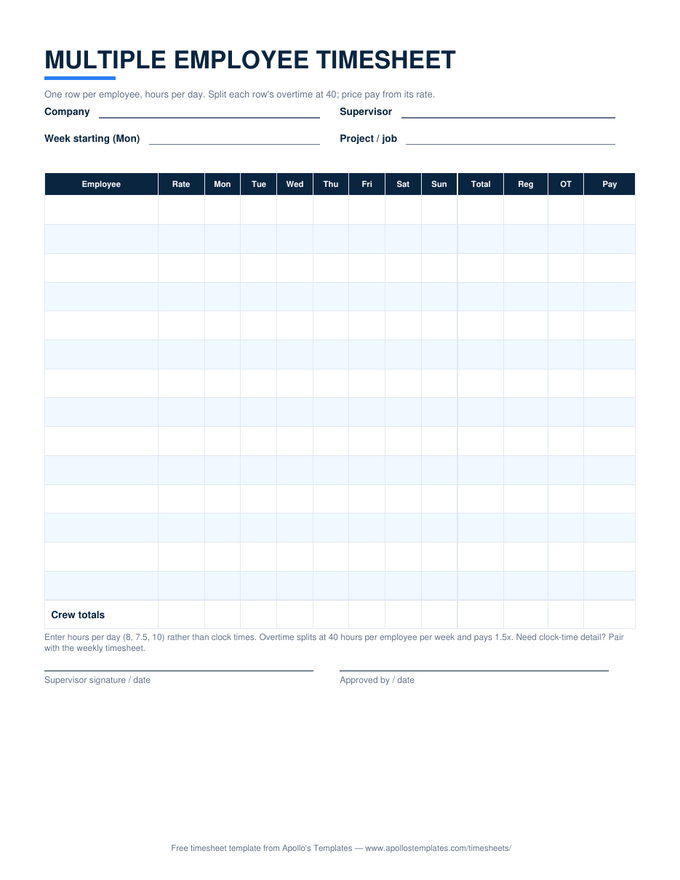
Multiple-employee timesheet with the crew's week in rows, hours per day, and overtime and pay per employee

Multiple employee — crew grid

Employees enter hours from phones; each row splits its own overtime as the foreman watches totals build.
Home care timesheet with visit times, services provided, miles driven, and client and aide signature lines

Home health aide — visit sheet

Log visits between clients from a phone; hours, miles, and pay total in your Drive.
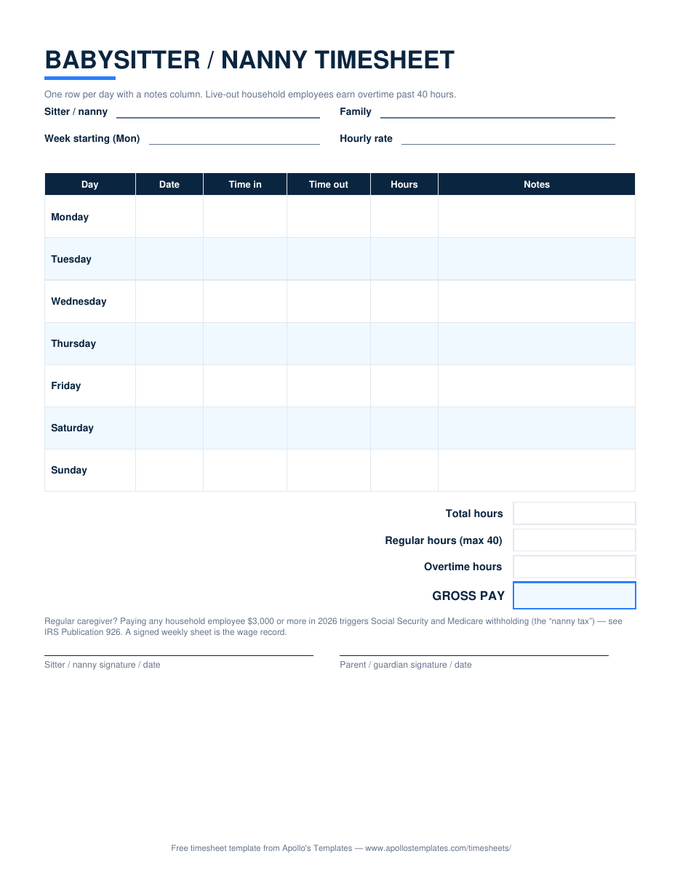
Babysitter timesheet with daily times, a notes column, overtime past 40 hours, and parent and sitter signature lines

Babysitter / nanny — with notes

The sitter logs times from a phone; the family watches the week's total build.
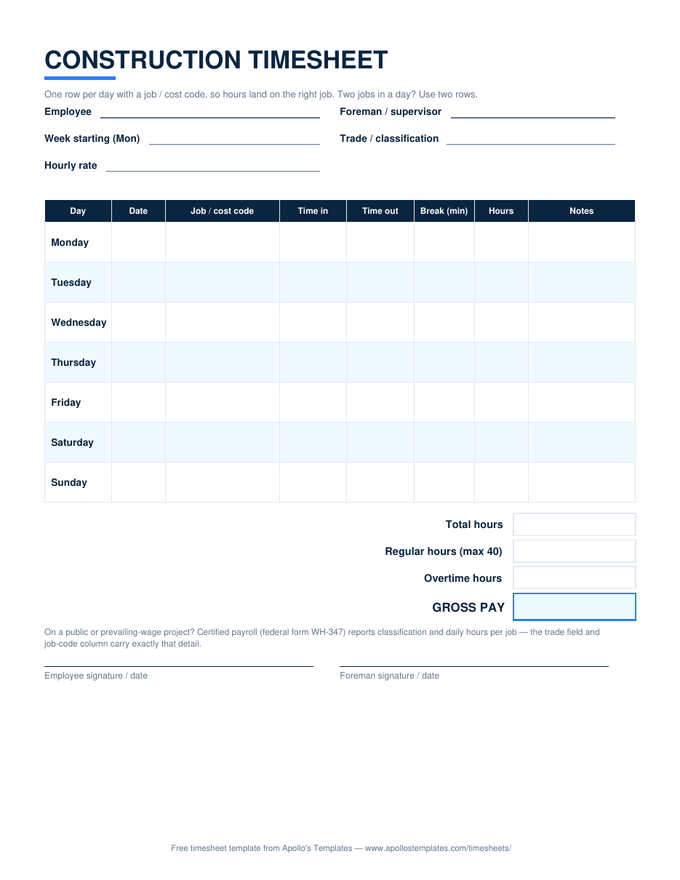
Construction timesheet with daily rows, a job and cost code column, break minutes, and overtime at 40 hours

Construction — job-coded days

Tailgate entries from the truck; hours land on the right job code before anyone drives home.
Why Sheets for time tracking

The shared-sheet workflow.

Paper timesheets have one failure mode — they’re wherever you aren’t. A Sheets copy shared with the right two people turns the timesheet into a small system: the employee enters times as they happen, the manager watches the totals build, and on payday the numbers are already added, already legible, already backed up in Drive’s version history. That version history doubles as an audit trail — every edit, timestamped, attributable.

When the period closes, File → Download → PDFproduces the frozen copy for the payroll file, and next period starts from a fresh copy of the template. Two clicks of ceremony, and your records satisfy the FLSA’s two-year retention rule without a filing cabinet.

The same math, offline
Excel Timesheet Templates
All eleven sheets as .xlsx downloads — identical formulas, no Google account.
Open
Start here
All Timesheet Templates
The whole library — weekly to monthly, PDF to Sheets — on one page.
Browse
Task-level tracking
Daily Timesheet
The per-task time log, ideal as a shared Sheets copy for freelance work.
Open

Frequently asked questions

How does the “Make a copy” flow actually work?
Each button above opens Google's copy page for that template. Click “Make a copy” and Google places a fully editable duplicate in your own Drive — formulas, formatting, and all. The original stays untouched on our side (it's read-only to the world), and your copy is completely yours: rename it, share it with your manager, make one per week. We never see your copy or your data; that's Google's mechanic, not ours.
Do I need a Google account, and is there any catch on your side?
You need a Google account because the copy has to save into somebody's Drive — that's Google's requirement, and any free Gmail account qualifies. On our side there is no catch: no signup with us, no watermark on the sheet, no trial that expires, no “premium version” with the formulas withheld. If you'd rather not involve Google at all, every card has a Download Excel button for the identical .xlsx.
Do the formulas work in the Google Sheets phone app?
Yes — the math runs server-side in Sheets, so entering a clock-out time on your phone updates the hours and pay totals the same as it would at a desktop. Entering times on a phone keyboard is honestly the clunkiest part: type them as 8:00 AM with the space, or set the sheet's locale time format once and use the keyboard's numeric row. A common crew pattern: employees enter times from phones during the week, the manager reviews totals from a laptop on Friday.
Should I make the copy in a personal or work Google account?
Whichever Drive should own the record — and it's worth deciding deliberately. If the timesheet is a payroll document for your employer, a work-account copy keeps it where the business controls retention when people leave. If you're a freelancer tracking billable hours across clients, your own account keeps your history yours. The one setup to avoid: the sole copy of a business's payroll records living in an employee's personal Drive.
Updated through September 2026