
50/50 raffle tickets
The self-funding fundraiser: sell numbered tickets, split the pot with the winning stub. These tickets are built for the treasurer as much as the winner — sequential numbers on both halves, buyer-info lines on the stub, and wording that states expect on a cash raffle.
The stub keeps the same number as the ticket. Buyer-info lines satisfy the states that require name, address and phone on the retained half.
100 tickets · Nº 001 through 100 · = 10 sheets of 10
Prints edge-to-edge on Avery 16154 tear-away stock (and 16795, 76154, 95288, 99154) — no cutting. Proof one page on plain paper first, hold it against the stock, and use “Flip stub end” or the nudge arrows if your printer lands a hair off. Print at 100% / Actual Size — never “Fit to page.”
10 vertical tickets per letter sheet — the Avery 16154 grid, edge to edge. Preview fonts are approximate — the PDF embeds the real ones.
Built for the cash box, not just the drum
A 50/50 is the one raffle where the accounting is the event. The pot is whatever the tickets brought in, so the treasurer needs to know — to the ticket — what was sold. That is what sequential numbering is for: tickets 001 through 250 at five dollars means $1,250 in the box and a $625 prize, and any gap in the sequence is a conversation, not a mystery.
Treasurer tip: selling at more than one table? Give each table its own prefix — A- and B- — and both sequences stay auditable without coordinating numbers across the room.
Because the prize is cash, 50/50s usually sit in the stricter half of each state's charitable-gaming rules — licenses at lower thresholds, more required wording on the face. The generator's fields cover the common requirements: organization name, price, drawing date, time and place, a need-not-be-present line, and an extra line for a license number.
A 50/50 raffle ticket template that is two-part, numbered and green
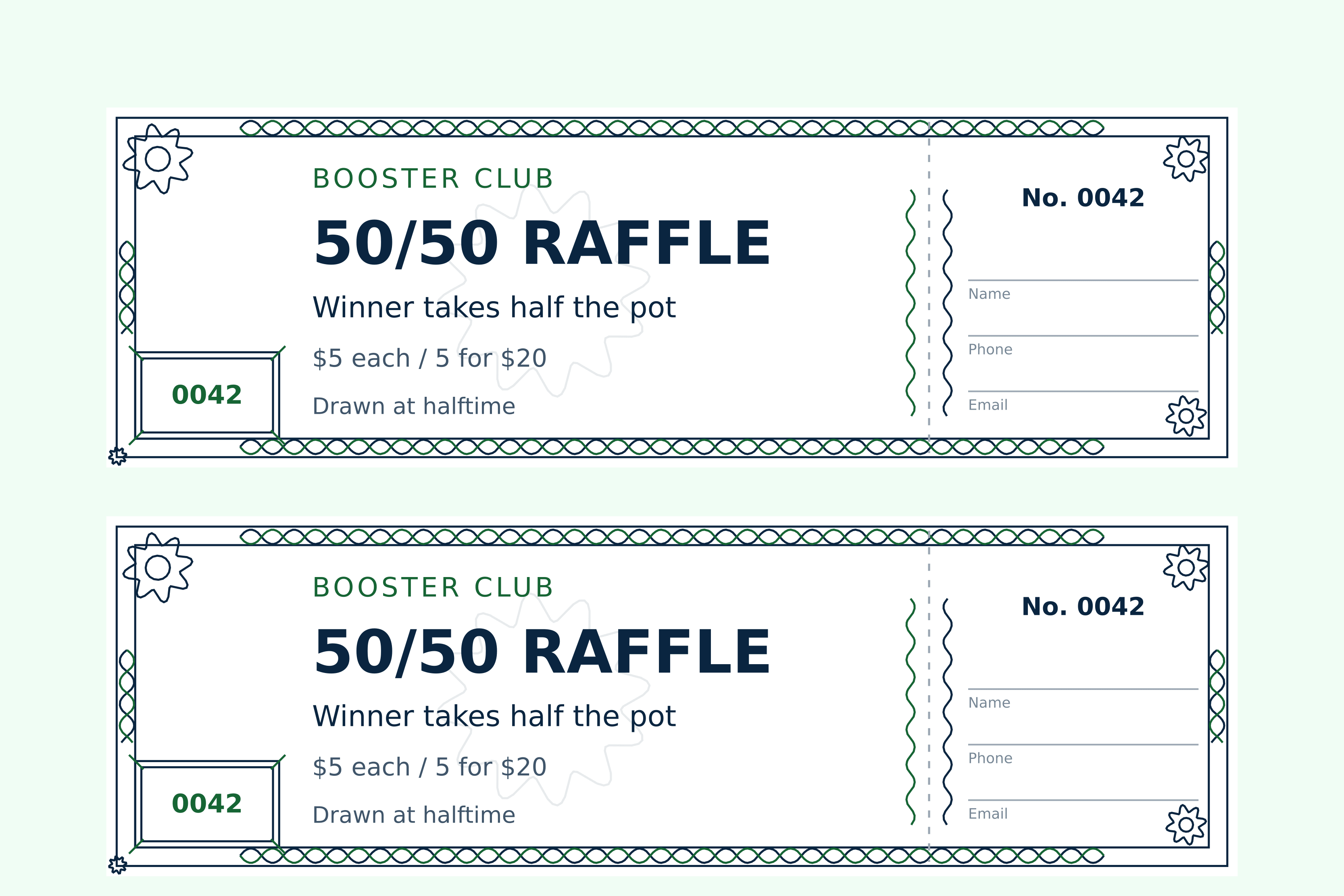
A 50/50 lives on its stubs: half the pot goes to whichever stub comes out of the drum, so the ticket has to be two-part and the two parts have to carry the same number. That is the default here. The Money style opens in green — the colour most clubs already associate with the cash draw — with a banknote-style border that makes the ticket look like it is worth something, and the stub has name and phone lines so the treasurer can reach the winner who left at halftime.
If you sell in strips, set the price line to “$5 each / 5 for $20” and the buyer keeps five consecutive numbers. If you would rather hand-write prices at the table, leave the field empty for blank 50/50 raffle tickets with the numbering intact. Related makers: Christmas raffle tickets for the December draw, diaper raffle tickets for showers, and the classic generator for any other wording.
Questions
How does a 50/50 raffle work?
Tickets are sold for a fixed price, the money goes into one pot, and at the drawing the winning stub takes half the pot — the other half stays with the organization. The prize funds itself, which is why 50/50s are the workhorse of booster clubs, legion halls and game-night fundraisers.
Why do 50/50 tickets need to be numbered?
Because the prize is cash, the paper trail matters more than in any other raffle. Sequential numbers on ticket and stub let the treasurer reconcile tickets sold against cash collected — if you sold numbers 001 through 250 at $5, there should be $1,250 in the box. Auditors, and several states' charitable-gaming rules, expect exactly that arithmetic.
What price should tickets be?
Most 50/50s sell at $1, $2 or $5, often with a bundle deal — "$5 each or 5 for $20" is common and the price field takes that wording as-is. Bundles move more tickets and grow the pot, which is the whole show in a 50/50.
Are 50/50 raffles legal?
In most states, yes — for qualified nonprofit organizations, sometimes with a license or registration depending on the prize total. A few states restrict or prohibit them outright. Because the prize is cash, 50/50s tend to sit in the stricter half of each state's raffle rules, so check your charitable-gaming office first. The extra line on the ticket takes a license number where one is issued.
Announce the pot as it grows?
Yes — it's the best sales tool a 50/50 has. Post the running total where tickets are sold; when the room hears the pot crossed $400, the line forms again. Numbered tickets make the running total trivial to compute: last number sold × price, divided by two, is the current prize.
Updated through September 2026.