




Apollo's Templates
HomeBudget Templates50/30/20
Three buckets, one rule

50/30/20 Budget Template

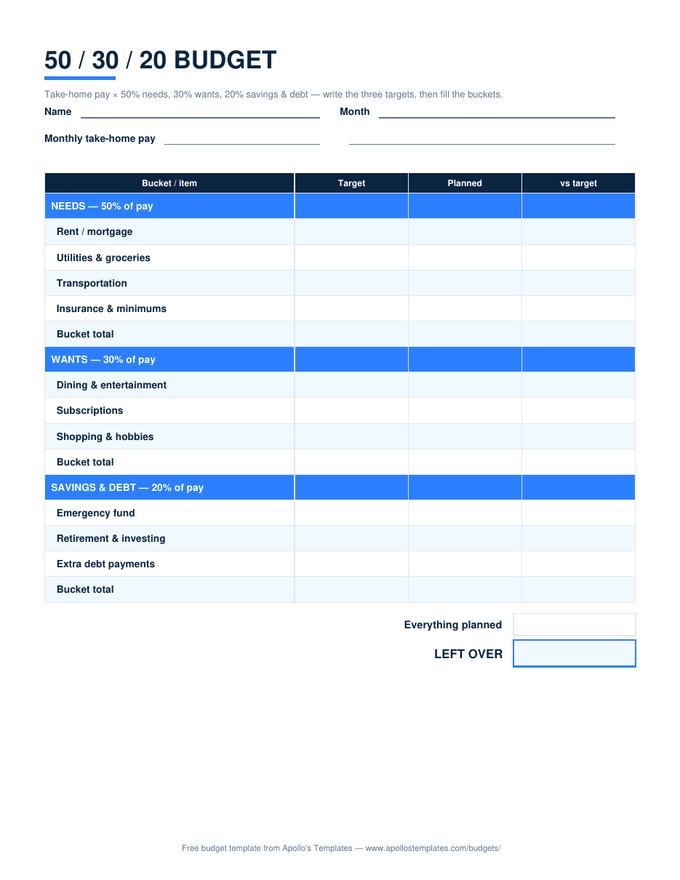
The 50/30/20 rule compresses budgeting into three numbers: half of take-home pay for needs, thirty percent for wants, twenty for savings and debt beyond the minimums. This sheet does the arithmetic \u2014 enter your pay once and the three targets set themselves \u2014 then lets each bucket show over or under as you fill in the real spending. It's the least paperwork that still counts as a plan, which is exactly why it's the right first budget for most people.

No download needed

Type your pay, read your plan.

Try it right here

The 50/30/20 calculator

Needs · 50%
$—
Rent, utilities, groceries, insurance, minimum debt payments, the commute.
Wants · 30%
$—
Dining out, entertainment, subscriptions, shopping, hobbies, travel.
Savings & debt · 20%
$—
Emergency fund, retirement, investing, extra debt payments.
The rule, computed

One sheet, every format.

Excel — targets set themselves

Take-home pay in, three targets out; every bucket totals itself and shows its distance from target.
Printable PDF preview
PDF

Printable PDF

The three buckets printed with target boxes — one multiplication, then a pen.
Download PDF

Word / Google Docs

The bucket layout as an editable table — write your three targets at the top monthly.
Worth knowing

The line between a need and a want is sharper than it feels.

The rule’s hard question isn’t math — it’s classification, and there’s a test that settles most of it: a need is what you must pay to keep life and obligations running at their current commitments— rent, utilities, groceries, insurance, minimum debt payments, the commute. Everything upgrading the experience is a want: the restaurant version of dinner, the faster phone, the streaming stack. Groceries are a need; DoorDash is a want wearing a need’s coat.

And the ratios are a starting posture, not a verdict. The rule’s originators — Elizabeth Warren and Amelia Warren Tyagi, in All Your Worth— built it as a balance test, and imbalance is information: needs at 65% in a high-rent city is a housing-market fact, not a personal failure, and the honest response is trimming wants toward twenty rather than abandoning the framework. Protect the 20% first; it’s the bucket your future self is standing in.

When you need the detail
Monthly Budget
Full categories with planned/actual — the microscope to this rule's compass.
Open
The strictest version
Zero-Based Budget
Beyond buckets: every single dollar assigned a named job.
Open
Just starting out
College Budget
The student version — semester math with aid and job income.
Open

Frequently asked questions

Which income number do I use — before or after taxes?
After-tax take-home, with one adjustment the rule's authors specify: if retirement contributions or health premiums come out of your paycheck before it lands, add them back conceptually when judging your savings bucket — a 401(k) contribution is 20%-bucket savings that already happened. In practice most people just use net pay and count payroll retirement as bonus savings beyond the 20%, which errs in the right direction.
Do minimum debt payments count as needs or savings?
Minimums are needs — they're obligations, and missing them has need-level consequences. Everything beyond the minimum is the 20% bucket doing its work: extra principal is functionally savings with a guaranteed return of your interest rate. This split matters practically, because it means a heavy debt load shows up as a swollen needs bucket (honest) rather than letting all debt payments masquerade as virtuous savings (flattering).
What if my needs are way over 50%?
Join the club — housing costs have pushed real-world needs to 55–65% for a lot of households, especially in big metros. The rule still earns its keep as a diagnostic: knowing needs run 62% tells you the squeeze must come from wants (toward 18%) rather than savings, and it tells you what a cheaper apartment or paid-off car would actually buy you in monthly freedom. A rule you're failing informatively beats a plan you're not keeping at all.
Is 50/30/20 enough, or do I need a full category budget?
It's enough when it's working — the rule deliberately trades precision for sustainability, and a sustained rough plan beats an abandoned precise one. Upgrade to the category sheets when the buckets stop answering your questions: wants chronically over but you can't say why (the monthly sheet's categories will), money evaporating between buckets (zero-based will find it), or paycheck timing causing the trouble rather than amounts (the paycheck budget). Many people run 50/30/20 as the yearly shape and a category sheet inside it.
Updated through August 2026