




Apollo's Templates
HomeBudget TemplatesZero-Based
Make it hit zero

Zero-Based Budget Template

Zero-based budgeting runs on one sentence: income minus every planned dollar equals exactly zero. Not because you spend it all \u2014 savings, giving, and the buffer are jobs too \u2014 but because a dollar without a job gets one assigned by whatever catches your eye first. The Excel version keeps a live LEFT TO BUDGET line that counts down as you assign; when it reads $0.00, the plan is finished and every dollar knows where it's going.

Every dollar, one job

One sheet, every format.

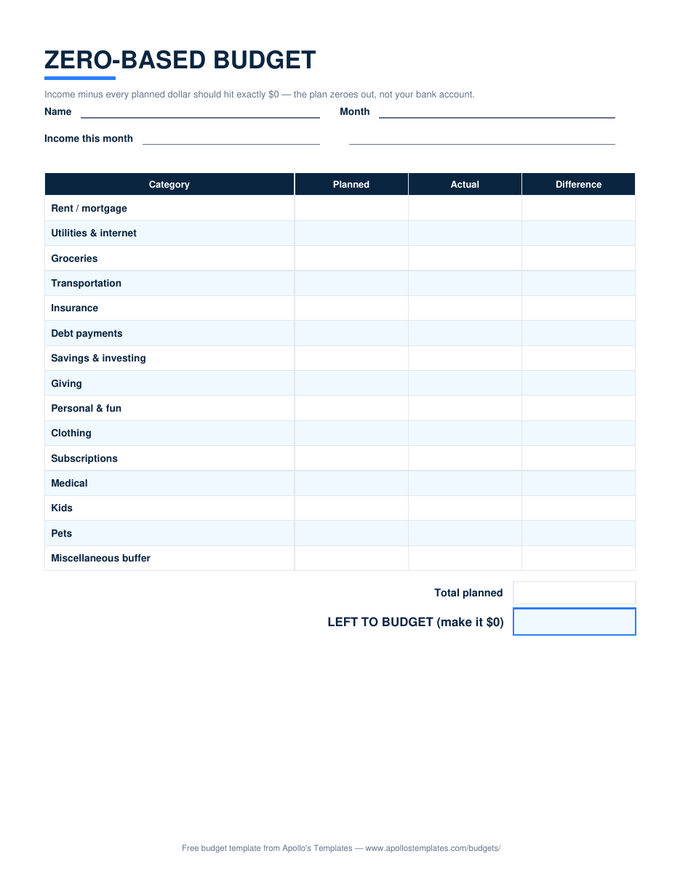
Excel — the $0.00 check line

Fifteen jobs for your income with a LEFT TO BUDGET line that computes live — the plan is done when it hits zero.
Printable PDF preview
PDF

Printable PDF

The give-every-dollar-a-job list on paper — pencil, eraser, and a zero at the bottom.
Download PDF

Word / Google Docs

The job list as an editable table — rename jobs to match your month before printing.
Worth knowing

Zero the plan, not the bank account.

The method’s name misleads a lot of first-timers: nothing about zero-based budgeting requires your account to hit zero — only the unassigneddollars do. A month that assigns $800 to savings and $170 to a miscellaneous buffer is thoroughly zero-based; the money has jobs, and two of the jobs are “stay.” The discipline is in the assignment, not the spending.

Why it works when gentler methods don’t: leftover money doesn’t survive contact with a month. Budgets that plan the big categories and leave $600 “unbudgeted” reliably end the month at zero anyway — the money finds small exits. Zero-based closes the exits in advance by making even slack explicit. That thoroughness costs something (you will name a number for fun, and for the buffer), which is why it’s the method of choice for evaporating-money seasons and less so for people whose budget already behaves.

The same rule, per check
Paycheck Budget
Zero-based applied to each paycheck, with the bill calendar attached.
Open
Gentler structure
Monthly Budget
Planned/actual with groups — margins allowed.
Open
Zero-based, in cash
Cash Envelope Printables
Give the spending jobs physical envelopes — empty means done.
Open

Frequently asked questions

What if LEFT TO BUDGET won't reach zero?
Positive remainder is the easy case — dollars still waiting for jobs. Assign them somewhere deliberate: extra debt, a sinking fund, next month's buffer, honest fun money. Negative is the harder, more valuable signal: you've planned more than the month's income, and the sheet is telling you before the overdraft does. Shrink the adjustable jobs until zero returns — and if the only lines left are rent and groceries, the sheet has just documented an income problem, which no budget method fixes but every honest one reveals.
Is this the Dave Ramsey / EveryDollar method?
Zero-based budgeting is the method those tools popularized, yes — the give-every-dollar-a-job principle long predates any brand, coming from corporate budgeting where every line must justify itself from zero. This sheet implements the principle without a subscription or an ecosystem: income at the top, jobs below, a live zero line. If you're following any zero-based program, this sheet is compatible paper for it.
How is zero-based different from a regular monthly budget?
A regular budget plans the categories that matter and lets the remainder float; zero-based forbids the float. Practically the sheets look similar — the difference is one line and one obligation: LEFT TO BUDGET exists and must reach zero, meaning savings, giving, buffer, and fun all get named numbers instead of inheriting whatever remains. It's the difference between a plan with a margin note and a plan with no margins.
What's the miscellaneous buffer for — isn't that cheating?
It's the opposite: honesty codified. Every month contains something no category predicted — the school fundraiser, the parking meter, the gift you forgot. A named buffer ($100–200 for most households) absorbs reality without breaking the plan, and because it's a job like any other, overshoot is visible: a buffer that empties by the 10th three months running is telling you a real category is missing. Unbudgeted slack hides that signal; a buffer measures it.
Updated through August 2026