



Apollo's Templates
HomeBudget TemplatesPaycheck
Budget when the money lands

Biweekly & Paycheck Budget Template

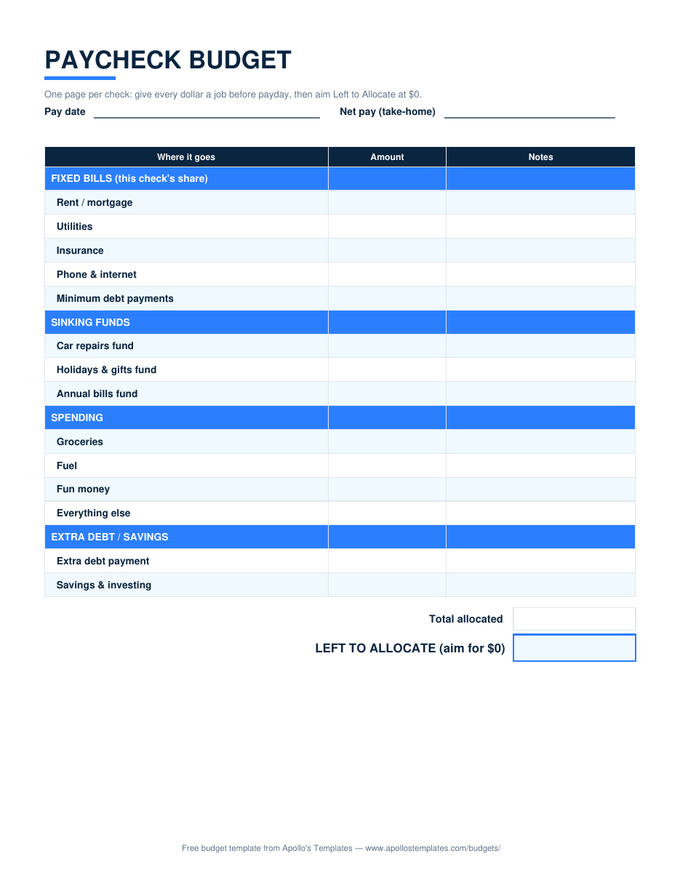
If you're paid every two weeks, the calendar month is a fiction your bills believe in and your paychecks don't. This template budgets the way the money actually arrives: a plan sheet per paycheck where every dollar gets a job before payday, a bill calendar that assigns each bill to the check that pays it \u2014 with the split computed automatically \u2014 and a sinking-funds tracker that turns December and car trouble into line items instead of emergencies.

The four-sheet system

One sheet, every format.

Excel — four working sheets

Two per-check plan sheets driving LEFT TO ALLOCATE to $0, a bill calendar with per-check totals, and sinking funds.
Printable PDF preview
PDF

Printable PDF

Two printed pages: the per-check plan (print one per payday) plus the bill calendar and fund tracker.
Download PDF

Word / Google Docs

The per-check plan as an editable page — pre-type your bills once, print each payday.
Worth knowing

The three-paycheck months are the whole trick.

Biweekly pay means 26 checks against 12 months — which is why two months a year quietly contain a third paycheck. Families who budget monthly never see them; the extra check dissolves into the same month it arrived. Budget per check and those two paychecks become visible, unclaimed, and enormous: a 27th and 28th check’s worth of margin every year, arriving on a schedule you can circle on a calendar in January.

The bill calendar carries the other half of the fix. Most biweekly stress isn’t about the total — it’s that the rent check and the car-payment check aren’t the same check, and nobody wrote that down. Assign every bill to check one or check two, read the split the sheet computes, and if one check is drowning: due dates move. Most billers will shift a date for the asking, and one phone call can rebalance an entire year of paydays.

The same rule, monthly
Zero-Based Budget
Every dollar a job across a whole month instead of per check.
Open
Steer the variable weeks
Weekly Budget
Week columns for groceries and fuel between paydays.
Open
Cash for the spending lines
Cash Envelope Printables
Withdraw the spending categories and stuff the envelopes each payday.
Open

Frequently asked questions

Biweekly and semimonthly aren't the same — which does this fit?
Both, with one difference in rhythm. Semimonthly (paid the 1st and 15th, 24 checks a year) maps perfectly: two plan sheets, two halves of the bill calendar, done. Biweekly (every other Friday, 26 checks) runs the same two-sheet cycle for ten months — and then twice a year a third check lands in one month. Plan that check on a fresh copy of the plan sheet and point it at goals; it's the bonus round, not a rounding error.
How much goes into sinking funds per paycheck?
Work backwards from the bills you already know are coming. Car insurance $600 twice a year is $46 a check; holiday spending $800 is $31 a check starting in January; the inevitable car repair gets whatever history says — $50 a check is a common start. The tracker's 'Still to save' column shows each fund's gap so you can throttle per-check amounts honestly. The psychological shift is the point: annual bills stop being emergencies and become subscriptions you pay yourself.
What if a paycheck can't cover its bills?
First, read the bill calendar's per-check split — the fix is usually that one check carries too many due dates, and moving one or two (most billers will) rebalances it. If both checks are genuinely underwater after fixed bills, the plan sheets make the deficit visible line by line, which is where the harder but clearer conversations start: which sinking funds pause, which spending lines shrink, whether the debt minimums need a renegotiation. A visible $80 shortfall beats an invisible overdraft.
Why does LEFT TO ALLOCATE want to be $0?
Because an unassigned dollar is a decision postponed until a store makes it for you. This is zero-based budgeting applied per paycheck: net pay minus every job — bills, funds, spending, extra debt — should land on exactly zero. If it's positive, give the remainder a job (even 'fun money' is a job); if negative, the plan is spending money the check doesn't have, and better to know Tuesday night than at the register.
Updated through August 2026