




Apollo's Templates
HomeBudget TemplatesWeekly
Seven days at a time

Weekly Budget Template

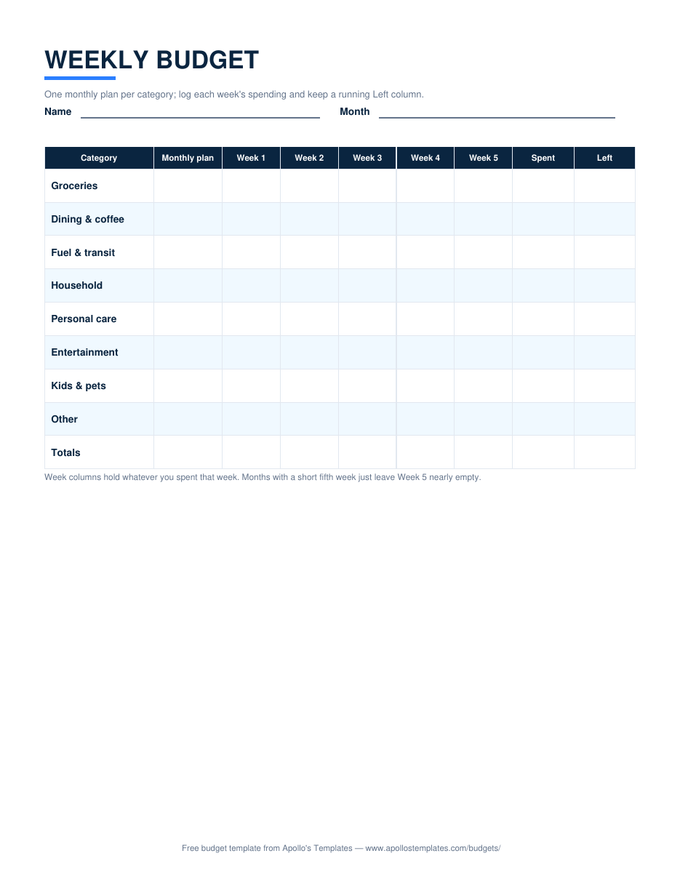
A month is too long to steer. This sheet keeps the monthly plan \u2014 one number per category \u2014 but tracks the spending in week columns, so course corrections happen four or five times a month instead of once in the post-mortem. Overspend groceries in week one and the Left column says so while there's still a month to fix it. The variable categories live here; the fixed bills don't need weekly watching.

The short-cycle sheet

One sheet, every format.

Excel — five weeks across

Plan monthly, log weekly — Spent sums the weeks and Left counts down from the plan per category.
Printable PDF preview
PDF

Printable PDF

The week-columns grid printed — one honest number per category per week.
Download PDF

Word / Google Docs

The same grid as an editable table for a weekly typed check-in.
Worth knowing

Weekly is the natural rhythm of variable spending.

Fixed bills happen monthly; life happens weekly. Groceries, fuel, eating out, the odds-and-ends run — these arrive in seven-day cycles, which is why a monthly food number always feels abstract until it’s suddenly gone. Dividing by weeks turns one unsteerable number into four checkpoints: $600 for groceries is vague, but “$150 this week and we’re at $180 by Thursday” is a decision you can still make.

The workflow that makes this sheet stick: a two-minute Sunday close. Total the week’s spending per category (bank app, receipts, or memory — imperfect is fine), write it in the week column, glance at Left. That’s the whole ritual. It’s the budgeting equivalent of a weekly weigh-in — frequent enough to steer, infrequent enough to sustain.

The full month view
Monthly Budget
Grouped categories with planned/actual for everything, fixed bills included.
Open
Paid every two weeks
Paycheck Budget
Plan each check as it lands instead of an abstract month.
Open
The weekly headliner
Grocery Budget
The grocery-only version with per-trip columns.
Open

Frequently asked questions

Which categories belong on a weekly budget?
The variable ones — groceries, dining and coffee, fuel, household odds-and-ends, entertainment, the kid-and-pet miscellany. Rent, insurance, and subscriptions are monthly creatures; tracking them weekly just clutters the grid with zeros. A good test: if the category's spending arrives more than once a week, it belongs here. Most people run this sheet for six to eight variable categories alongside a monthly sheet (or autopay) for the fixed ones.
How do I split a monthly plan across weeks?
You don't have to — that's the design. The plan stays monthly (one number per category) and the Left column simply counts down as the weeks spend it, which handles naturally lumpy categories: a big week-one grocery stock-up followed by three lighter weeks looks fine, because Left tracks the month, not the week. If you want per-week pacing anyway, divide the plan by 4.3 in your head and treat it as a soft weekly speed limit.
What about months with five weeks?
The grid has a fifth column, and the honest accounting is that a fifth week is partial — a month is 4.3 weeks on average. Log whatever the stub week spends in Week 5 and let the monthly totals judge; leaving it near-empty in four-week months is expected, not an error. People paid weekly sometimes flip the logic and treat the occasional fifth paycheck as bonus savings — the weekly grid makes those months easy to spot.
Is weekly budgeting better than monthly?
For steering variable spending, usually — the feedback loop is four times faster, and most budget blowouts are variable-spending blowouts. For the overall plan, monthly still wins because income and fixed bills are monthly. That's why this sheet is a hybrid: monthly plan, weekly tracking. If you want the fully weekly version of life — paid every Friday, bills mapped to paychecks — the paycheck budget is the purer tool.
Updated through August 2026