




Apollo's Templates
HomeBudget TemplatesGrocery
The cart, contained

Grocery Budget Template

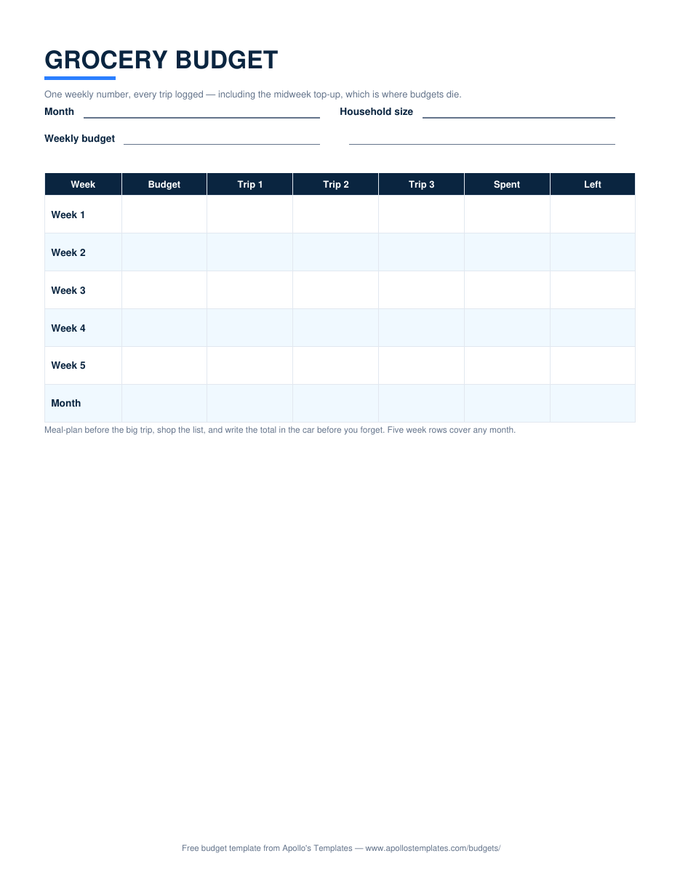
Groceries are where budgets go to die \u2014 the biggest variable category in most households, spent across a dozen small decisions a week. This sheet fights back with structure: one weekly number, three trip columns per week (because the midweek top-up is the real killer), and Spent and Left that compute per week while the month total watches. Household size in the header turns the result into a per-person number you can actually benchmark.

One category, done right

One sheet, every format.

Excel — trips, weeks, month

Set the weekly budget once; log each trip and the week's Left — plus a per-person-per-week figure — compute live.
Printable PDF preview
PDF

Printable PDF

The grid on paper — write the trip total in the parking lot before it fades.
Download PDF

Word / Google Docs

The same grid as an editable table with your weekly number pre-typed.
Worth knowing

The midweek top-up is the whole ballgame.

Almost nobody blows a grocery budget at the big weekly shop — that trip has a list, a cart, and a total you watch. The budget dies Tuesday: the “just milk” run that leaves at $32, twice a week, invisibly. That’s $250 a month that never appears in anyone’s mental grocery number, which is why this sheet has three trip columns per week instead of one — logging the top-ups is the intervention.

The other lever is sequencing: plan meals first, then the list, then the store. A budget applied to an unplanned cart is a speed limit with no road — meal planning is what converts the weekly number from a hope into a list length. Pair the two habits and the per-person figure at the bottom becomes genuinely steerable; USDA’s food-plan tables make a decent sanity check for what per-person ought to run at your household size.

Groceries in cash
Cash Envelope Printables
The classic envelope category — when the envelope's empty, the week is done.
Open
All the variable lines
Weekly Budget
The same week-column treatment for fuel, dining, and the rest.
Open
The whole household
Family Budget
Where the grocery line lives among the other twenty.
Open

Frequently asked questions

What's a reasonable weekly grocery budget?
It varies too much by region, household size, and diet for one number, but the per-person-per-week figure this sheet computes gives you a comparable metric: many US households land between $60 and $110 per person per week at 2026 prices, cooking mostly at home. The USDA publishes monthly food-plan costs at four spending levels (thrifty to liberal) that make a fair external benchmark. The practical approach: log two honest weeks, set the budget 10% below your actual, and tighten from success.
Do restaurants and coffee count as groceries?
Keep them out — this sheet works because it isolates one behavior: food that comes home in bags. Dining out responds to different pressures (social plans, energy, convenience) and belongs on its own line in the monthly or weekly budget. The one gray zone worth a rule: prepared food from the grocery store counts as groceries here (it's in the cart, on the receipt), even though it's nutritionally takeout wearing a store brand.
How does the per-person number work with kids?
Count everyone who eats as a whole person and accept that it's approximate — a teenager out-eats an adult, a toddler doesn't, and the average washes out usefully at the month level. The figure's job isn't precision; it's comparability across months ('why did per-person jump $14 in July?' — oh, the cousins visited) and a sanity check against benchmarks. Households with big age spreads sometimes count little kids as half; pick a convention and keep it.
Five weeks, four weeks — how do I read the month row?
The month row totals whatever the weeks actually spent and compares against five times the weekly budget, so four-week months will show naturally 'under' — read the weekly Left columns for the real verdict, and the month row for the trend. If you'd rather have a calendar-true monthly figure, multiply your weekly budget by 4.33 mentally; the sheet deliberately keeps the arithmetic visible instead of hiding a conversion factor.
Updated through August 2026