




Apollo's Templates
HomeBudget TemplatesFamily
The household huddle

Family & Household Budget Template

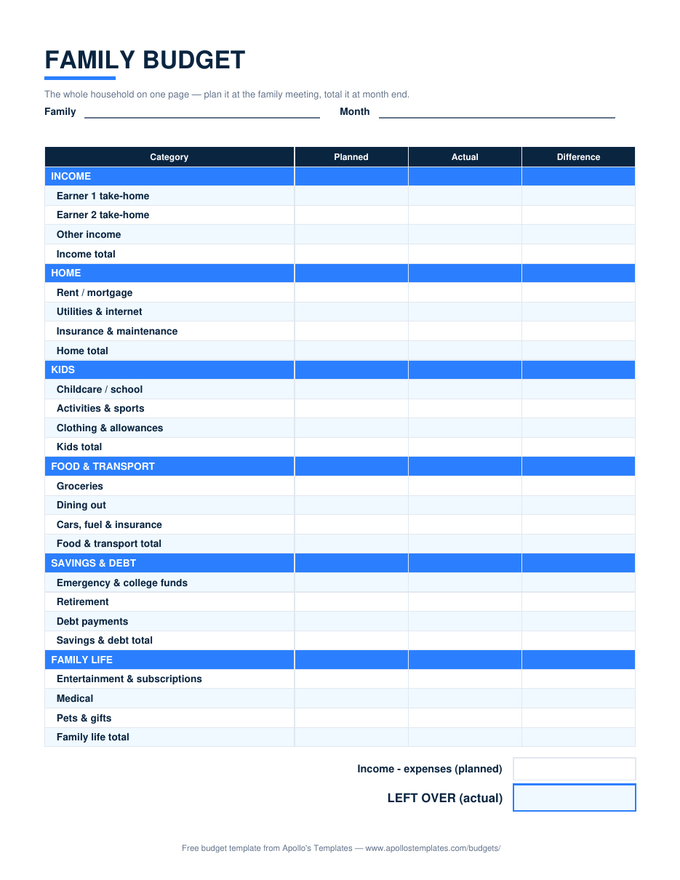
A household's money has more moving parts: two incomes, childcare that costs like a second rent, activity fees, the pets, the gifts. This sheet gives the family all of it on one page \u2014 an income block for both earners, kids' categories that most budgets forget, and the planned/actual/difference math that turns the monthly money conversation from an argument about memory into a look at the same numbers.

The whole house, one sheet

One sheet, every format.

Excel — the household ledger

Both incomes, six category groups including KIDS, and the family LEFT OVER computed in planned and actual.
Printable PDF preview
PDF

Printable PDF

The household month printed for the corkboard — plan it together with a pen on Sunday night.
Download PDF

Word / Google Docs

An editable table the family can adapt — add a column per kid, a row per activity.
Worth knowing

The family meeting is the feature.

Couples don’t usually fight about money — they fight about surprises. The sheet’s real product isn’t the arithmetic; it’s the fifteen-minute monthly conversation where both adults look at the same Planned column before the month starts and the same Difference column after it ends. Money decided together in advance stops being ammunition later.

Two structural notes from how families actually use these: give each adult a personal line that needs no justification — a fun-money row per person prevents more arguments than any category discipline — and put the kids’ activity costs in their own group rather than buried in “entertainment,” because watching KIDS become the second-biggest group is how families plan for it instead of being ambushed seasonally.

Just the two columns
Monthly Budget
The general-purpose month, lighter on household structure.
Open
The grocery line, tamed
Grocery Budget
The family sheet's biggest variable, contained week by week.
Open
Kid leaving the nest
College Budget
The semester sheet for the student — parents and student see the same numbers.
Open

Frequently asked questions

How should two earners split the budget?
The sheet deliberately doesn't take a side — both incomes land in one block and the household plans as a unit, which is the most common approach. Couples who keep proportional finances (each contributes by income share) still budget the shared categories here, then apply the split to the LEFT OVER and personal lines. The one pattern that reliably fails is budgeting separately and hoping the halves add up; whatever the split, plan on one page.
What belongs in the KIDS group versus the family groups?
KIDS holds the costs that exist because the children do: childcare and school, activities and sports, their clothing and gear, allowances. Groceries stay in food (everyone eats), the bigger car stays in transportation. The point of the split is planning visibility — childcare alone often rivals housing, and activity fees arrive in seasonal waves — not accounting purity. If a cost is ambiguous, put it where you'd want to see it grow.
How do we budget for irregular family costs — camps, holidays, back-to-school?
Twelve-month them. Summer camp at $1,200 is a $100 monthly line all year, not a June crisis; holidays and back-to-school work the same way. Give each a row (the Gifts & giving and Activities rows are natural homes) and plan the monthly slice even in months you spend nothing — the Difference column will show those months positive and the spike months negative, netting honest across the year. Families on biweekly pay often pair this sheet with the paycheck budget's sinking-funds tracker.
Should the kids see the budget?
Age-appropriately, yes — and the paper version helps. A teenager who sees that their travel team costs what the family spends on groceries in a month learns more about money than any allowance lecture teaches; a printed sheet on the corkboard makes the household's choices ordinary instead of secret. Plenty of families keep two prints: the full sheet for the adults, and the KIDS group posted where the kids can see what their season costs.
Updated through August 2026