




Apollo's Templates
HomeBudget TemplatesCollege
Semester math

College Student Budget Template

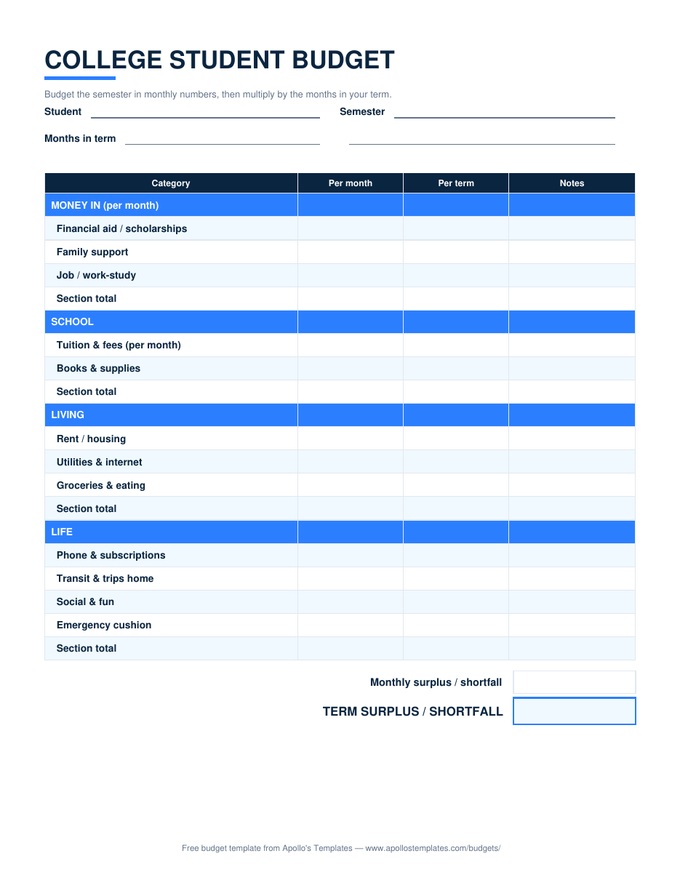
College money arrives in lumps \u2014 an aid disbursement in August, family help monthly, a job paying weekly \u2014 and leaves in lumps too. This sheet flattens the chaos to a monthly number per line, then multiplies by the months in your term so the semester total stares back before the semester starts. A shortfall discovered in September is a work-study application; the same shortfall in November is a crisis.

The student sheet

One sheet, every format.

Excel — monthly × term

Enter monthly numbers and your term length once — per-term columns and the TERM SURPLUS line compute themselves.
Printable PDF preview
PDF

Printable PDF

The semester sheet printed for the dorm corkboard — per-month and per-term columns side by side.
Download PDF

Word / Google Docs

The semester layout as an editable table — useful for financial-aid office conversations.
Worth knowing

Run the term line before the term runs you.

The single most valuable number a student can compute in week one is TERM SURPLUS / SHORTFALL — everything coming in for the term minus everything going out. Positive means breathe. Negative in September is a solvable problem with a semester of runway: more work-study hours, a books-cost appeal, a call home with actual numbers instead of vibes. The identical number discovered at Thanksgiving has none of those options left.

One honest accounting trick makes the sheet work: lump sums get divided by the months in the term. Aid that arrived as $6,000 in August is $1,500 a month on a four-month term; tuition paid up front is a monthly line the same way. It feels artificial exactly until midterms, when the students who divided still have grocery money and the students who didn’t are discovering that August generosity was actually November’s rent.

First real paycheck
50/30/20 Budget
The three-bucket rule — the natural graduation from the semester sheet.
Open
The food line
Grocery Budget
Week-by-week containment for the category students blow first.
Open
Spring break, solvent
Travel Budget
Plan the trip against a real number before booking anything.
Open

Frequently asked questions

How do I budget an aid refund that arrives all at once?
Divide it by the months in your term the day it lands, and treat only that month's share as spendable — the sheet's per-month column is built for exactly this entry. A $4,800 refund on a four-month term is $1,200 a month, not a windfall. The practical guard: park the balance in a savings account and move one month's share over on the first of each month, which turns discipline into a transfer instead of a daily decision.
What counts as income for a student budget?
Everything that actually arrives during the term, monthly-ized: aid and scholarship disbursements (divided across the term), regular family support, job or work-study pay at realistic hours, and recurring side income. Loans belong in income for cash-flow honesty — they pay real rent — but it's worth a row note distinguishing them, because a term 'surplus' built on loan dollars is borrowing, not margin. Don't count hoped-for overtime or maybe-gifts; the sheet is for money with a date on it.
Semester, quarter, or summer term — does the math change?
Only the one number: months in term. Four for a typical semester, about 2.5 for a quarter, two or three for summer — every per-term column recomputes from it automatically. Quarter-system students should budget slightly harder in week one, since the shorter runway means a shortfall has less time to be fixed; the same $400 gap is a different problem across ten weeks than sixteen.
What do students always forget to budget?
The one-time-but-every-term costs: course materials beyond textbooks (lab fees, software, art supplies), the trips home at breaks, the roommate's birthday, printing, and the emergency cushion that turns a dead laptop charger into an annoyance instead of a missed deadline. The sheet ships with 'Trips home' and 'Emergency cushion' rows deliberately — the $50-a-month cushion is the line most likely to save a semester, and the least likely to appear in a first draft.
Updated through August 2026