




Apollo's Templates
HomeBusinessExpense Report TemplatesContractor
Expenses you bill back

Contractor Expense Report Template

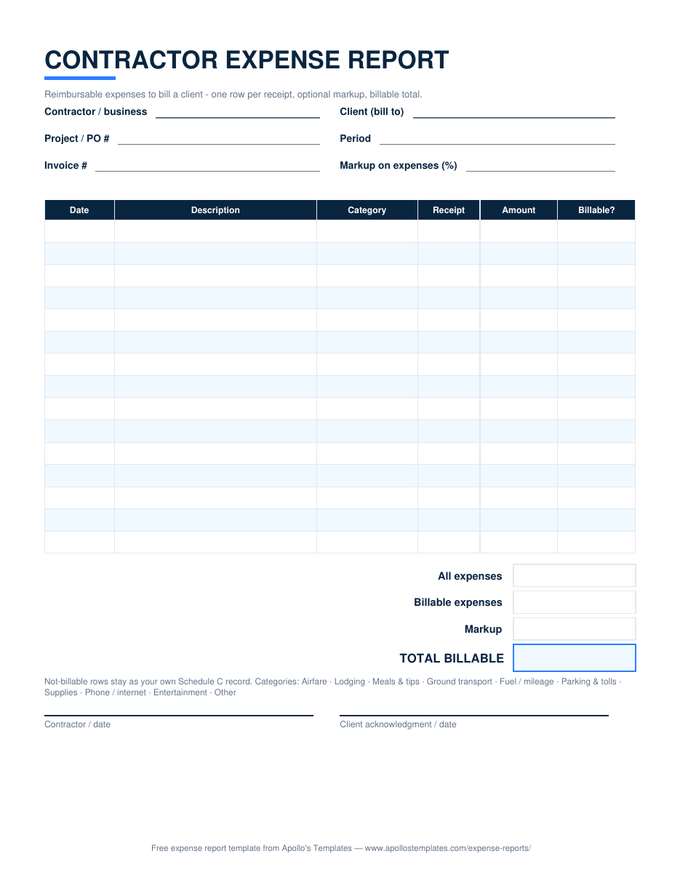
Contractors don't get reimbursed \u2014 they bill. This sheet turns a week or a project's receipts into the expense lines on an invoice: one row per receipt, a billable flag, an optional markup percent, and the total billable to the client, with the not-billable rows kept on the same page as your own Schedule C record. The client-acknowledgment line gets the expenses agreed before the invoice goes out.

Three formats

Billable expenses, three ways.

Excel — billable total computes

Fifteen rows with category, receipt, and billable dropdowns; billable subtotal, markup, and total billable compute; all-expenses total kept for your own books.
Contractor expense report with receipt and billable columns, a markup percent, and the total billable to the client
PDF

Printable PDF

The job-site version — fill it as receipts come in, get the client's initials, attach it to the invoice.
Download PDF

Word (.docx)

Editable for contractors who type the expense schedule into a proposal or invoice packet.
Worth knowing

Get expenses acknowledged before they become an invoice dispute.

The invoice line that gets questioned is almost never the labor — it’s the $340 of materials the client didn’t know about until the bill arrived. A weekly expense sheet with the site lead’s initials on it settles that in advance: the expenses are agreed, the receipts are attached, and the invoice just totals what was already approved.

Keep the sheet even on fixed-price jobs where nothing is billed back. The not-billable total is your real cost of the job, and the next fixed price you quote is only as good as the expense record from the last one.

Put it on the bill
Hourly Invoice Template
Dated sessions times rate — add the billable expenses as lines.
Open
Hours behind the expenses
Contractor Timesheet
Job, clock times, hours that total to an amount to invoice.
Open
Employee version
Expense Reimbursement Form
The out-of-pocket form for employees under an accountable plan.
Open

Frequently asked questions

Should contractors mark up reimbursable expenses?
Only if the contract says so — and many do, typically 5–15%, covering the carrying cost and the admin of buying on the client's behalf. Whatever the agreement, this sheet prints the markup percent so it's never a surprise. Set it to zero to pass expenses through at cost, which is the norm when the client pre-approves purchases.
Are reimbursed expenses taxable income for a contractor?
Yes — expense reimbursements from clients are part of your gross receipts on Schedule C, and the underlying expenses are deductible against them. The two net out, but both have to be recorded, which is why the sheet totals all expenses and billable expenses separately. Your accountant wants both numbers; keep the receipts either way.
How is this different from the employee reimbursement form?
Direction of the money and the tax treatment. An employee's reimbursement under an accountable plan is tax-free and comes from an employer; a contractor's billed expenses are revenue from a client. The employee form has an approval signature; this one has a client acknowledgment and an invoice number, and it pairs with the hourly invoice rather than with payroll.
What belongs in the not-billable rows?
Costs the contract doesn't cover but your business incurred anyway — the tool you bought, the mileage the client won't pay, the software subscription. They don't go on the invoice, but they're deductions, and recording them next to the billable ones is how contractors stop losing them at tax time.
Updated through September 2026