




Apollo's Templates
HomeBusinessInvoice TemplatesHourly
Time, priced

Hourly Invoice Template

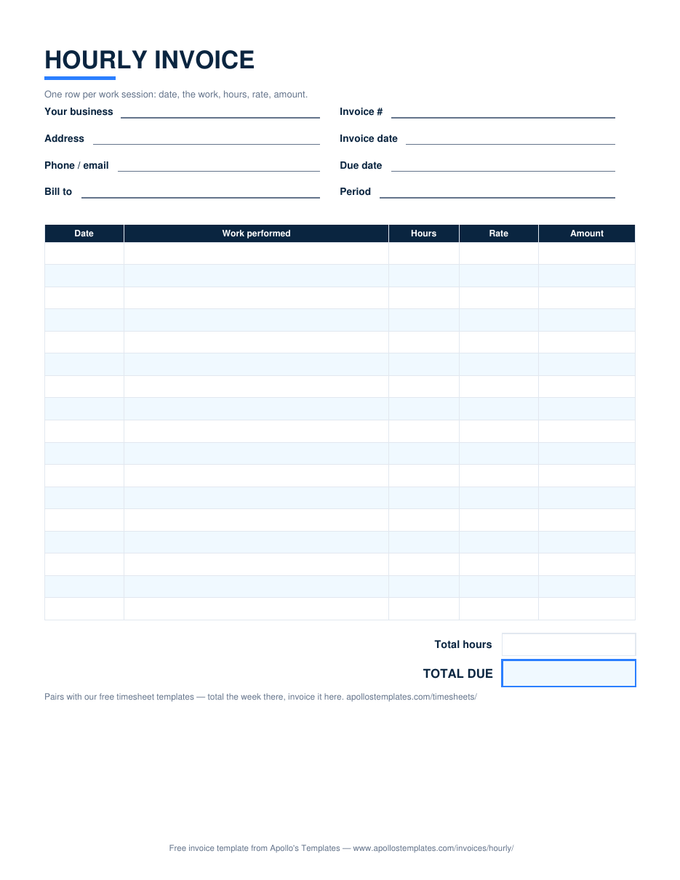
For anyone who sells time: one row per work session with the date, what you did, the hours, and the rate \u2014 the sheet multiplies each row, sums the hours, and totals the money. The total-hours cell matters as much as the total-due cell: clients sanity-check hourly bills by the hours, and a bill that shows its time plainly gets approved instead of questioned.

Three formats

Your hours, itemized.

Excel — hours and money total

Fourteen dated session rows, hours-times-rate math, a computed total-hours cell, and the total due.
Hourly invoice with dated work-session rows, hours times rate per row, and total hours and total due
PDF

Printable PDF

The paper version — dated rows and write-in boxes for total hours and total due.
Download PDF

Word (.docx)

The session log as an editable table for typed, branded bills.
Worth knowing

The bill is the argument for your rate.

An hourly invoice does double duty: it collects this month’s money and justifies next year’s rate. A neat, dated, plainly-described record of where the time went is the single best artifact you have when the rate conversation comes — it shows the shape of the work, not just its volume. Freelancers who keep clean session rows renegotiate from evidence.

Invoice on a fixed rhythm — the 1st, or every other Friday — rather than when a project feels done. Hourly work has no natural end, so undated billing drifts late. The Period field at the top makes the rhythm visible to the client, and visible rhythm is what turns one-off gigs into retainers.

Where the hours come from
Timesheet Templates
Weekly, biweekly, and daily timesheets that total themselves.
Open
Flat-fee projects instead
Freelance Invoice Template
Deliverable pricing with the deposit credited.
Open
Phone-first billing
Google Sheets Invoice Templates
Make-a-copy versions with the math verified.
Browse

Frequently asked questions

How detailed should the work descriptions be?
One line per session that names the deliverable touched: “Homepage revisions per feedback” rather than “design work.” Hourly billing runs on trust, and trust runs on the client recognizing the work in the words. If a session covered several things, the biggest one gives the line its name — itemizing quarter-hours reads as padding.
Should I bill in 6-minute, 15-minute, or real increments?
Pick one and disclose it; consistency is what matters. Quarter-hour rounding is the small-business norm and what this sheet assumes (hours take decimals, so 1.25 is a row). Lawyers' six-minute tenths exist for a reason, but for most freelance work they buy precision nobody asked for at the cost of bookkeeping everyone resents.
Where do my timesheet totals fit into this?
Track in a timesheet, bill from this invoice — a week of granular time entries becomes two or three summarized session rows here. Our timesheet templates compute the weekly totals; carry them over and the two documents reconcile if a client ever wants the detail behind a line.
What about capping hours or estimates I gave?
If you quoted a cap, show your work against it: bill the true hours and, when you're eating overage, add a visible discount line rather than silently shrinking hours. “32 hrs, 4 hrs over estimate — courtesy discount applied” builds the kind of trust that survives the next estimate being wrong too.
Updated through September 2026