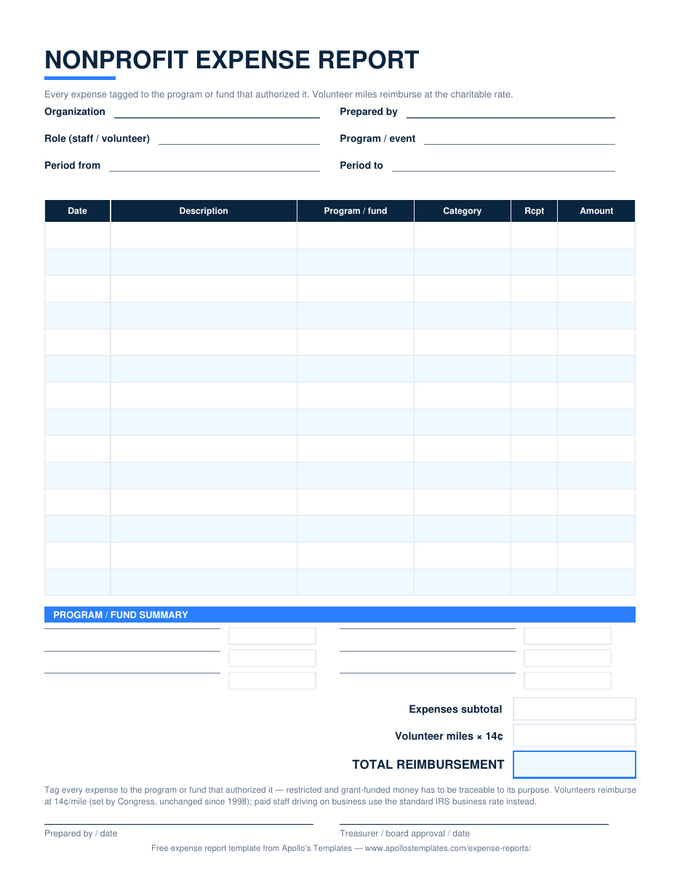
Why does every expense need a program or fund?
Because a nonprofit's money usually isn't fungible. Grant dollars, restricted gifts, and designated funds each come with a purpose the organization promised to honor, and proving that promise was kept means tracing individual expenses back to the program that authorized them. Doing it at the moment of the expense costs nothing; reconstructing it during an audit, a grant report, or a Form 990 preparation costs a weekend and rarely convinces anyone. The summary block totals each program automatically so the answer is ready before it's requested.
What rate do we reimburse volunteers for mileage?
14 cents per mile — and this surprises nearly everyone. The charitable mileage rate is set by Congress in statute rather than by the IRS's annual cost study, so it has sat at 14¢ since 1998 and does not inflation-adjust the way the business rate does. That's why this sheet has its own mileage line prefilled at 14¢ instead of borrowing the business rate from our standard mileage log. Important distinction: this rate applies to volunteers driving in service of the organization. Paid staff driving on business are employees, and their reimbursement uses the standard business rate. IRS reference: charitable mileage under Publication 526.
Can our organization reimburse a volunteer at more than 14 cents?
You can pay more, but the excess isn't tax-free the way the charitable rate is, and it may become reportable income to the volunteer. Many organizations choose the opposite route: reimburse at 14¢ and remind volunteers that unreimbursed charitable mileage may be deductible on their own return if they itemize. Either way, the log has to exist — a volunteer claiming a deduction needs the same date-purpose-miles record this sheet captures. Talk to your accountant before setting a policy above the statutory rate.
Does this work for a church as well as a registered nonprofit?
Yes, and churches are one of the clearest fits — the program/fund column handles exactly the situation churches live in: youth ministry, missions, building fund, a specific outreach event, each with its own designated money and its own people spending it. The treasurer approval line matches how most congregations actually authorize reimbursement. Nothing on the sheet assumes a particular denomination or filing status; rename "Program / fund" to "Ministry" if that's your vocabulary.
How does this fit an accountable plan for a nonprofit?
The same way it does for a business, and it matters just as much: an accountable plan requires a business connection, substantiation within a reasonable time, and return of any excess advance — meet all three and reimbursements aren't taxable income to the person reimbursed. Miss them and your organization is arguably paying wages without withholding, which is a much bigger problem for a 501(c)(3) than for a company. The date, purpose, program, receipt, and signature fields here are the substantiation half of that test.