Apollo's Templates
HomeBusinessExpense Report TemplatesSimple
Four columns, one total

Simple Expense Report Template

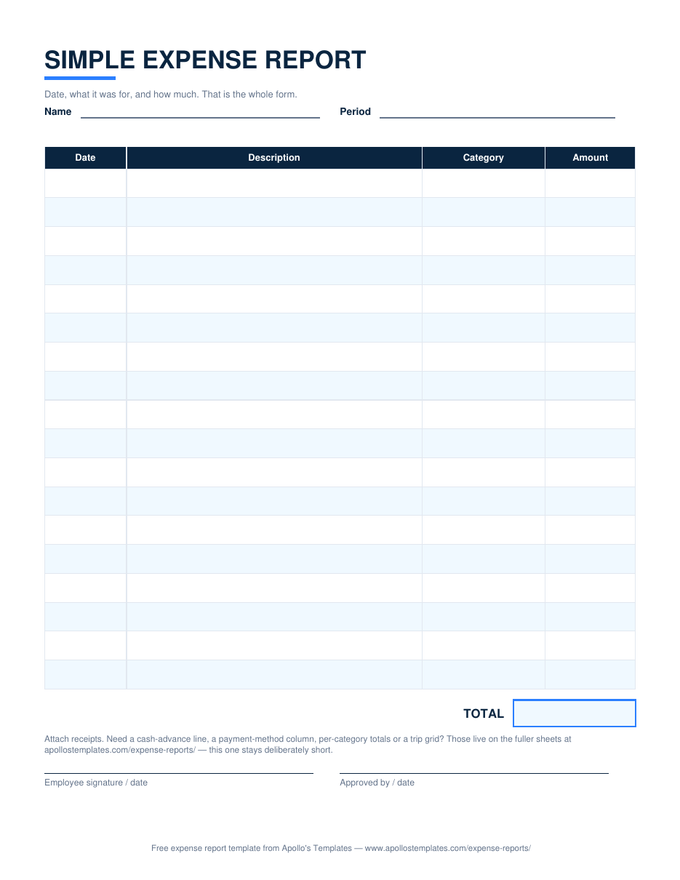
Most “simple” expense templates are the full form with a friendlier name. This one is actually shorter: date, what it was for, a category, and the amount — then a total that adds itself. No payment-method column, no cash-advance row, no notes field, no six-field header. If your situation needs those, our standard report has them all; if it doesn't, they're just boxes to leave blank.

The short version

One download, four formats.

Excel — four columns, one total
Twenty rows, a category dropdown if you want it, and a total that adds itself. Nothing else to fill in, nothing else to ignore.
Printable PDF preview
PDF
Printable PDF
The one-page blank form: eighteen generous rows, a total box, and two signature lines.
Download PDF
Word (.docx) & Google Docs
Type it, brand it, print it. The same four columns as an editable table.
Worth knowing

Fewer fields means more filed reports.

Every field on a form is a small tax on the person filling it in, and expense reports are already competing against “I’ll do it later.” A form that asks for a department, a business purpose, a payment method, and an advance reconciliation makes sense inside a company with a policy behind each of those questions. Handed to a volunteer with three receipts, the same form quietly becomes the reason the receipts stay in a drawer.

One thing this sheet keeps despite the trimming: the receipt habit. The IRS still wants documentary evidence for lodging and for any single expense of $75 or more, and the description field still has to say what the expense was for— “client lunch, Acme contract” rather than “lunch.” Simple means fewer boxes, not a weaker record.

When you need the full form
Expense Report Templates
The standard report with categories, payment method, cash advance and reimbursement math.
Browse
Blank and print-ready
Printable Expense Reports
Every sheet in the library as a blank PDF, this one included.
Open
For one trip
Travel Expense Report
Still simple, but shaped for a trip: day rows, expense-type columns, one total.
Open

Frequently asked questions

What was actually removed to make this “simple”?
Four things, deliberately: the payment-method column, the cash-advance row, the per-row notes column, and the six-field header block. What's left is date, description, category, amount, and a total — plus a name and a period at the top. That's not a marketing simplification; it's a different form. If you find yourself wishing one of those four things were back, you don't want the simple report, you want the standard one, and it's a click away.
Is “simple” the same as “basic” or “blank”?
Near enough that this page serves all three, though people mean slightly different things. Simple usually means fewer fields — that's this sheet. Basic often means the same thing, sometimes with a nod to being free. Blank usually means printable and empty, which is the PDF above (and there's a whole page of blank PDFs for every sheet in the library). If what you actually want is the opposite — a detailed report with categories broken out per day — the travel and monthly sheets are built for exactly that.
Can I add a column back if I need one?
Yes. Nothing is locked or protected: insert a column in Excel or Google Sheets, type a header, and the total formula keeps working because it sums the Amount column by reference rather than by position. The one thing worth knowing is that our fuller sheets already solved the common additions — cash advances, business/personal splits, per-category summaries, per-day trip grids — so before rebuilding one by hand, check whether it exists on another page.
Who is this actually for?
The person with four receipts and a manager who just wants a number. Volunteers handing in event costs, a contractor billing a client for materials, an employee at a company with no expense system, a freelancer keeping a personal record for tax time. The full-featured report earns its complexity when there's a policy, an advance, and an approver behind it. When there isn't, the complexity is just friction — and friction is why expense reports get filed late or not at all.
Updated through August 2026