What are California's overtime rules, exactly?
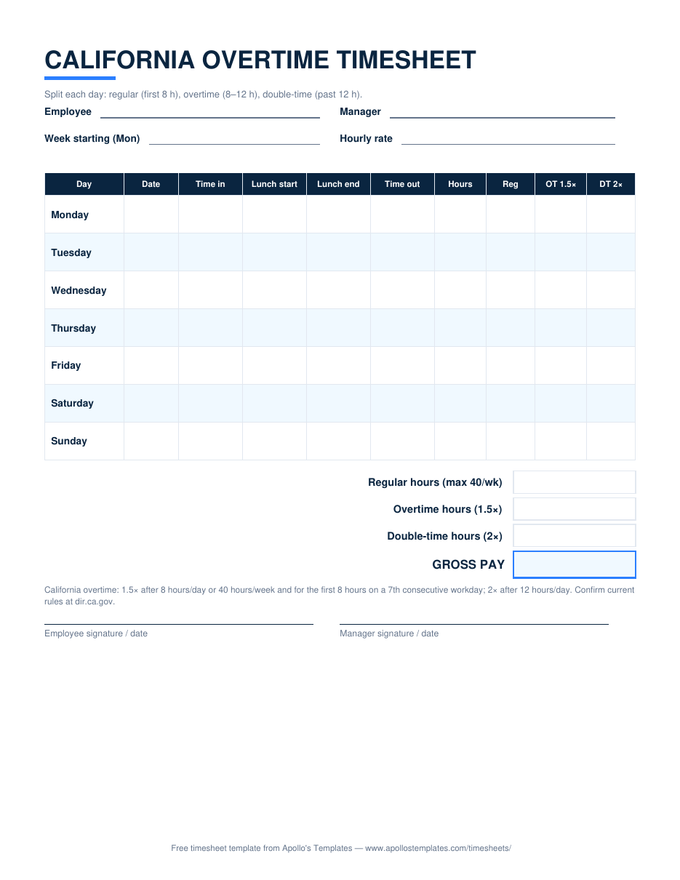
For most nonexempt employees: time-and-a-half after 8 hours in a workday or 40 in a workweek, and for the first 8 hours worked on a seventh consecutive workday; double-time after 12 hours in a workday, and past 8 hours on that seventh consecutive day. The daily triggers are what make California different — a 10-hour Tuesday earns 2 overtime hours even in a 38-hour week, which a standard weekly timesheet computes as zero. Current details live at the California DIR's overtime page (dir.ca.gov); some occupations and alternative workweek schedules have their own rules.
Does the spreadsheet handle the seventh-consecutive-day rule?
No, and the sheet says so on its face rather than pretending. The 7th-day premium depends on the consecutive-day streak, which can start in the previous week's sheet — a single-week grid can't see it reliably, and a wrong automatic answer is worse than an honest manual one. When someone works all seven days, reclassify that seventh day by hand: the first 8 hours to the OT column, anything beyond to double-time. The note row on the printed sheet spells out the same rule.
Who should use this sheet instead of the standard weekly one?
Anyone paying or being paid for nonexempt hourly work performed in California — the standard weekly sheet's 40-hour-only split will systematically undercount overtime on long days there. It's also the right sheet for the handful of other daily-overtime jurisdictions (Alaska and Nevada compute daily OT past 8 hours too, though without California's double-time tier — ignore the DT column there). If your crew never crosses 8 hours in a day, the two sheets produce identical numbers and the standard weekly is simpler.
Is this sheet legal advice?
No — it's arithmetic. The formulas implement the general daily and weekly thresholds, which cover most straightforward hourly situations, but California layers exemptions, alternative workweek schedules, meal-period premiums, and occupation-specific wage orders on top. The sheet gets the standard math right and prints its assumptions where an auditor can read them; for edge cases, the DIR's site and a payroll professional outrank any template, ours included.