
Apollo's Templates
HomeBusinessTimesheet TemplatesWeekly
The Monday-to-Sunday standard

Weekly Timesheet Template

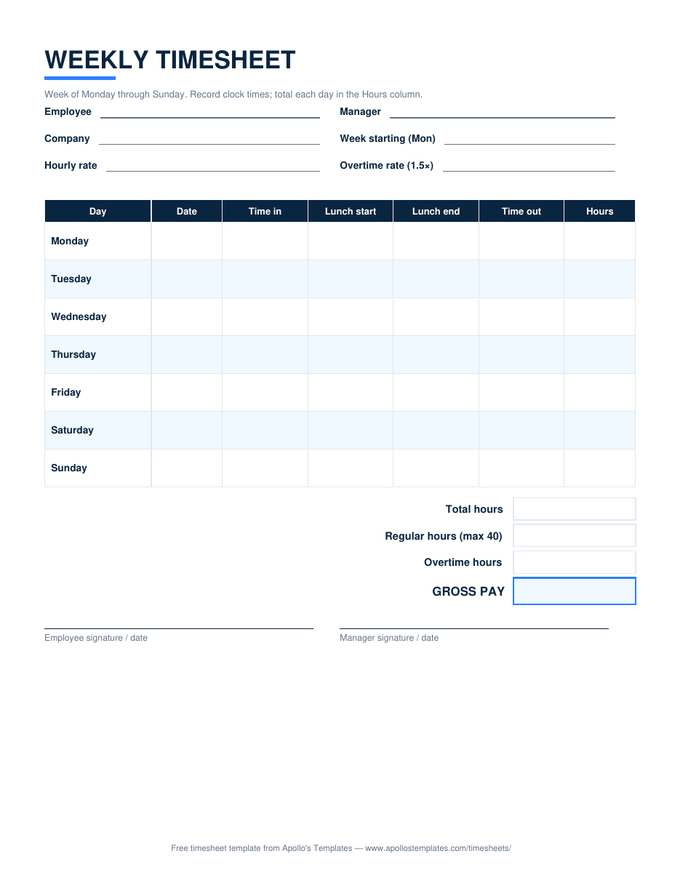
One week per page, one row per day: time in, lunch out, lunch back, time out, hours. The Excel version does all the arithmetic — daily totals, the 40-hour overtime split, gross pay from an hourly rate — while the PDF version prints big enough to fill in with a pen at the time clock. Signature lines for employee and manager close out the week.

With lunch tracking

The full weekly sheet.

Seven days with lunch-break columns — the layout that matches how most hourly days actually run.
The stripped-down version

Simple in/out — no lunch columns.

For salaried check-ins, part-timers on short shifts, or any workplace where breaks are paid: one in, one out, done.

Worth knowing

One sheet per workweek is a legal boundary, not a preference.

Federal overtime is computed inside each fixed workweek — hours can’t average across weeks, even on a biweekly paycheck. That’s why this sheet totals exactly seven days and why the overtime row caps regular time at 40. Paid every two weeks? Use the biweekly sheet, which runs this same split twice, once per week, before totaling the period.

And a filing habit worth stealing: photograph the signed sheet every Friday. Timesheets are a federal payroll record with a two-year retention requirement — a camera roll named “timesheets” satisfies it for free.

Two-week paychecks
Biweekly Timesheet
The same daily layout across a two-week pay period, overtime split per week.
Open
Daily overtime states
California Overtime Timesheet
Regular, 1.5×, and double-time split per day under California rules.
Open
All formats
Excel Timesheet Templates
Every sheet in the library as an .xlsx with working formulas.
Browse

Frequently asked questions

How does the overtime calculation work?
The Excel and Google Sheets versions total each day from your clock times, sum the week, then split the result: regular hours are capped at 40, and everything past 40 lands in the overtime row at 1.5× your hourly rate. Gross pay adds the two together. If your state calculates overtime daily rather than weekly — California most famously — use our California overtime timesheet instead; the split there happens per day.
What if someone skips lunch or the shift has no break?
Leave the two lunch columns empty for that day. The formula checks whether lunch times exist: with them, it adds the morning and afternoon segments; without them, it simply counts time-in to time-out. You never have to enter a zero-minute lunch or fake a break to make the math work. If nobody at your workplace ever takes an unpaid break, the simple version below drops the lunch columns entirely.
Why does the week start on Monday?
Because most hourly workweeks do, and because a Monday start keeps the weekend visually together at the bottom of the sheet. The FLSA lets an employer define the workweek as any fixed 168-hour cycle, so if yours runs Sunday to Saturday, just enter your Sunday date in the “Week starting” field — the day labels will be off by one but every calculation stays correct, since the math only cares about the seven rows.
Should I print the PDF or use the spreadsheet?
Use both, honestly — that's how small shops actually run. The printed PDF lives where people clock in and collects real signatures; the spreadsheet is where the manager transfers the times on payday and lets the formulas do the totaling. If only one, pick by who fills it in: employees writing times by hand want the PDF's big cells, a bookkeeper entering times at a desk wants the Excel file's automatic math.
Updated through August 2026