




Apollo's Templates
HomeBusinessInvoice TemplatesConstruction
The draw request

Construction Invoice Template

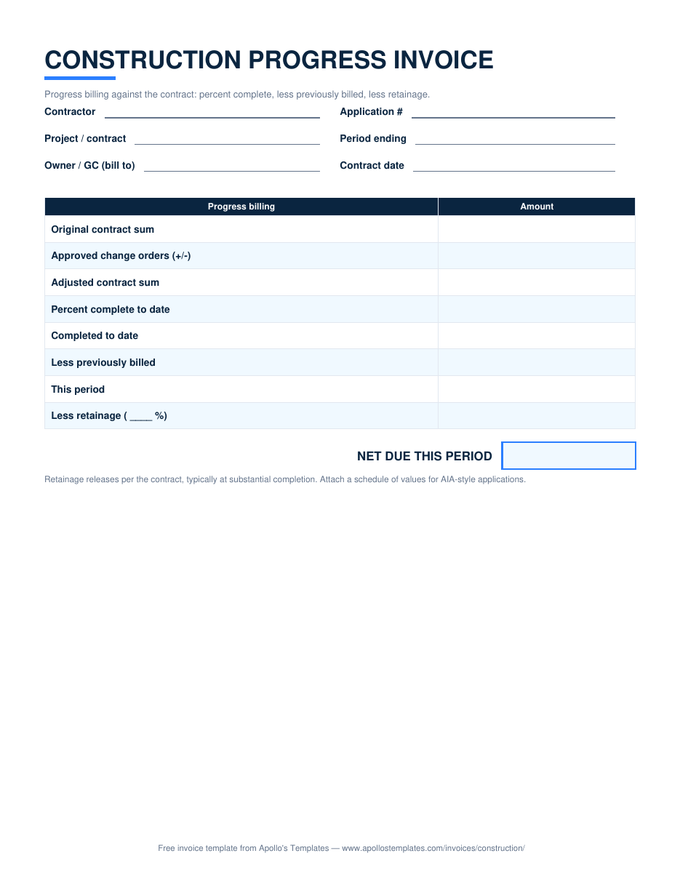
Contract jobs don't bill hours \u2014 they bill progress. This sheet runs the draw math: contract sum plus approved change orders, times percent complete, minus what's been billed, minus retainage, equals the net due this period. It's the plain-English cousin of the AIA G702 \u2014 the same logic without the license fee, sized for residential and light-commercial work.

Three formats

The progress draw, computed.

Excel — the draw chain computes

Enter contract, changes, percent, previous, and retainage — every derived line and the net due compute.
Construction progress invoice with contract sum, percent complete, previously billed, and retainage rows
PDF

Printable PDF

The blank application for jobs where the GC wants paper.
Download PDF

Word (.docx)

Editable for repeat billing against the same contract — save per project.
Worth knowing

Cash flow is won at billing time.

Construction fails on cash flow more than on workmanship, and the draw request is the pump: bill on the contract’s schedule, the day the milestone hits. A contractor who submits clean, arithmetic-tight applications — this period reconciling to last period, retainage tracking — gets processed first by every owner’s bookkeeper.

Track the retainage as its own receivable — five draws at 10% is a hidden invoice nobody will pay until you ask. The completion punch list plus a retainage-release application, submitted together, is how the last check shows up while the trailer is still on site.

Completed-job billing
Contractor Invoice Template
Labor and materials with markup for shorter jobs.
Open
The job's own budget
Construction Budget Template
Cost categories and contingency for the build.
Open
Crew hours behind draws
Construction Timesheet
Daily crew time with job codes.
Open

Frequently asked questions

What is retainage and why is it on my invoice?
Retainage is the percent — typically 5–10% — the owner holds from every draw until completion, as insurance the job finishes. The sheet computes it against this period so the net you're actually asking for is honest, and the held total accumulates visibly. It releases per the contract at substantial completion; invoice the release explicitly when it's due, because nobody volunteers it.
How do I defend the percent complete?
With a schedule of values — the contract broken into line amounts (foundation 12%, framing 22%…) and each line's progress supporting the total percent. This sheet takes the summary number; attach the breakdown on bigger jobs. A percent you can walk someone through gets paid; a round number that moved 15% since last month gets a site visit.
Where do change orders go?
Approved ones — in writing, priced, signed — enter the change-orders cell and lift the adjusted contract sum; the math flows through automatically. Unapproved work goes nowhere on this sheet, which is precisely the discipline: progress billing against a sum the paper doesn't support is how contractors finance disputes.
When is this the wrong invoice?
Short jobs billed at completion want the contractor invoice's labor-and-materials tables instead. This sheet earns its structure when there's a signed contract sum and multiple payments across it — remodels on a schedule, spec builds, subcontract packages under a GC.
Updated through September 2026