





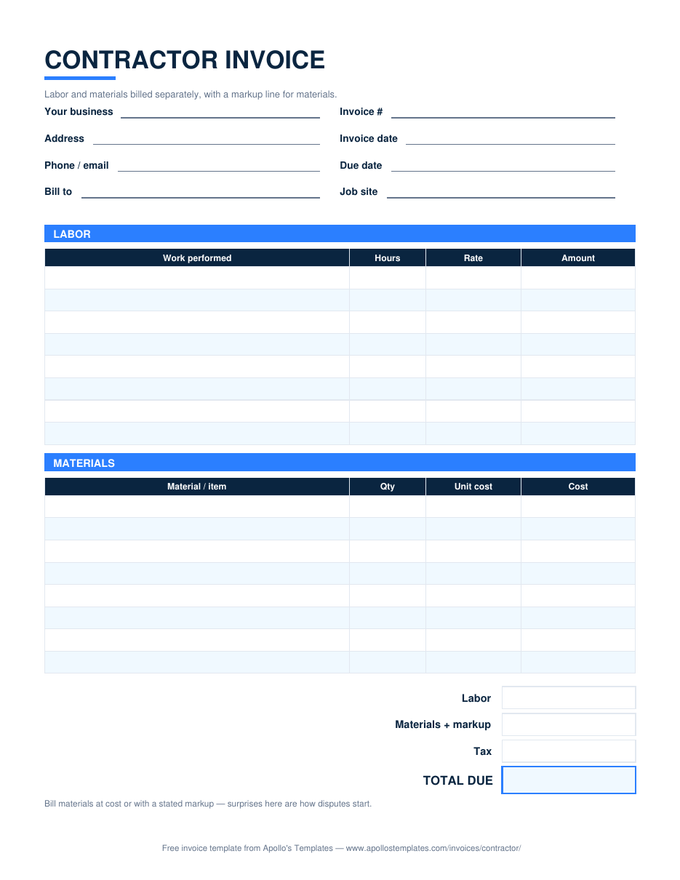
Contractor Invoice Template
The two-table bill that matches how job work actually costs out: labor rows with hours and rates in one table, materials with quantities and unit costs in the other, and a stated markup percent applied to materials in the open. The Excel version computes the whole chain \u2014 labor, marked-up materials, tax, total \u2014 from what you type.
The job, costed honestly.
The estimate and the invoice should rhyme.
Most contractor payment disputes are really document disputes: the estimate said one shape of number and the invoice arrived in another, and the gap reads as bad faith even when it’s just bad formatting. Bill in the same lines you estimated — if the estimate said labor, materials, and markup, the invoice should show labor, materials, and markup. This sheet’s structure is that discipline made default.
Change orders are where the rhyme breaks. Any add beyond the estimate deserves its own labeled lines — “ADD: owner-requested second coat, bedroom” — not a silent swelling of the original numbers. An invoice that separates the agreed job from the added work collects both amounts faster than one that blends them.