




Apollo's Templates
HomeBusinessInvoice TemplatesHandyman
Small jobs, clear bills

Handyman Invoice Template

The small-jobs bill: a service-call fee that makes short visits worth rolling for, labor rows by the hour, and a materials table for the hardware run \u2014 totaled without ceremony. Handyman work lives on volume and word of mouth; a bill the customer understands in ten seconds is part of why the neighbor calls next.

Three formats

Today's jobs, billed today.

Excel — the visit computes

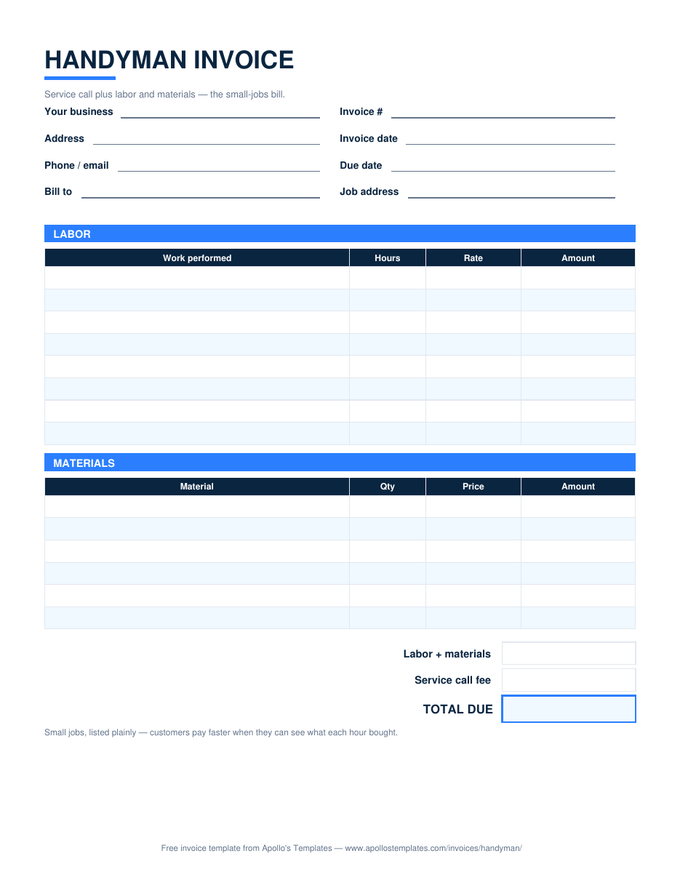
Labor and materials tables with the call fee stacking in, total in blue.
Handyman invoice with labor and materials tables and a service call fee line
PDF

Printable PDF

The glovebox pad — write it at the door, leave the copy.
Download PDF

Word (.docx)

Editable for the email-after version — type, PDF, send from the phone.
Worth knowing

Bill at the door, not from the couch.

The handyman’s real inventory is trust and momentum, and both peak at the moment the drill goes back in the case. Bill right there — the paper pad or the phone-typed Word version — and the day’s work is the day’s revenue. Invoices written from the couch on Sunday shed hours, forget hardware runs, and turn a business into loose ends.

Track the punch-list pattern: when one customer’s invoices keep growing rows, that’s a maintenance relationship asking to happen. A standing monthly visit at a day rate beats seven scattered call fees — and the invoice history is what makes that pitch with numbers instead of vibes.

The licensed cousins
Plumbing Invoice Template
Fixtures and the permit line for licensed work.
Open
Bigger jobs, more structure
Contractor Invoice Template
Labor and materials with stated markup.
Open
Where the hours go
Daily Timesheet Template
Per-task time tracking that feeds the labor rows.
Open

Frequently asked questions

Should a handyman charge a service call fee?
Yes — it's the difference between a business and a hobby. The fee covers the drive, the quote, and the too-small jobs, and it filters the tire-kickers at booking. Common structure: a flat fee that includes the first half hour or hour, then the hourly rate. This sheet shows it as its own line so it's priced, not smuggled.
Hourly rate or per-job pricing?
Hourly for unknowns (diagnose-and-fix, punch lists), flat per-job for the repeatable (ceiling fan, toilet swap, TV mount). Most working handymen quote flat for the known and fall back to hourly with the call fee otherwise. The labor table takes both — a flat job is one row with the price, no hours.
How do materials work when it's a Home Depot run?
List them at receipt cost — the customer can see the same shelf you did, so markup on visible hardware breeds distrust. Your procurement time is already in the hourly rate or the call fee. Photograph the receipt to your job folder; on multi-stop days, one receipt often splits across two invoices.
Punch lists — one invoice or several?
One invoice, one labor row per task: “Fix gate latch — 0.5,” “Caulk tub — 0.5,” “Patch drywall, hall — 1.5.” The itemized list is your best advertisement — it shows six problems became six fixed things in a morning, which is the entire handyman value proposition in writing.
Updated through September 2026