




Apollo's Templates
HomeBudget TemplatesConstruction
Built without surprises

Construction Budget Template

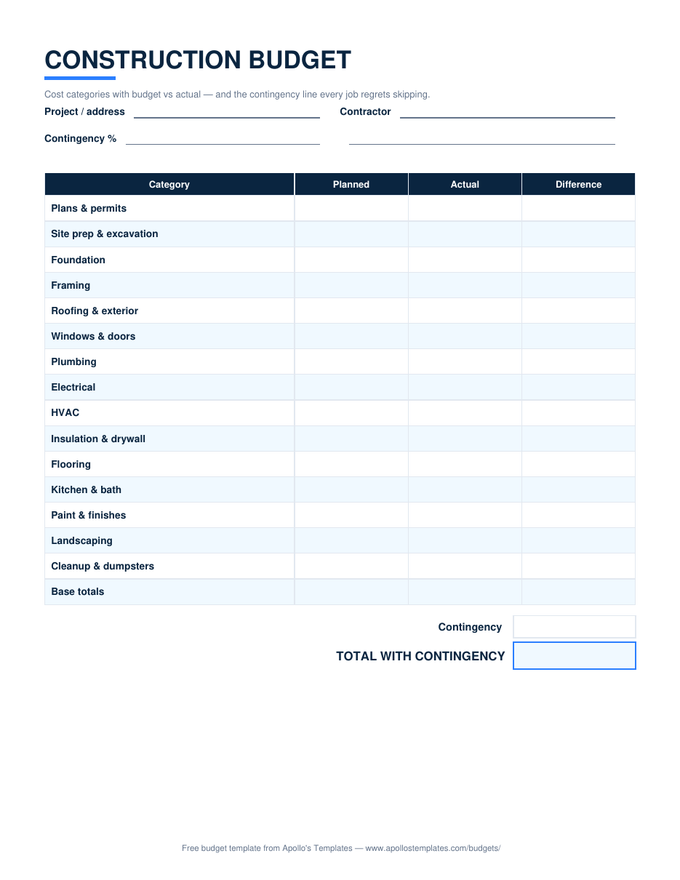
Fifteen cost categories that follow the build's actual sequence \u2014 plans and permits through cleanup \u2014 each with budget, actual, and variance, plus the line that separates finished projects from stalled ones: contingency, computed as a percentage you set. Ten percent is the residential floor; older-home remodels earn fifteen to twenty. The variance column tells you which trade is eating it while there's still budget to defend.

From permits to punch list

One sheet, every format.

Excel — with the contingency math

Fifteen categories with budget/actual/variance; contingency computes from your percentage and joins the total.
Construction budget with fifteen build cost categories and contingency summary boxes
PDF

Printable PDF

The category grid on paper for contractor meetings — write the bids in as they arrive.
Download PDF

Word / Google Docs

The cost categories as an editable table — attach it to the contract as the working budget.
Worth knowing

Contingency is a budget line, not an apology.

Every experienced builder carries contingency; every first-time renovator discovers why. The wall opens and the wiring is aluminum; the soil report was optimistic; materials quoted in March cost differently in July. Ten percent on new construction and fifteen-plus on remodels isn’t padding — it’s the statistically honest price of not knowing what’s behind the drywall. The sheet computes it from your percentage and adds it to the total up front, because financing arranged without contingency is a stalled project with a start date.

Spend it by name: when the surprise arrives, log the cost in its category row and note that contingency covered it. A job that ends with contingency intact came in under budget honestly, and — the part that compounds — the categories that consumed it become the next project’s better estimates. Builders who track this on three jobs stop having surprise categories; they have known risks with prices.

The crew's hours
Construction Timesheet
Job-coded daily hours — the labor actuals that feed these category rows.
Open
Task-level control
Project Budget
Hours × rate per task, for jobs managed by phase instead of trade.
Open
The money's other end
Mileage Log
Supply runs add up — the IRS-rate log for the truck.
Open

Frequently asked questions

How much should each category get?
Get real bids for the big five — framing, foundation, plumbing, electrical, HVAC typically eat 50-60% of a residential budget — and estimate the rest from your market's rules of thumb, then let the bids overwrite the estimates as they arrive. The sheet's variance column starts working at bid time, not build time: a framing bid 20% over your budget line is the moment to re-scope, while the lumber is still theoretical.
What does everyone forget to budget in a renovation?
The unglamorous end of the list: permits and plan revisions, dumpsters and haul-away, temporary utilities or housing during the messy weeks, and the finish-line costs — hardware, fixtures, paint-grade trim — that feel small individually and total like a trade. That's why Cleanup & dumpsters and Plans & permits have their own rows here instead of hiding in 'misc.' If you're living in the house during the work, budget eating out; kitchens take longer than promised, always.
How do change orders fit into this sheet?
Log them into the category they hit, the day they're signed — a change order is just a variance you agreed to in writing. The discipline that keeps builds honest: no verbal changes, and every change order updates this sheet before work proceeds, so REMAINING contingency always reflects reality. Projects lose control not through one big overrun but through eleven small 'while we're at it' decisions nobody priced.
Does this work for house flipping?
It's the core of a flip budget — the renovation side — and flippers should add three rows the sheet leaves to you: acquisition and closing costs, carrying costs (loan interest, taxes, insurance, utilities times your hold months), and selling costs. The renovation categories then do the same job they do for homeowners, with a sharper edge: on a flip, the variance column is your margin eroding in real time, and the contingency line is the difference between a thin deal and a lost one.
Updated through August 2026