




Apollo's Templates
HomeBudget TemplatesProject
Every task, its own number

Project Budget Template

Projects don't overrun in total \u2014 they overrun one task at a time, quietly, in the lines that never had a number. This sheet gives every task its own row: labor as hours times rate (computed), materials and other costs beside it, and the task's budget one column over. The totals reconcile at the bottom, and REMAINING tells you the only running truth a project manager needs between status meetings.

Task by task

One sheet, every format.

Excel — hours × rate math

Labor computes from hours and rate per task; task totals, project totals, and budget REMAINING keep themselves.
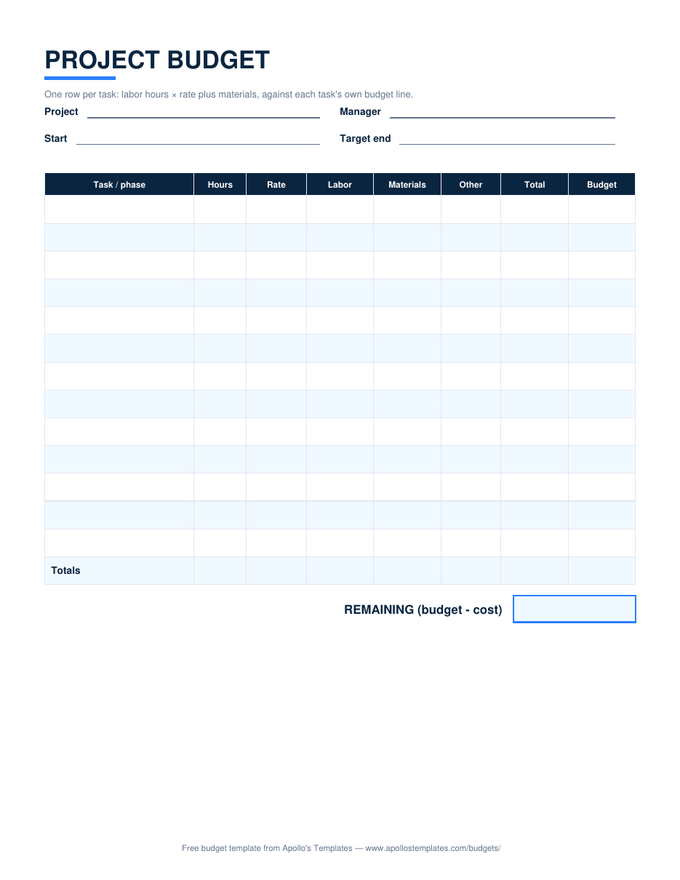
Project budget task rows with hours, rate, labor, materials, and per-task budget columns
PDF

Printable PDF

The task grid on paper for scoping sessions — pencil in the estimates before they harden into commitments.
Download PDF

Word / Google Docs

The task table in Word for proposals and statements of work — same columns the tracking sheet uses.
Worth knowing

Estimate at the task level or not at all.

A project budgeted as one number is a wish with a deadline. The row-per-task structure is the discipline: forcing an hours estimate per task surfaces the vague ones immediately (the task you can’t estimate is the task you don’t understand yet), and when reality arrives, the variance points at a specific piece of work instead of the project in general. “We’re 20% over” starts an argument; “integration testing took 30 hours against 12” starts a fix.

Two habits from teams whose projects land on budget: estimate labor in hours even for fixed-fee work (the fee goes in Other, but the hours tell you whether the fee was sane), and add an explicit contingency task — 10-15% of the total, spent by name when surprises arrive. A project that ends with contingency unspent came in under budget honestly; one that never budgeted contingency just hid the same money inside padded tasks where no one can learn from it.

Jobs with cost codes
Construction Budget
The building version — cost categories, contingency percent, and trade rows.
Open
The company-level view
Business Budget
Where the project's numbers roll up at year scale.
Open
Bill the hours
Timesheet Templates
The daily task timesheet feeds this sheet's hours honestly.
Open

Frequently asked questions

How do I estimate labor hours honestly?
Decompose until the pieces are small enough to feel — nobody can estimate 'build the website' but most people can estimate 'design the homepage' within a factor of two. Then apply the correction every veteran applies: take the comfortable estimate and add half, because estimates are made on good days about ideal conditions. The sheet helps by making the reconciliation visible task by task; after two or three projects, your personal correction factor stops being folklore and becomes data.
What goes in Materials versus Other?
Materials is physical and consumable — lumber, licenses bought for the project, print runs, hardware. Other is the catch-basin for costs that aren't your labor or materials: subcontractor fixed fees, permits, travel, equipment rental, the venue. The split matters mainly for learning: when a project overruns, knowing whether labor, materials, or external costs drove it tells you whether the fix is estimating, purchasing, or vendor management.
How should client-facing budgets relate to this internal one?
Build this sheet first, at full honesty, then derive the client version from it — never the reverse. The internal sheet carries your real hours, real rates, and contingency; the proposal shows the client whatever level of detail the relationship warrants (often task totals only). When a client negotiates the price down, the discipline is changing scope on this sheet to match, not just shrinking the number — a budget cut without a scope cut is a loss you've merely scheduled.
What does the REMAINING line actually govern?
Decisions mid-project — it's the number that answers 'can we absorb this?' when the surprise arrives, which it will. A change request against $8,000 remaining is a conversation; against $400 it's a change order. Teams that update actuals weekly get an early-warning system for free: REMAINING shrinking faster than the task list is the overrun announcing itself months before the final invoice would have.
Updated through August 2026