




Apollo's Templates
HomeBudget TemplatesBusiness
The year, planned by month

Business Budget Template

The operating budget every small business needs and most run without: the year laid out month by month, revenue rows on top, expense rows below, and a NET line that computes per month and for the year. Plan January through December before January happens, and the seasonal months stop being surprises \u2014 they're right there in the row, planned in October. The Excel version totals everything both directions; the printable tallies by quarter.

The operating plan

One sheet, every format.

Excel — the 12-month grid

Revenue and expenses across twelve month columns, with row totals, column totals, and NET computing per month and for the year.
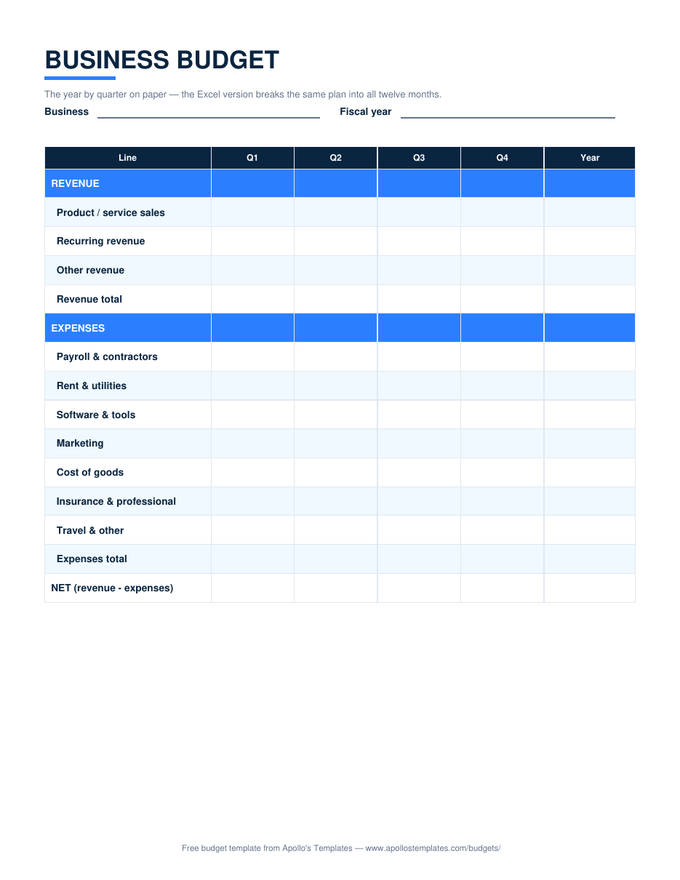
Business budget quarterly grid with revenue, expense, and net rows
PDF

Printable PDF

The quarterly paper version — plan the year at the kitchen table before opening the spreadsheet.
Download PDF

Word / Google Docs

The quarterly grid as an editable table — rename the expense rows to your chart of accounts.
Worth knowing

Budget the seasonality, not the average.

The classic small-business planning error is budgeting twelve identical months — average revenue, average expenses — when no real business has an average month. The month columns exist to hold the truth: the December spike, the summer trough, the insurance premium that lands whole in March. A budget that knows August is slow can pre-fund it in June; a budget of averages discovers August in August.

Plan revenue conservatively and expenses honestly — optimism belongs in the sales pipeline, not the budget. The most useful single discipline: fill next year’s grid from this year’s actuals (your accounting software’s monthly P&L maps straight onto these rows), then adjust deliberately, line by line, with a reason for every change. A budget built from real history plus named changes is a forecast; one built from wishes is a haiku.

The month-close ritual
Budget vs Actual
Where this plan meets the accounting — variance by line, favorable positive.
Open
One channel, deeper
Marketing Budget
The year by channel and quarter, with unallocated budget kept visible.
Open
The other direction
Expense Report Templates
Track the spending that feeds this budget's actuals.
Open

Frequently asked questions

How is this different from a P&L or a forecast?
Timing and intent. A P&L reports what happened; a forecast predicts what will; a budget commits to what you'll allow. This sheet holds the commitment — the spending plan you'll actually manage against — which is why it pairs with the budget-vs-actual sheet at each month close. In practice the three documents share the same row structure, which is deliberate: your accounting software's monthly P&L should map onto this grid line for line, so building next year's budget starts with exporting this year's truth.
What expense categories should a small business budget use?
Start with the sheet's nine — payroll, rent and utilities, software, marketing, cost of goods, insurance and professional services, equipment, travel, other — and then make them yours by renaming toward your chart of accounts. The test for whether a category earns its own row: would you make a different decision if you saw it separately? Payroll always passes; 'office snacks' never does. Most businesses run well on eight to twelve rows, and a budget with forty rows is a budget nobody updates.
How do I budget revenue for a new business with no history?
Bottom-up, not top-down: units times price times a conversion story you can defend, month by month, starting embarrassingly small. The grid helps here precisely because it's monthly — 'we'll do $120k this year' hides everything, while 'March: 4 clients at $2,500' is a claim you can test against reality in April. Budget expenses at full honesty from day one (they arrive on schedule regardless), and treat the first six months' revenue column as a hypothesis you're funding.
Should owner pay be in the budget?
Yes, explicitly, even when — especially when — you're not paying it yet. An owner's draw or salary row in payroll keeps the business's real economics visible: a company that 'profits' $60k while the owner works unpaid is actually breaking even on labor the budget refuses to see. Bankers and buyers will make this adjustment anyway; making it yourself first means your NET line tells you the truth all year instead of once, during diligence.
Updated through August 2026