




Apollo's Templates
HomeBudget TemplatesBudget vs Actual
Where the plan met reality

Budget vs Actual Template

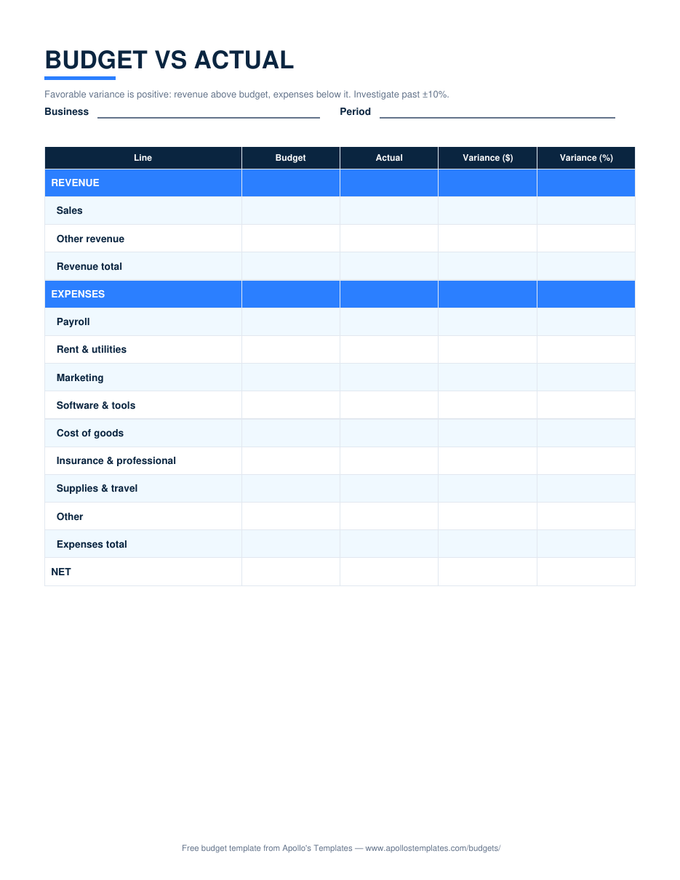
The five-minute month-close discipline that separates managed businesses from surprised ones: every line's budget beside its actual, with the variance computed in dollars and percent. The sign convention is the useful kind \u2014 positive is always favorable (revenue above plan, expenses below it) \u2014 so the column scans at a glance and the negative numbers are exactly the ones that deserve a question.

The month-close sheet

One sheet, every format.

Excel — variance both ways

Budget and actual per line; variance computes in dollars and percent with the favorable-positive convention throughout.
Budget versus actual statement with variance columns in dollars and percent
PDF

Printable PDF

The paper version for the monthly sit-down — the printed sheet is harder to skip reviewing than the file.
Download PDF

Word / Google Docs

The variance layout as an editable table for board packets and month-end memos.
Worth knowing

Interrogate the big variances in both directions.

The instinct is to investigate the unfavorable variances and celebrate the favorable ones — but a big favorable variance is often the more informative number. Marketing 40% under budget isn’t discipline; it’s a campaign that didn’t run, and next quarter’s revenue line will say so. The working rule: anything past ±10% gets one sentence of explanation, favorable or not. Most sentences are boring (“insurance renews in March”), and the two that aren’t are the month’s real findings.

Percent and dollars matter together, which is why the sheet computes both. A 30% variance on a $2,000 line is a $600 conversation; a 3% variance on payroll can outweigh it fivefold. Scan the percent column to find the surprises, the dollar column to rank them — the line worth the meeting is the one that’s big in both.

The plan itself
Business Budget
The 12-month grid this sheet audits at every month close.
Open
Variance for jobs
Project Budget
The per-task version — budget lines against real labor and materials.
Open
Variance for households
Monthly Budget
The personal planned/actual sheet — same idea, kitchen-table scale.
Open

Frequently asked questions

What does the sign convention actually mean?
Positive variance is always good news, negative always the question mark — regardless of line type. For revenue, variance is actual minus budget (selling more than planned is positive). For expenses it flips to budget minus actual (spending less than planned is positive). This is the convention accountants call 'favorable/unfavorable,' and encoding it in the math means the column reads at a glance without anyone mentally flipping signs on expense rows.
How often should we run budget vs actual?
Monthly, within a week of the books closing — the cadence matters more than the depth. Variance data ages badly: a September overrun caught in early October changes Q4 behavior, while the same number discovered in January is archaeology. Quarterly reviews work for very stable businesses, but monthly is where the habit earns its keep, and the five-minute version (scan, one sentence per big variance) beats the skipped thorough one.
What counts as a variance worth investigating?
Two thresholds, applied together: percent (past ±10% deserves a sentence) and dollars (set an absolute floor, say $500 for a small business, so trivial lines don't eat the meeting). Then one refinement that separates useful reviews from ritual ones — distinguish timing variances (the expense is coming, just not yet) from real ones (the spending pattern changed). Timing variances self-correct next month; real ones are the budget asking to be revised or the business asking to be examined.
Should we revise the budget when actuals drift?
Not monthly — a budget revised every month is just a lagging record of actuals, and the variance column stops meaning anything. The standard practice: hold the original budget for the year, and if reality has genuinely diverged (lost a major client, unexpected growth), add a mid-year reforecast as a separate column or copy rather than overwriting the plan. Original budget, reforecast, actual: three numbers that together tell you both what happened and how your planning is improving.
Updated through August 2026