



Apollo's Templates
HomeBudget TemplatesMarketing
Channels, quarters, one cap

Marketing Budget Template

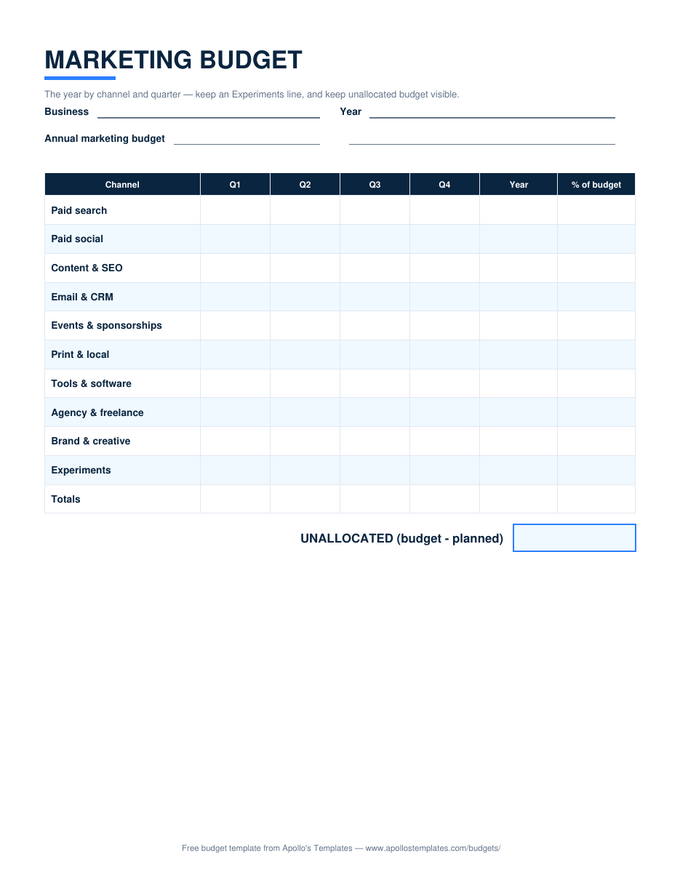
Marketing budgets fail in two directions: the cap nobody wrote down, and the channel mix nobody can see. This sheet fixes both \u2014 an annual budget set once at the top, ten channels planned by quarter beneath it, each channel's share of the total computed live, and the UNALLOCATED line keeping the difference between planned and committed visible all year. The Experiments row is deliberate; leave it funded.

The channel plan

One sheet, every format.

Excel — shares computed

Channels by quarter with year totals, each channel's share of the annual budget, and UNALLOCATED always visible.
Marketing budget with channel rows across four quarters and a percent-of-budget column
PDF

Printable PDF

The channel grid on paper for the planning offsite — argue the mix before committing it.
Download PDF

Word / Google Docs

The plan as an editable document for the budget approval memo.
Worth knowing

Fund experiments or fossilize.

The channel mix that worked last year is this year’s comfortable default and next year’s slow decline — channels saturate, audiences migrate, costs creep. The Experiments row (5-10% of budget is the working convention) is the structural answer: money pre-committed to trying what isn’t proven yet, so the question “should we test that?” is already funded instead of competing against the proven channels every time. Most experiments fail cheaply; the occasional one that works becomes a main row next year, and that’s the entire game.

The quarterly columns earn their keep at reallocation time. Marketing is the budget most worth revisiting mid-year — a channel that’s clearly working by June deserves Q3 money that January couldn’t have known to give it — and quarter-level planning makes those moves explicit rather than drifty. Pair the sheet with whatever performance numbers you trust, and let the quarters be decision points, not just dates.

Where it rolls up
Business Budget
The company's 12-month grid — marketing is one row there, ten here.
Open
Did it work?
Budget vs Actual
The variance sheet for judging the plan at each quarter close.
Open
Market the event
Event Budget
The per-event version — sponsorships, invites, and the AV bill.
Open

Frequently asked questions

How much should a business spend on marketing overall?
The common small-business benchmarks run 5-10% of revenue for maintaining position and 10-15% for aggressive growth, with wide variance by industry — B2C and competitive local services sit high, referral-driven B2B professional practices low. The more actionable version of the question is unit math: what a customer is worth against what acquiring one costs in each channel. The sheet's job is making whatever number you choose explicit and capped — an unwritten marketing budget always turns out to have been bigger than intended.
What counts as marketing spend — do tools and salaries belong here?
Draw the line deliberately and keep it consistent year over year. This sheet's convention: campaign spend, tools, agencies, and freelancers in; full-time salaries out (they live in the payroll budget), with the gray zone — a contractor who's practically staff — assigned once and noted. The consistency matters more than the philosophy, because the budget's real job is comparability: this year's mix against last year's, plan against actual, without redefinitions muddying every comparison.
How do we split budget across channels with no history?
Start where your customers demonstrably already are (ask the last ten how they found you — the answer is usually humbling), weight two or three channels enough to actually test them, and resist the instinct to spread thin across everything. A channel funded at $200 a month tells you nothing; the same $2,400 concentrated for one quarter produces an answer. First-year mixes are guesses by nature — the sheet's quarterly structure exists so the second-quarter version can be a correction instead of a continuation.
What does the UNALLOCATED line do that a total doesn't?
It keeps opportunity money real. A budget fully allocated in January has no answer for the March conference invitation or the competitor's stumble in August except 'take it from something' — which in practice means take it from nothing and overspend. Holding 10-20% unallocated at year start, visibly, converts mid-year opportunities from budget crises into planned spending. Watch it drain across the year: gone by June means you're improvising; untouched in November means you were too conservative, and that's next January's lesson.
Updated through August 2026