




Apollo's Templates
HomeBudget TemplatesEvent
Estimated, then actual

Event Budget Template

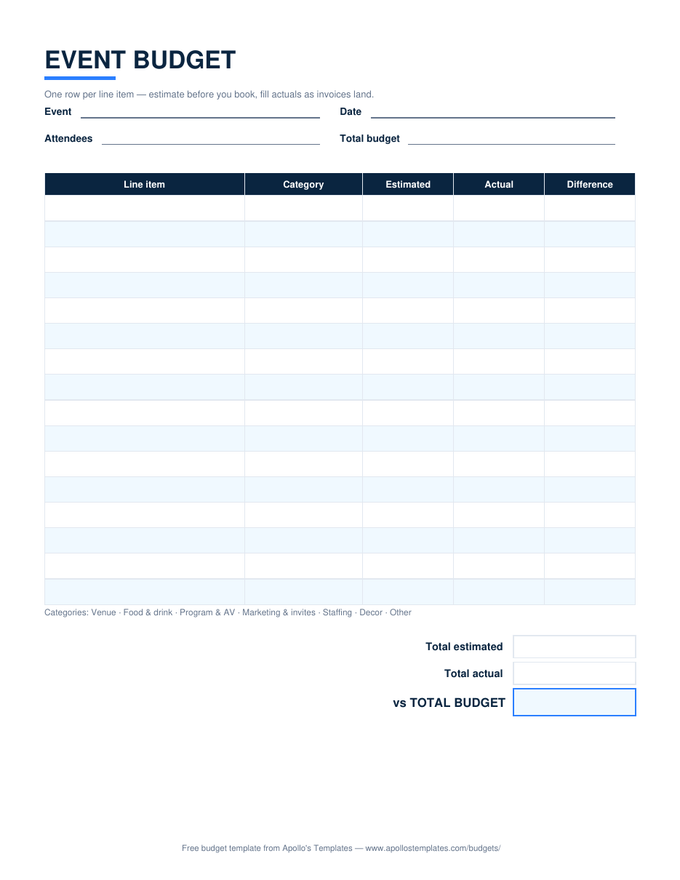
Event budgets live in two phases: the estimating phase, when everything is a quote and the total is a hope, and the actual phase, when invoices land and the truth arrives line by line. This sheet holds both \u2014 every line item carries an estimate and an actual with the difference computed, a category dropdown feeds a summary that shows where the money concentrates, and the per-attendee figure turns 'is this too expensive?' into a number the committee can actually debate.

From quote to invoice

One sheet, every format.

Excel — line items that reconcile

Estimates before booking, actuals as invoices land — with a SUMIF category summary and cost per attendee computed.
Printable PDF preview
PDF

Printable PDF

The line-item grid printed for event day — the clipboard copy for whoever holds the checkbook.
Download PDF

Word / Google Docs

The line items as an editable document — paste it into the proposal, fill actuals after.
Worth knowing

Estimate line items, not categories.

The estimating mistake that sinks events: budgeting “$3,000 for food” instead of listing what food means — buffet at per-head, bartender hours, cake, linens, delivery fee, service charge. Category-level estimates hide the lines that grow; item-level estimates make every quote comparable to what was hoped. The category summary then rebuilds the big picture automatically, so you get both altitudes without doing the math twice.

Two numbers to watch as actuals land: per-attendee cost, because events are per-head businesses and a headcount that slides from 80 to 65 quietly raises the per-person truth even while total spending holds; and the vs-budget line, which is the committee’s early-warning system. An event 15% over at the halfway mark has options — trim the open bar, drop the printed programs. The same discovery at load-in has none.

The biggest event
Wedding Budget
The specialized version — typical shares, deposits, and balances.
Open
Sell the tickets
Raffle Tickets
Printable raffle tickets for the fundraiser the budget is planning.
Open
Feed the planning
Event Invitations
Printable invitation templates for the event itself.
Open

Frequently asked questions

What categories should an event budget include?
The sheet's dropdown carries the seven that cover most events: venue, food & drink, program & AV, marketing & invites, staffing, decor, and other. What varies by event type is the weight — a conference is heavy on AV and venue, a fundraiser on food and printing, a birthday on food and decor. Type your line items first and let the category summary tell you your event's real shape; it's usually not the shape the first draft assumed.
How much contingency should an event carry?
Ten percent of the estimated total is the working standard, held as its own line item rather than padded invisibly into every estimate. Padded estimates make quotes impossible to evaluate — you can no longer tell whether the caterer came in high or your padding did. A visible contingency line spends transparently: when the AV cable run costs $200 nobody predicted, it comes out of contingency by name and the committee can watch the cushion deplete.
How do I budget an event where tickets offset costs?
Run this sheet as the cost side, gross — every expense at its real number — and track ticket or sponsor revenue separately rather than netting it into expense lines. Netting hides both truths: the event's actual cost and the revenue's actual performance. The break-even arithmetic then falls out cleanly: total actual cost divided by ticket price is the attendance you need, and per-attendee cost versus ticket price tells you the margin per seat.
What's the per-attendee number good for?
Decisions and defense. During planning it converts vague sticker shock into comparable terms — $52 a head for a client dinner reads differently than $52 a head for a staff picnic — and lets you price against alternatives (a restaurant buyout, a smaller venue). Afterward it's the number that makes next year's budget honest, and for fundraisers it's half of the equation donors and boards actually ask about: what did it cost per person to raise what we raised?
Updated through August 2026