



Apollo's Templates
HomeBudget TemplatesWedding
The best day, on budget

Wedding Budget Template

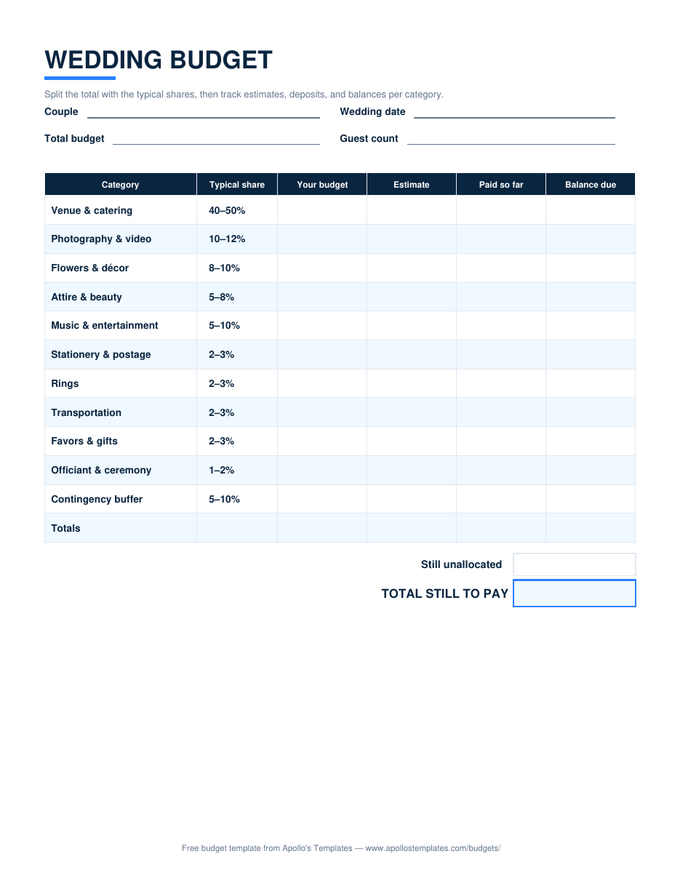
A wedding budget has two jobs most templates skip: telling you how to split the total before you've booked anything, and tracking the deposits after you have. This sheet does both \u2014 every category carries the share planners typically see (venue and catering alone eat 40\u201350%), and every row tracks your budget, the real estimate, what's been paid, and the balance still due. The totals reconcile against your overall number, and the cost-per-guest figure updates as the list grows.

Down the aisle, in the black

One sheet, every format.

Excel — shares, deposits, balances

Typical-share guidance beside your split; estimates, paid-so-far, and balance due compute per category and in total.
Printable PDF preview
PDF

Printable PDF

The full category grid printed for the wedding binder — typical shares included.
Download PDF

Word / Google Docs

The category list as an editable document — annotate vendors and dates inline.
Worth knowing

Log the deposit the day you pay it.

Wedding budgets rarely die from one big overspend — they die from balance-due amnesia. Every vendor takes a deposit months ahead, and by booking season a couple has paid eight deposits against eight remaining balances that nobody has summed. The Paid so far column exists for a ritual: the day any money moves, it gets logged, and TOTAL STILL TO PAY answers the only question that matters in the final month — what does the rest of this wedding actually cost from here?

On the shares: they’re a starting split, not a scorecard. The typical ranges reflect what planners commonly see — venue and catering dominating, photography around a tenth — but every real wedding rebalances around two or three priorities. The couple who cares about photography books the photographer at 15% and pulls flowers to 5% on purpose. The buffer row is the only one worth defending to the end: 5–10% unassigned until late is what turns surprises into line items.

Make it match the invites
Wedding Monogram Maker
Design the monogram for the stationery the budget just funded.
Open
The paper trail
Wedding Invitations
Printable invitation templates — the stationery line, handled for free.
Open
The other celebrations
Event Budget
Showers, rehearsal dinner, the day-after brunch — each on its own sheet.
Open

Frequently asked questions

How should we split our budget across categories?
Start from the typical shares printed on the sheet — venue and catering 40–50% combined, photography and video 10–12%, flowers and décor 8–10%, attire 5–8%, entertainment 5–10%, stationery 2–3%, with a 5–10% buffer — then deliberately rebalance around your top two or three priorities. The shares turn your total into first-draft dollar caps per category, which is what makes vendor conversations concrete: walking into a venue knowing your cap is $9,000 changes the meeting.
What does the average wedding actually cost?
Recent US averages run in the low $30,000s, but averages mislead here — they're pulled up by expensive metros and hundred-plus guest lists, and beautiful weddings happen at a fifth of that. The more useful number is the one this sheet computes: cost per guest. Catering, rentals, favors, and stationery all scale per head, so guest count is the biggest lever a couple controls — trimming twenty guests routinely funds the photographer upgrade.
What gets forgotten in wedding budgets?
The percent-shaped stuff and the day-of stuff: service charges and gratuities (venue service fees of 20%+ often aren't in the quote), alterations (routinely rivaling the garment), postage for the invitations, vendor meals, marriage license, and the getting-ready incidentals. This is the contingency buffer's real job — not disasters, but the forty predictable small lines no first draft contains. Log them as they surface and let the buffer absorb what the categories didn't foresee.
Who traditionally pays for what — and does it matter to the sheet?
Traditions exist (and vary by culture), but modern weddings mostly run on conversations, not rules — commonly the couple funds the bulk with defined contributions from parents. The sheet handles any arrangement the same way: the total budget is the sum of what everyone has actually committed, and contributed money toward a specific category (parents covering the venue, say) just gets noted on that row. What matters is that pledges become numbers before they become bookings.
Updated through August 2026