01Cover
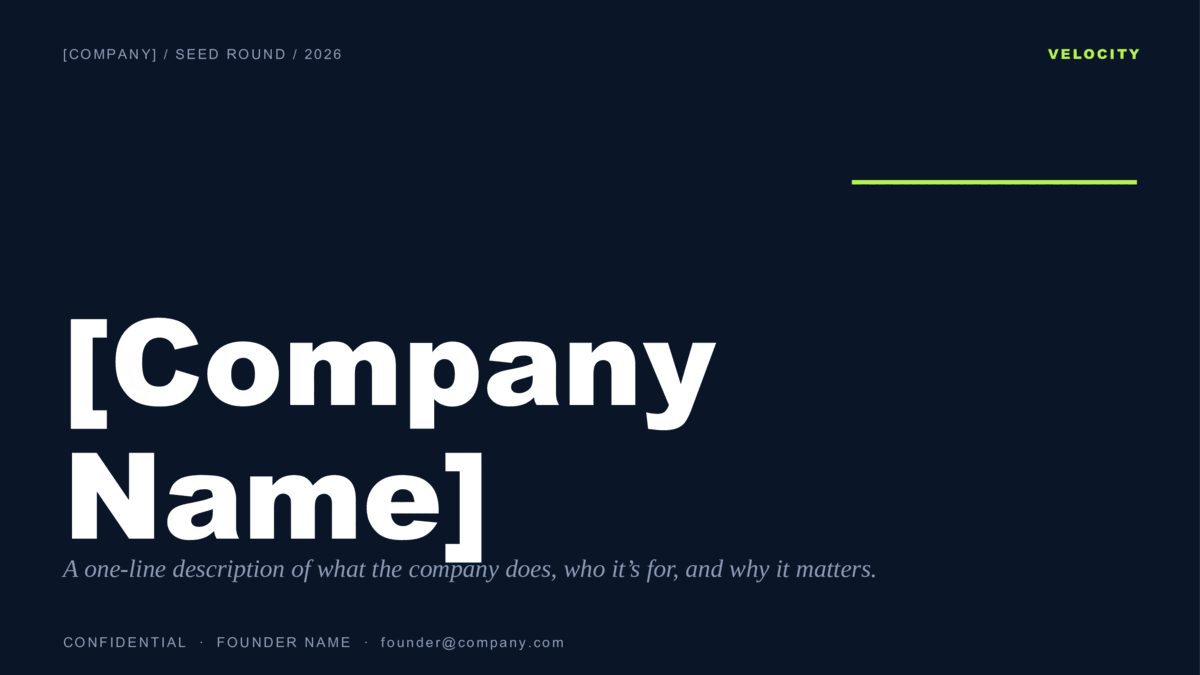
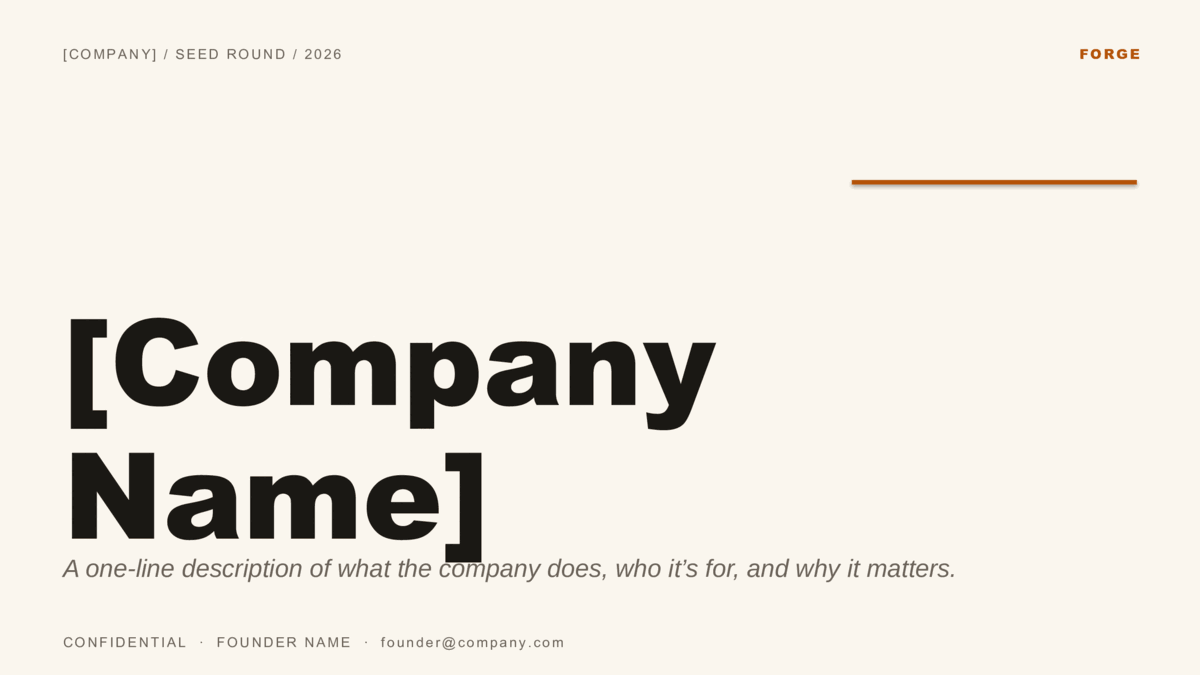
Tell them who you are and what round this is before they read another word.
Put on it: Company name, a one-line description of what you do and for whom, the round and amount, your name and email. That's all.
The usual mistake: A tagline instead of a description. "Reimagining work" tells an investor nothing; "Scheduling software for independent dental practices" tells them everything.
02Problem
Make the pain specific enough that the reader believes it exists.
Put on it: Who has the problem, how often, and what it costs them today. One or two numbers if you have real ones. A sentence of how they cope now.
The usual mistake: Describing the market instead of the problem. "The industry is worth $40B" is a market slide; "Practice managers spend eleven hours a week on the phone" is a problem.
03Solution
Answer the problem slide directly.
Put on it: What you built, in one sentence that mirrors the problem's wording. Then two or three ways it changes the customer's day. Save features for the product slide.
The usual mistake: Leading with technology. Investors want to know what changes for the customer; how it works can wait two slides.
04Market
Show that winning this is worth the trouble.
Put on it: TAM, SAM, SOM with one line on how you got each number — bottom-up beats a research report. Note if the market is growing and why.
The usual mistake: A top-down number with no method. "1% of a $50B market" is the slide investors have learned to ignore.
05Product
Prove it exists and that someone would use it.
Put on it: A screenshot or two, three to four capabilities in plain language, and where it is today — live, beta, prototype.
The usual mistake: A full feature list. Pick the three that map to the problem slide and leave the rest for the demo.
06Business Model
Show how money moves.
Put on it: Who pays, how much, how often. Pricing tiers if you have them. One line on what it costs you to deliver, if you know.
The usual mistake: Multiple revenue streams on a seed deck. Pick the one you're actually charging for; list the others as "later" if at all.
07Traction
Prove the thing is working, at whatever scale it's working.
Put on it: Two or three headline numbers — revenue, customers, growth rate, retention — with the time period. A short line of context under each.
The usual mistake: Vanity numbers. Sign-ups and page views don't count; paying customers, usage, and retention do. If you're pre-revenue, say so and show usage or letters of intent instead.
08Competition
Show you know the landscape and where you fit in it.
Put on it: Three or four real alternatives — including "do nothing" or "spreadsheet" if that's the true incumbent — and the two or three dimensions on which you win.
The usual mistake: "We have no competitors." Every investor reads that as "they haven't looked." A 2×2 with you in the top right is the second-most-common tell.
09Team
Convince them you're the people who can pull this off.
Put on it: Founders with one line each on the relevant thing they've done — not full résumés. Key hires if they're already in. Advisors only if they're actually involved.
The usual mistake: Logos of famous employers with no line on what the person did there. "Ex-Google" is not a credential; "led the team that shipped X" is.
10Ask
Say exactly what you want and what it buys.
Put on it: The amount, the rough use of funds (three or four buckets with percentages), the runway it gives you, and the milestones you'll hit before the next raise.
The usual mistake: A range instead of a number, or an amount with no milestones. Investors fund a plan, not a bank balance.