Apollo's Templates
HomeResumesDevOps
DevOps resumes · Word & Google Docs

Free DevOps Resume Templates

Free, ATS-friendly DevOps resume templates in Microsoft Word and Google Docs — four design languages, each native to the work. A resume-as-YAML config file, a status dashboard of SLO and MTTR tiles, a CI/CD pipeline node-flow, and a cloud blueprint with an architecture diagram. Across four roles — DevOps engineer, site reliability engineer (SRE), platform engineer, and cloud infrastructure engineer — every template foregrounds what DevOps hiring screens for: CI/CD, infrastructure-as-code, containers and Kubernetes, cloud (AWS/GCP), observability, and SRE practice (SLOs, error budgets). Whether you're breaking in with no experience, moving up from sysadmin, or going deep on reliability, pick the layout that matches your role and fill in your metrics.

The templates

Four DevOps roles, nine templates to choose from.

A config-file design for DevOps engineers, a monitoring dashboard for SREs (in two colors), a CI/CD pipeline for platform engineers (in three colors), and a cloud blueprint for infrastructure engineers (in three colors). Every one opens in Word or Google Docs, holds on one page, and is built to be ATS-friendly — with your CI/CD, IaC, Kubernetes, and cloud front and center.
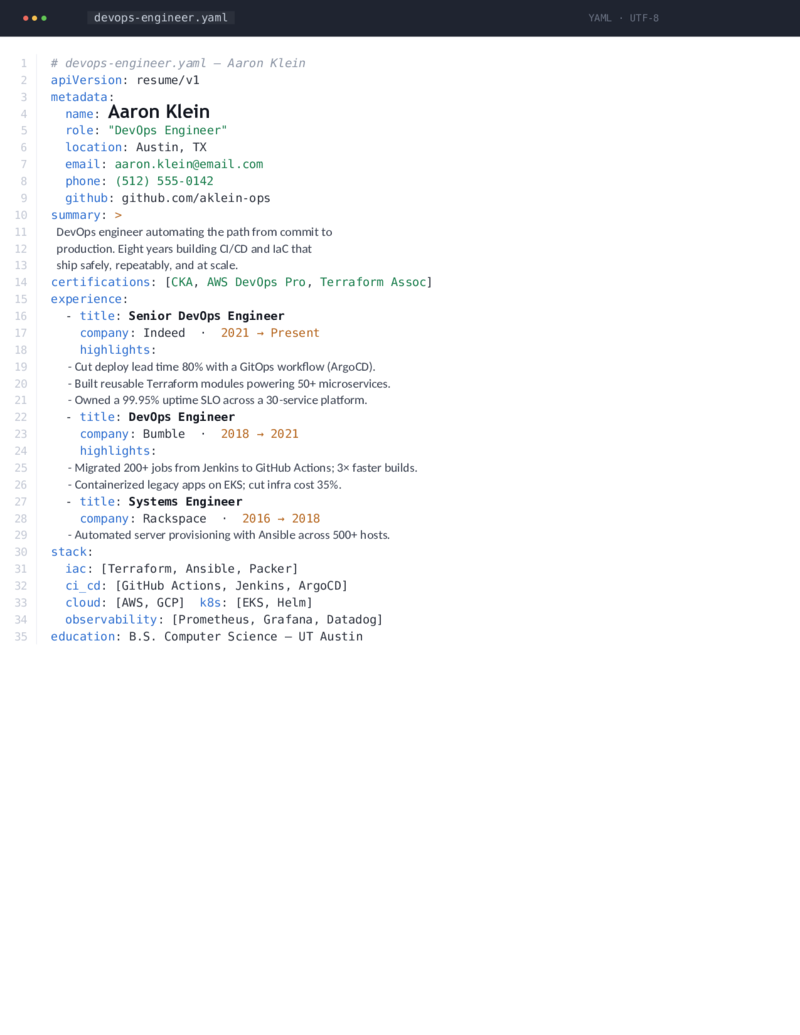
DevOps Engineer
A resume-as-YAML config file — line-number gutter, an editor tab bar, and syntax colors. The most distinctive of the set, foregrounding CI/CD, infrastructure-as-code, GitOps, and the full delivery stack.
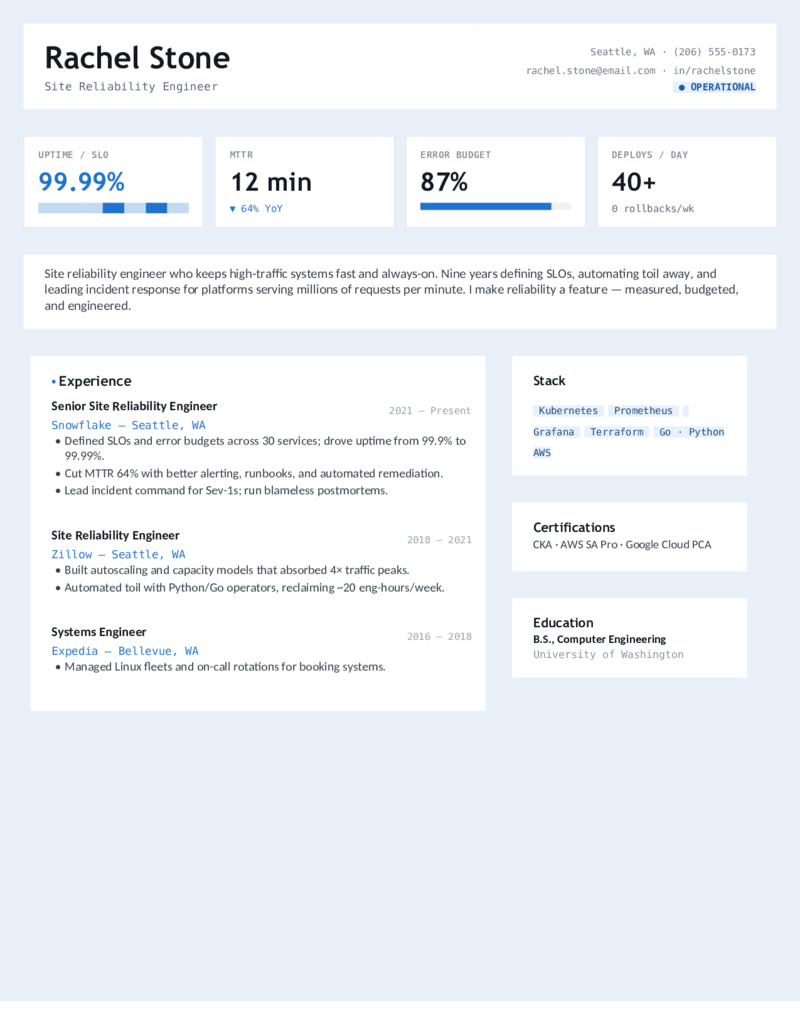
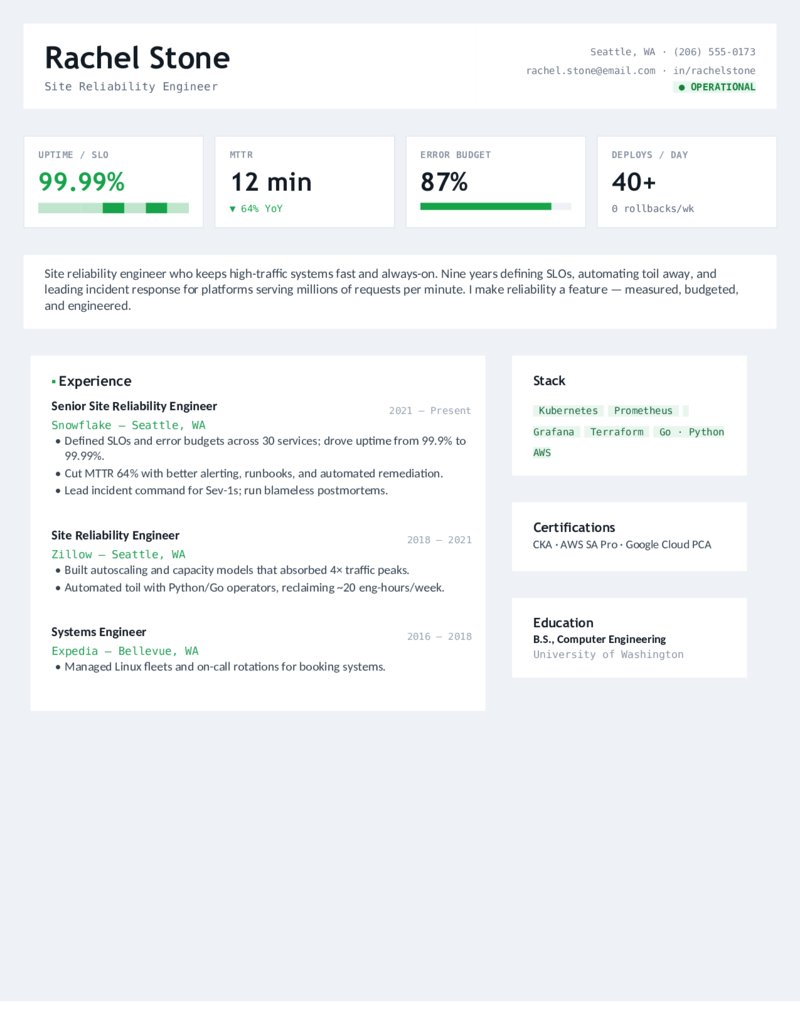
Site Reliability Engineer — Green
A status-dashboard layout for SREs — monitoring panels with SLO/uptime, MTTR, error-budget, and deploys-per-day tiles. Reliability sold as a feature: measured, budgeted, and engineered.
Site Reliability Engineer — Blue
The SRE dashboard on a light-blue background — the same SLO, MTTR, and error-budget tiles and incident-response focus, in a cooler palette.
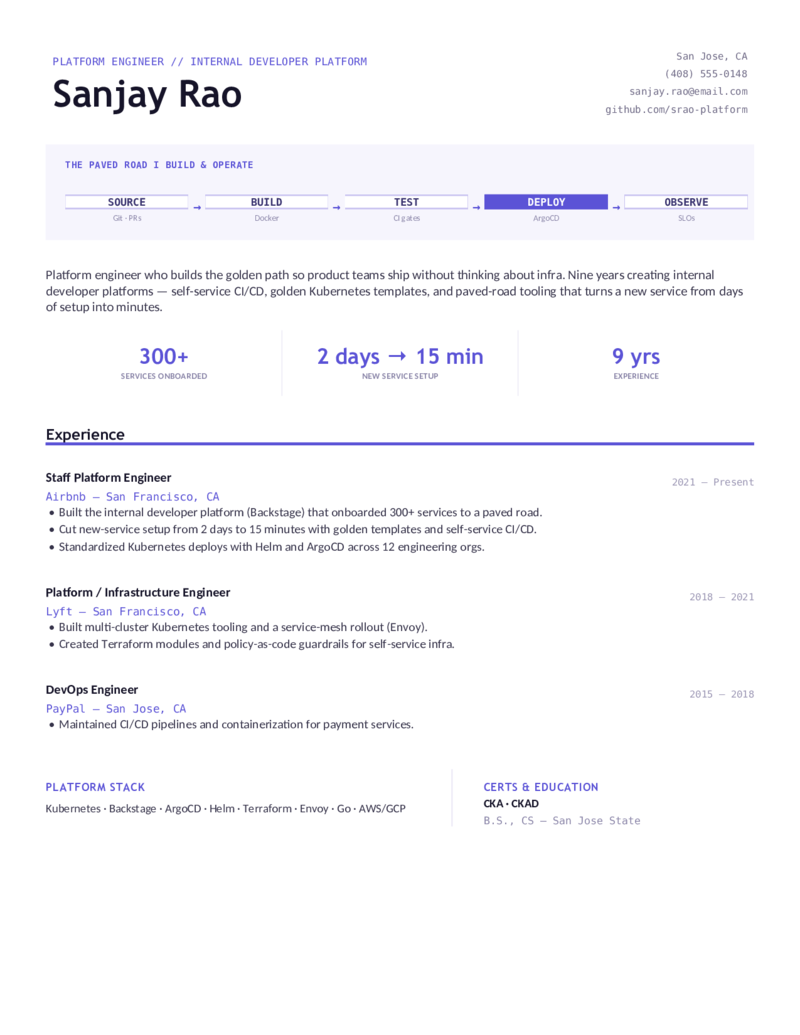
Platform Engineer — Violet
A CI/CD pipeline node-flow as the hero (source → build → test → deploy → observe) for platform engineers. Internal developer platforms, golden paths, and self-service Kubernetes.
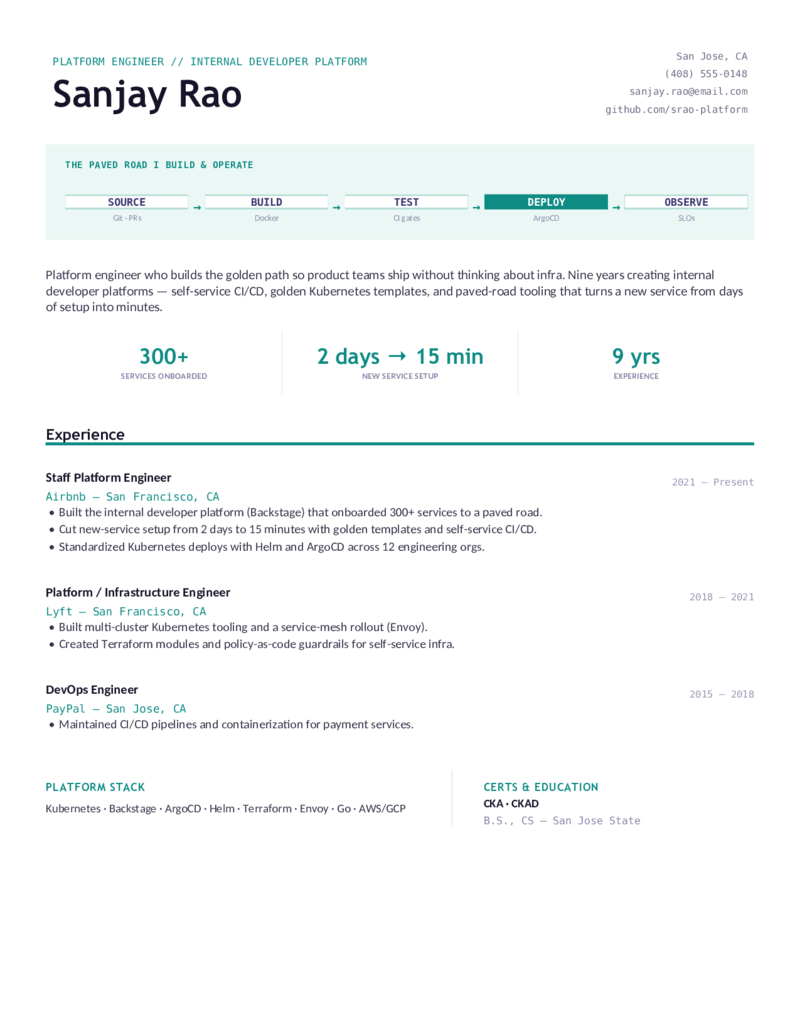
Platform Engineer — Teal
The platform-engineer pipeline layout in teal — paved-road tooling, Backstage, and golden Kubernetes templates, in a fresh green-teal palette.
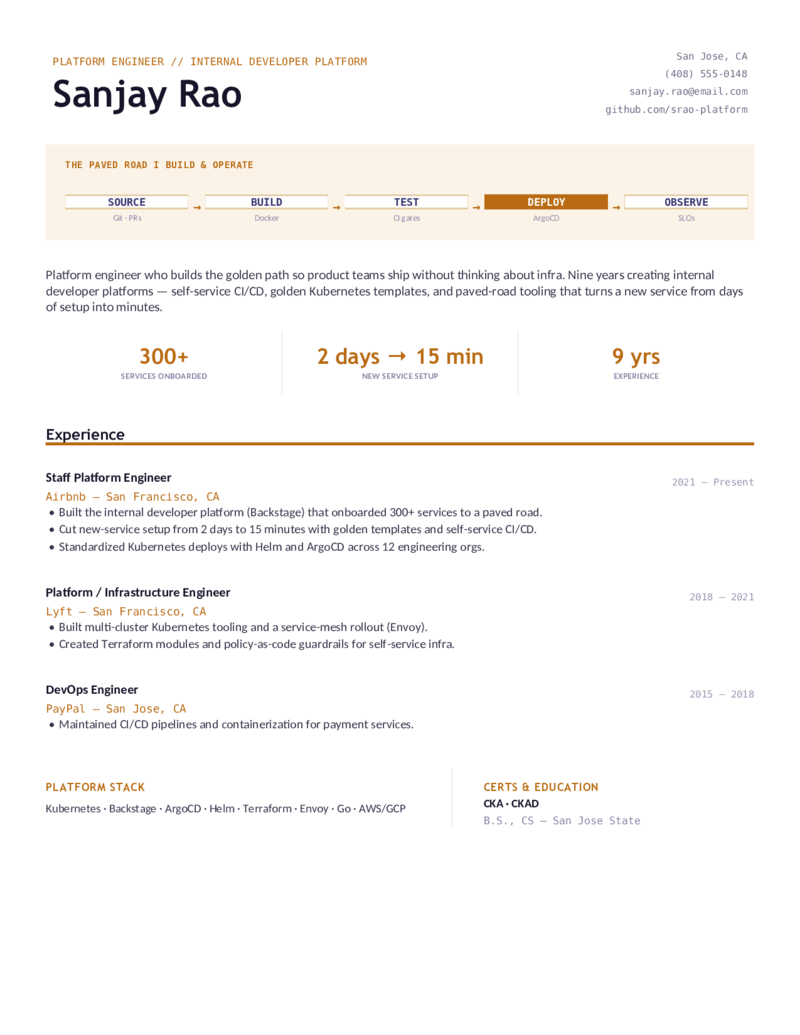
Platform Engineer — Amber
The platform-engineer pipeline layout in warm amber — the same node-flow hero and self-service-platform focus, with a bolder, distinctive accent.
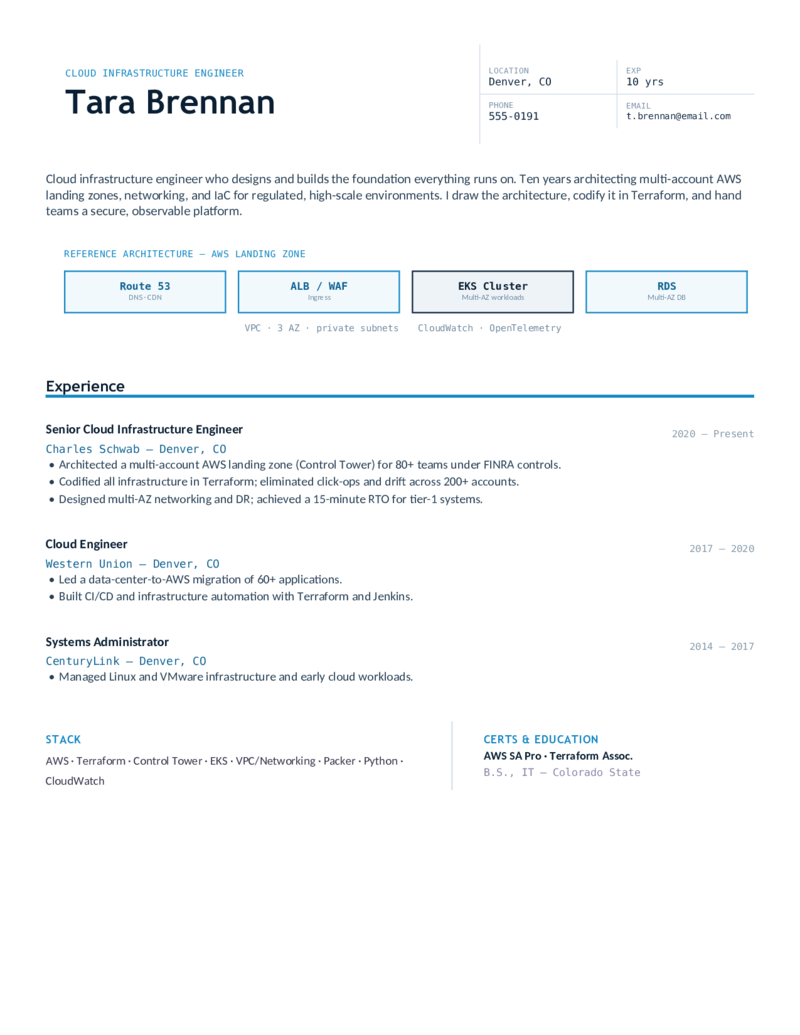
Cloud Infrastructure — Blue
A blueprint layout with a reference-architecture diagram (Route 53 → ALB/WAF → EKS → RDS) for cloud infrastructure engineers. AWS landing zones, Terraform, networking, and multi-AZ design.
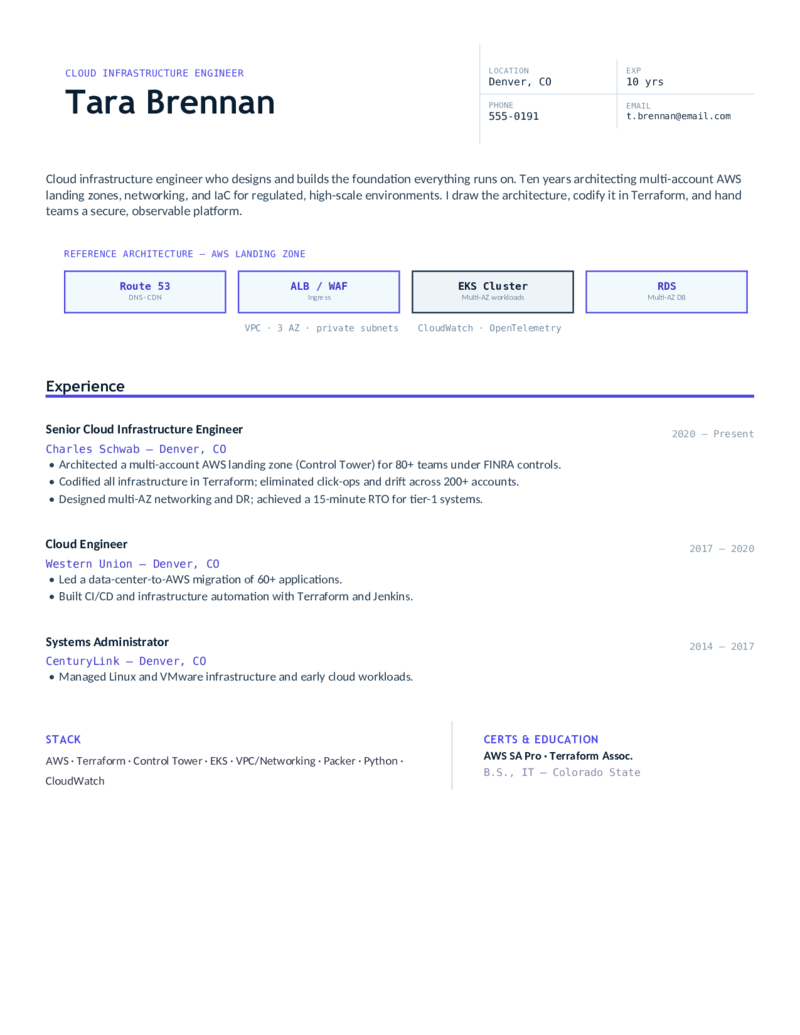
Cloud Infrastructure — Indigo
The cloud-infrastructure blueprint in indigo — the same title block and architecture diagram for AWS/Terraform landing-zone and networking roles.
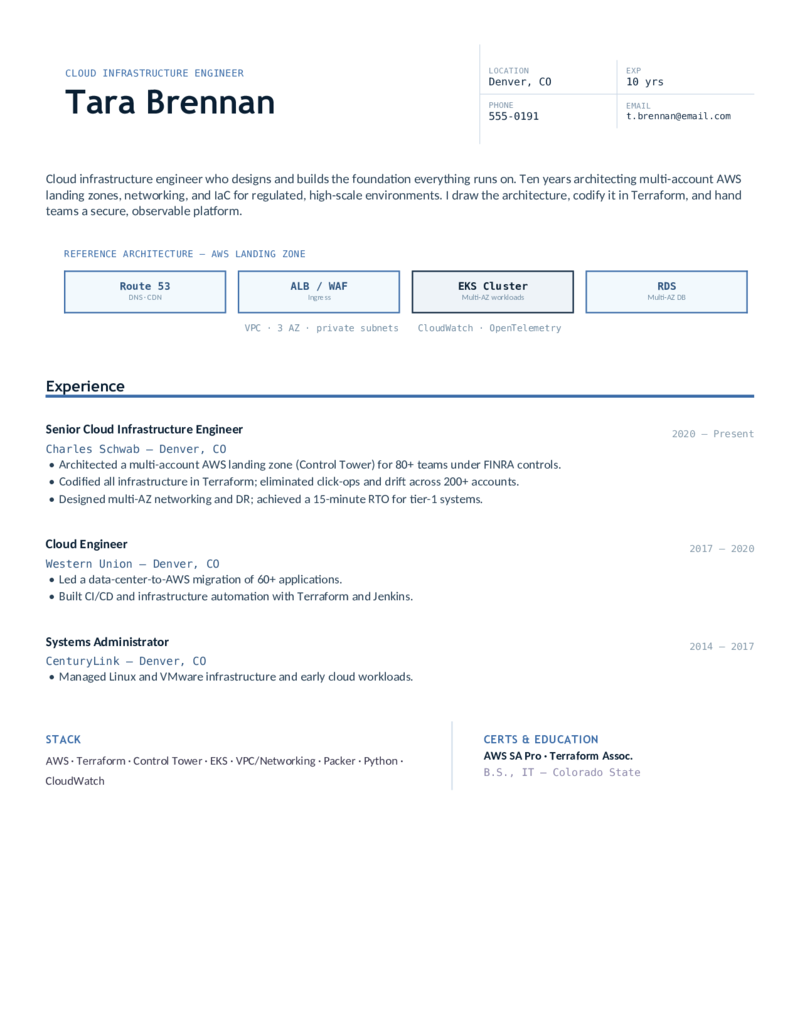
Cloud Infrastructure — Slate
The cloud-infrastructure blueprint in slate blue — a restrained, professional take on the architecture-diagram layout for senior cloud and infrastructure engineers.
What to include

What goes on a DevOps resume.

DevOps hiring screens on the delivery-and-reliability stack and on quantified impact. Put the things a DevOps hiring manager and the ATS look for where they’ll be seen — which is exactly what these templates do:

  • The delivery stack. CI/CD (Jenkins, GitHub Actions, GitLab CI), infrastructure-as-code (Terraform, Ansible), containers and Kubernetes (Docker, EKS/AKS/GKE, Helm), and GitOps (ArgoCD). These are the ATS-critical keywords.
  • Cloud & observability. One cloud deep (AWS/Azure/GCP) plus monitoring — Prometheus, Grafana, Datadog — and the reliability vocabulary: SLOs, SLIs, error budgets, MTTR, and DORA metrics.
  • Quantified outcomes. Tie every bullet to a number — “cut deploy lead time 80% with GitOps,” “drove uptime from 99.9% to 99.99%,” “onboarded 300+ services to a paved road.” Speed, reliability, and cost are what hiring scans for.
  • Projects when you’re new. No experience yet? A projects section — a CI/CD pipeline you built, a Dockerized app, a Terraform/AWS home lab — with a tool and a metric is the strongest substitute for work history.

Which role? DevOps leads with pipelines and IaC; SRE leads with reliability metrics; platform engineering leads with internal developer platforms and golden paths. If you write the product code rather than the pipeline, see software engineer; if you defend systems rather than ship them, see cybersecurity.

Make it yours

Fill it in and apply.

  1. Click Open in Google Docs to copy it into your Drive, or Download Word for the .docx.
  2. Fill the metrics with your real numbers — uptime/SLO, MTTR, deploy frequency, services onboarded, build-time and cost reductions.
  3. Mirror the job posting’s keywords exactly — CI/CD, Terraform, Kubernetes, Docker, AWS, observability — so the ATS scores you.
  4. Keep it to one page; export a PDF to send and a Word copy for ATS portals.
Common questions

DevOps resume FAQ

How do I write a DevOps resume with no experience?
Lead with a resume objective, then lean on hands-on projects, a bootcamp, and certifications: show a CI/CD pipeline you built, a Dockerized app, or a Terraform/AWS lab with a number attached ("automated deployment, cut build time 30% in a class project"). Name specific tools — Jenkins, Docker, Linux, Bash — instead of vague phrases like "knowledge of DevOps tools."
How do I move from sysadmin to DevOps on my resume?
Reframe your existing Linux, scripting, and automation work in DevOps language — turn "managed servers" into "automated provisioning with Ansible" and "wrote shell scripts" into "built deployment automation reducing manual steps." Signal one cloud deeply (AWS/Azure), add a cert in progress, and show two or three completed automation projects with metrics.
What's the difference between a DevOps, SRE, and Platform Engineer resume?
A DevOps resume emphasizes CI/CD pipelines, IaC, and delivery automation; an SRE resume leads with reliability metrics (uptime, MTTR, SLOs/SLIs, error budgets, incident response) and software-engineering skills (Python/Go); a Platform Engineer resume highlights internal developer platforms, golden paths, self-service tooling, and Kubernetes operations. Match your bullets to whichever the job title emphasizes.
Which certifications and tools should a DevOps engineer list on a resume?
Put certs in their own section with dates — AWS Certified DevOps Engineer (Professional), Certified Kubernetes Administrator (CKA), and HashiCorp Terraform Associate carry the most weight. For tools, cover the ATS-critical core: CI/CD, Docker, Kubernetes, Terraform, AWS/Azure/GCP, Jenkins, Ansible, Git, Linux, Python/Bash, plus observability (Prometheus, Grafana, Datadog).
How do I show Kubernetes and infrastructure-as-code projects on a DevOps resume?
Describe each project as an outcome with a tool and a number: "Migrated 30+ microservices to Kubernetes (EKS), cutting deployment time 70%" or "Provisioned multi-region infra with Terraform, reducing setup from days to minutes." Include the architecture (EKS/AKS/GKE, Helm, GitOps) and quantify reliability or speed gains.
Is my DevOps resume ATS-friendly?
Use a single-column-friendly layout with standard fonts and section headers, save as Word or PDF, and weave keywords in naturally ("Implemented CI/CD pipelines using Jenkins"). Make sure the ATS-critical terms appear — CI/CD, Docker, Kubernetes, Terraform, AWS, Linux, automation — since missing more than two often filters a DevOps resume out automatically.

DevOps resume templates · Updated June 2026

Keep going

More resume templates.

Related
Software Engineer Resumes
If you write the product code rather than the pipeline that ships it, the software engineer layouts foreground systems, languages, and shipping features.
Open
Related
Cybersecurity Resumes
If your work is defending systems — threat detection, vulnerability management, compliance — rather than building and operating them, the security layouts fit better.
Open
Pair it
Cover Letter Templates
Add a short cover letter that restates your strongest automation and reliability wins and the cloud and tooling you go deep on.
Open