Apollo's Templates
HomeResumesCybersecurity
Cybersecurity resumes · Word & Google Docs

Free Cybersecurity Resume Templates

Free, ATS-friendly cybersecurity resume templates in Microsoft Word and Google Docs — built around what security hiring actually screens for: certifications and hands-on tooling. Eight roles, each in its own layout — SOC analyst, penetration tester, security engineer, GRC/compliance, application security, incident response/DFIR, threat intelligence, and cloud/DevSecOps — every one foregrounding the certs (Security+, CISSP, OSCP, CEH, CISM) and tools (Splunk, CrowdStrike, Burp Suite, MITRE ATT&CK, NIST) that get you past the filter. Whether you're breaking in with no experience, no degree, or pivoting from IT or the military, pick the layout that matches your role and fill in your skills.

The templates

Eight cybersecurity roles, ten layouts to choose from.

Four security-console dossiers (SOC analyst, penetration tester, security engineer, GRC/compliance) plus four distinct layouts — a sidebar for application security, a forensic report for incident response, a centered intel matrix for threat intelligence, and a timeline for cloud/DevSecOps. The application security design comes in three colors. Every one opens in Word or Google Docs, holds on one page, and is built to be ATS-friendly — with your certs and tooling front and center.
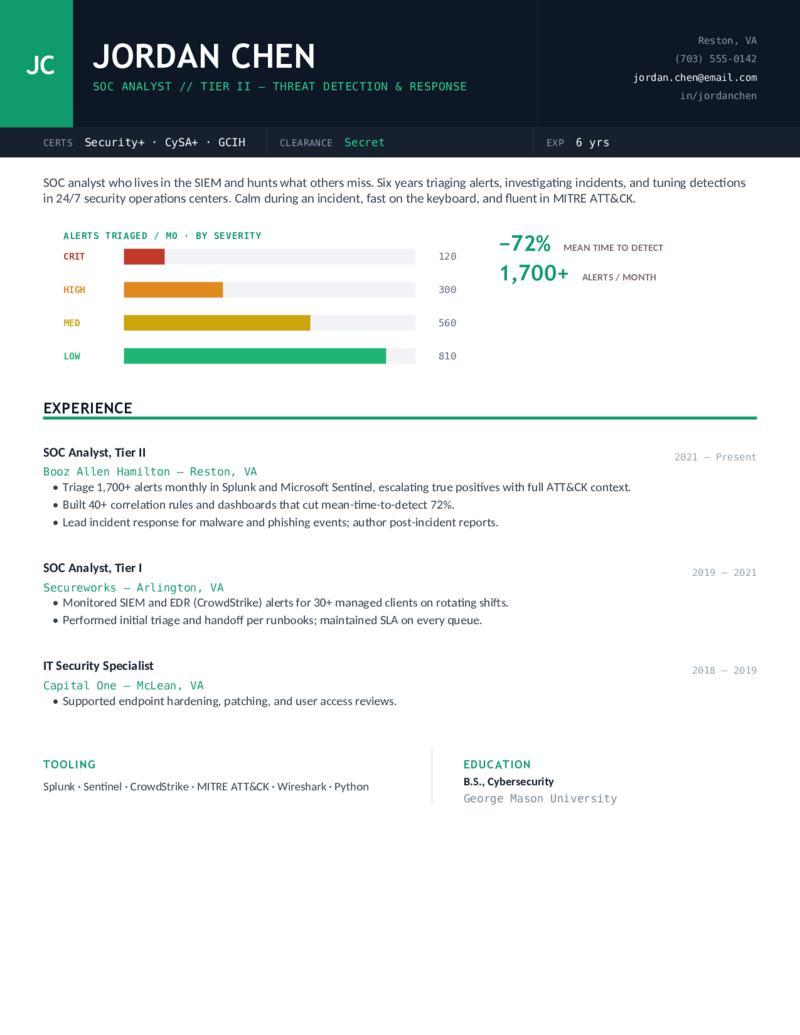
SOC Analyst
Security-console dossier for SOC and security-operations analysts — a dark hex-grid header, a certs/clearance strip, and an alert-severity meter with a mean-time-to-detect stat. Built around SIEM triage, detection, and incident response.
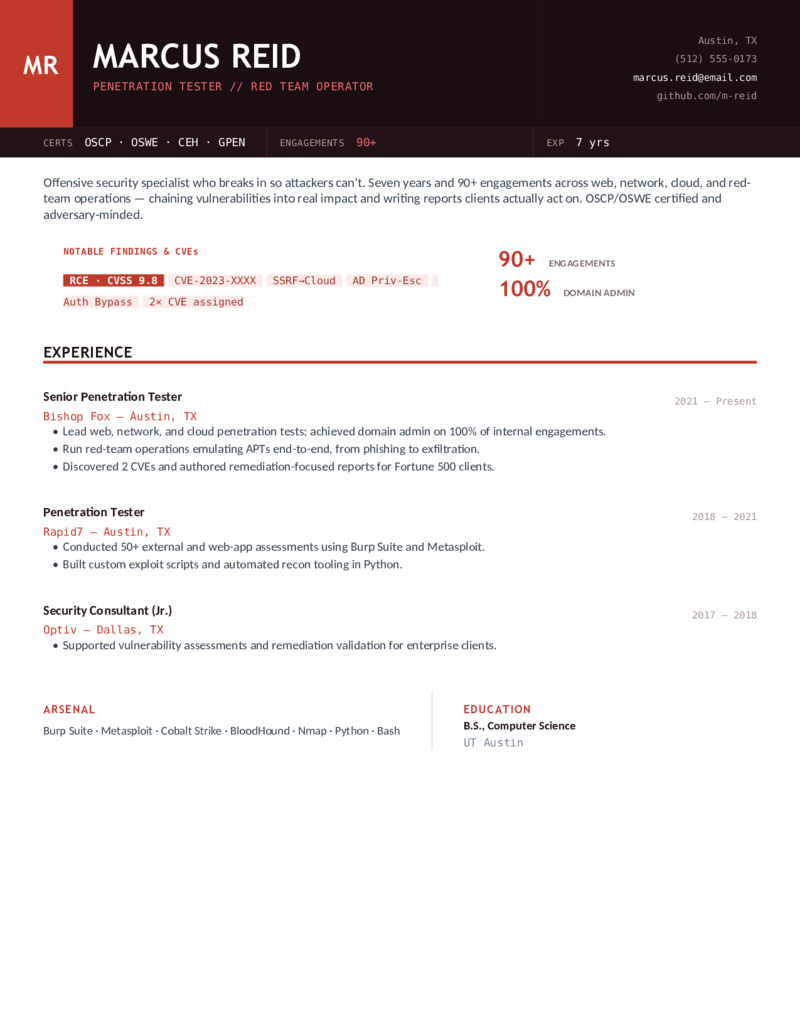
Penetration Tester
Offensive-security layout for pentesters and red teamers — a findings-and-CVE chip board with engagement stats. Foregrounds OSCP/OSWE, Burp Suite and Metasploit, and the impact you proved.
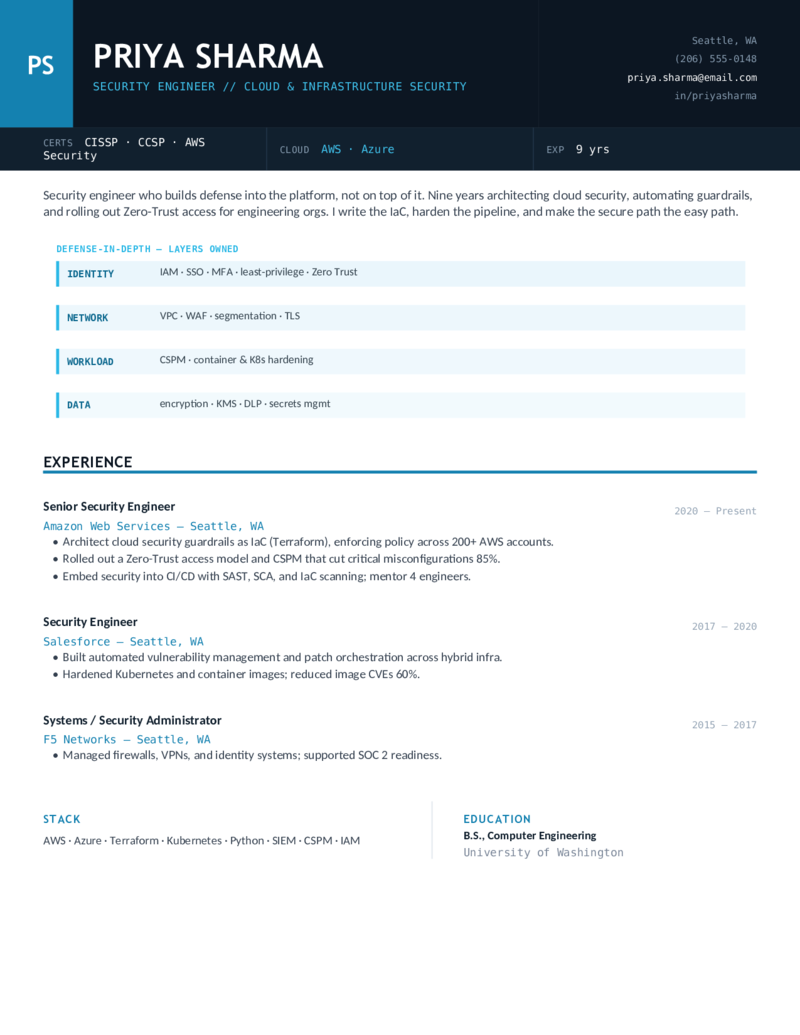
Security Engineer
Cloud and infrastructure security engineer dossier with a defense-in-depth layer stack (identity, network, workload, data). CISSP/CCSP, Zero Trust, IaC, and the pipeline you harden.
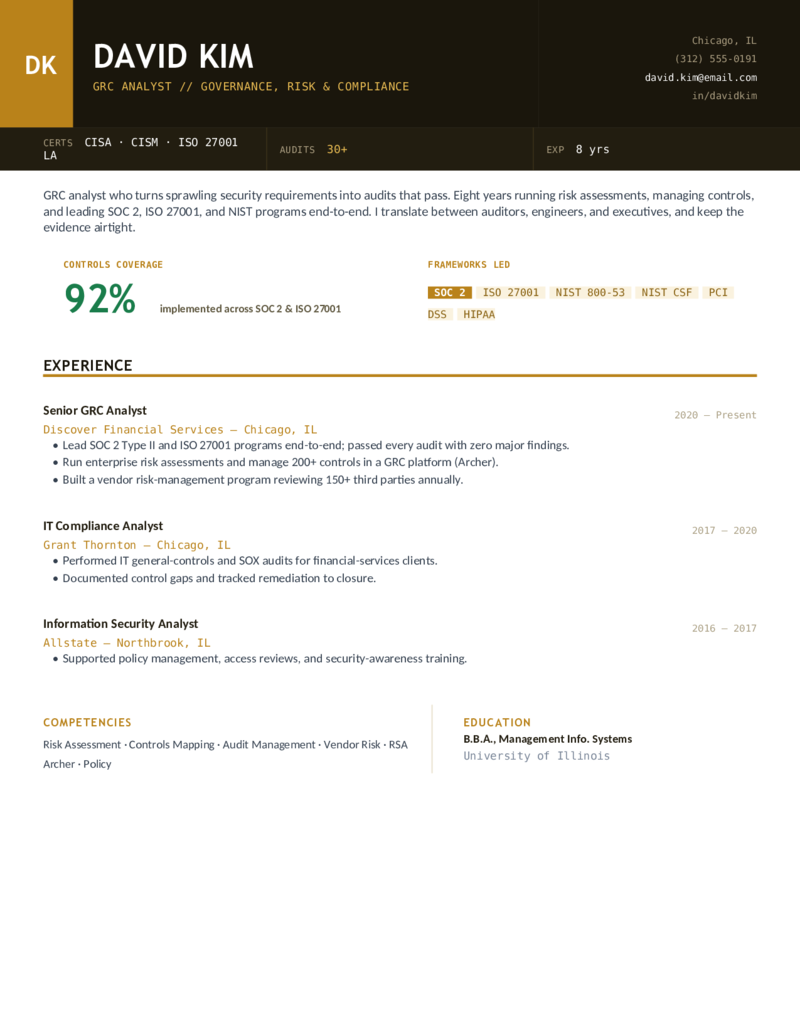
GRC / Compliance
Governance, risk & compliance analyst layout with a controls-coverage figure and a frameworks-led chip set (SOC 2, ISO 27001, NIST, PCI DSS). For risk assessments, audits, and CISA/CISM holders.
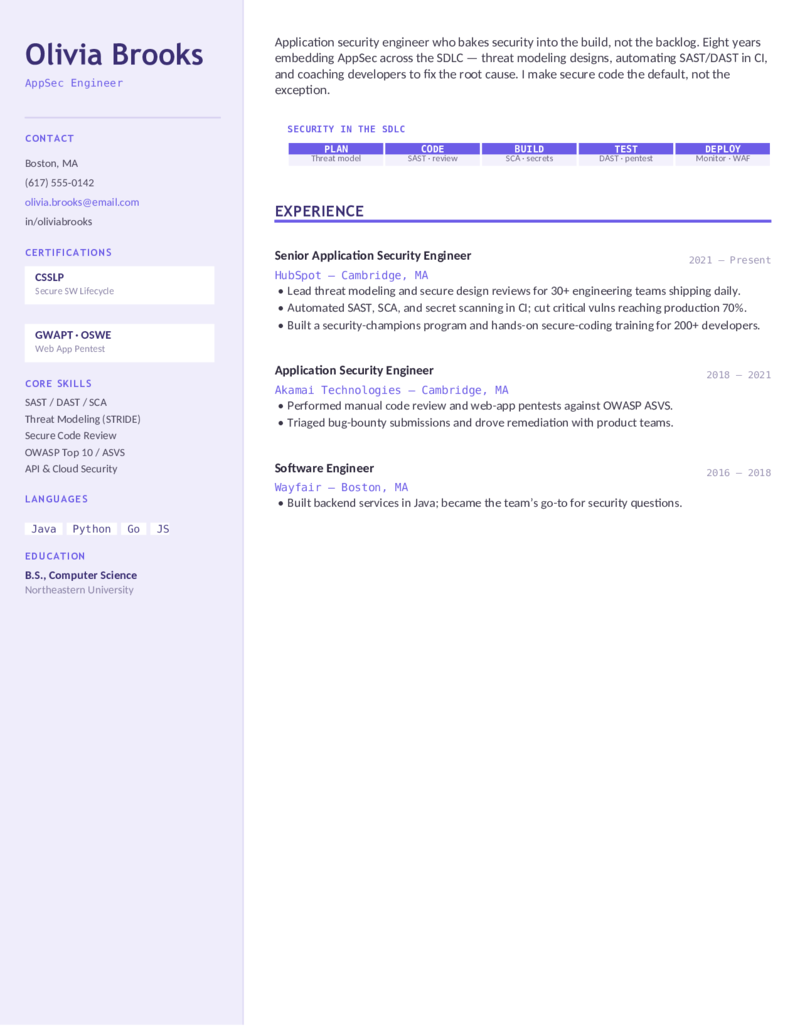
Application Security — Violet
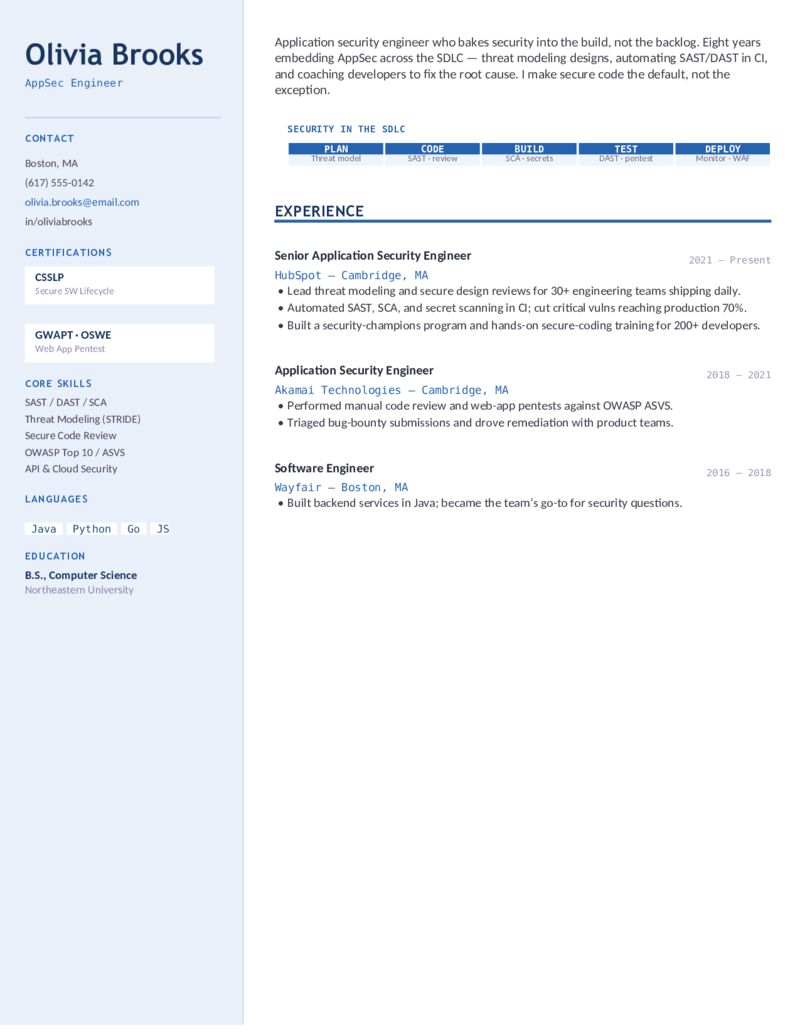
Sidebar layout for application security engineers — a full-height rail for certs, skills, and languages, plus a secure-SDLC pipeline. SAST/DAST/SCA, threat modeling, and OWASP.
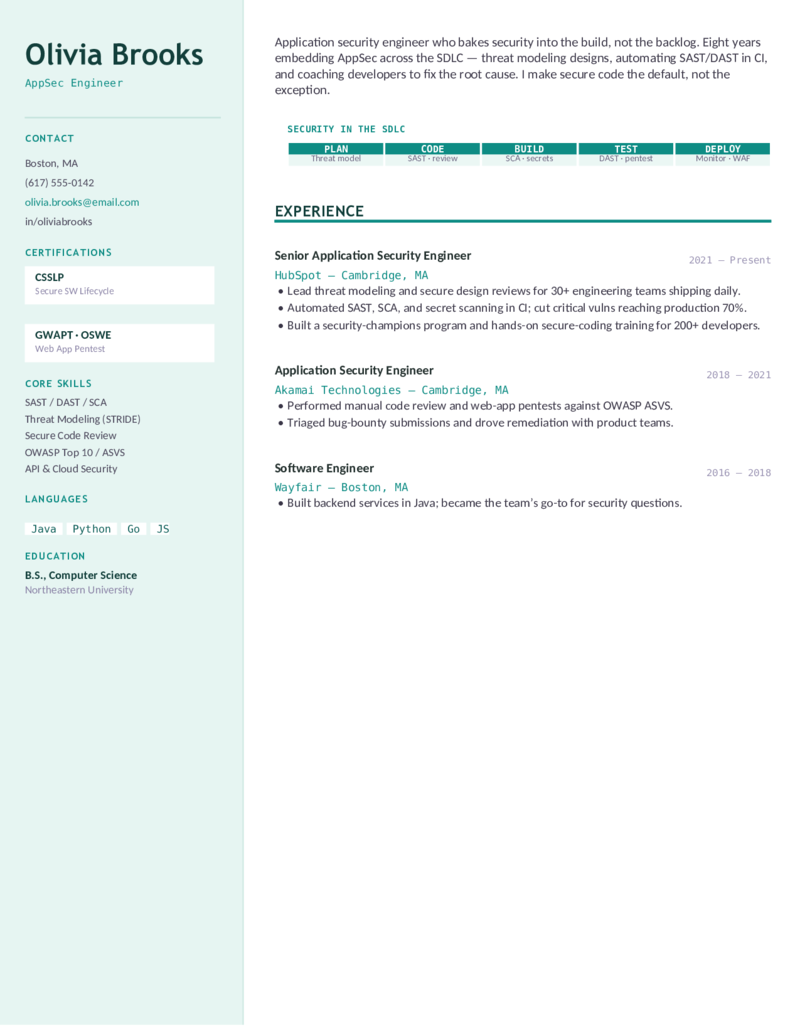
Application Security — Teal
The AppSec sidebar in teal — the same secure-SDLC pipeline and certs-and-skills rail for application and product security engineers, in a cooler palette.
Application Security — Blue
The AppSec sidebar in blue — a clean, professional take on the secure-SDLC layout for AppSec, DevSecOps, and secure-code-review roles.
Incident Response / DFIR
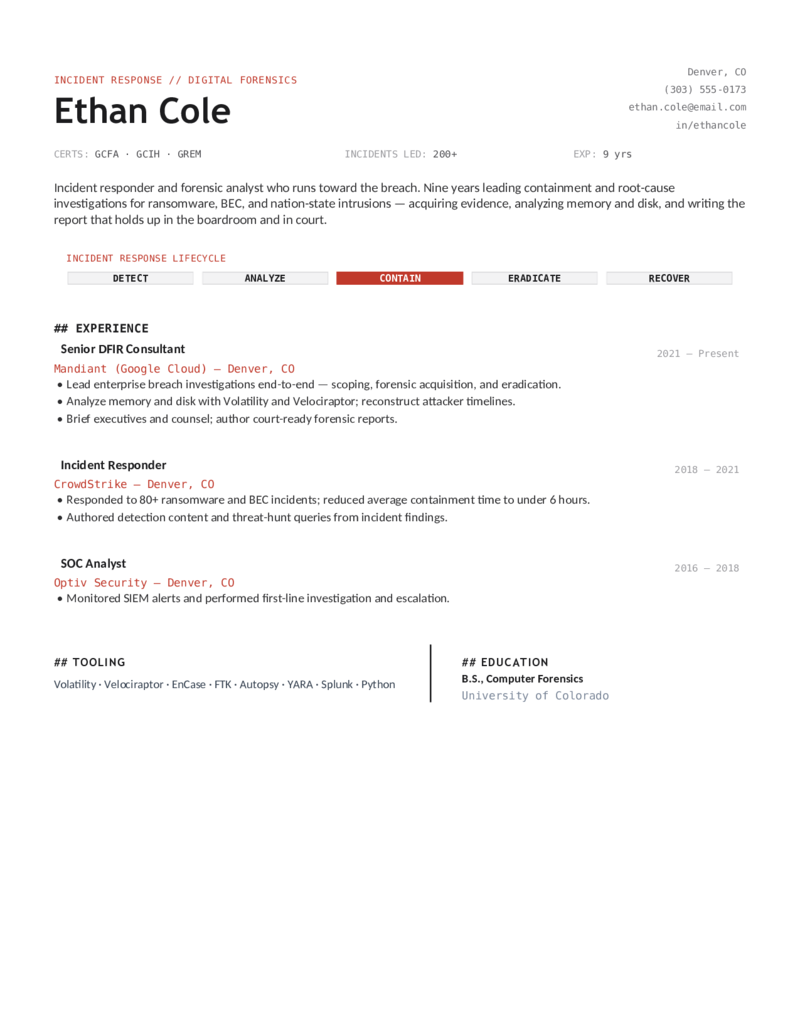
A minimal monospace forensic-report layout for incident responders and DFIR analysts — an IR-lifecycle flow (detect → analyze → contain → eradicate → recover) and tooling like Volatility and Velociraptor.
Threat Intelligence
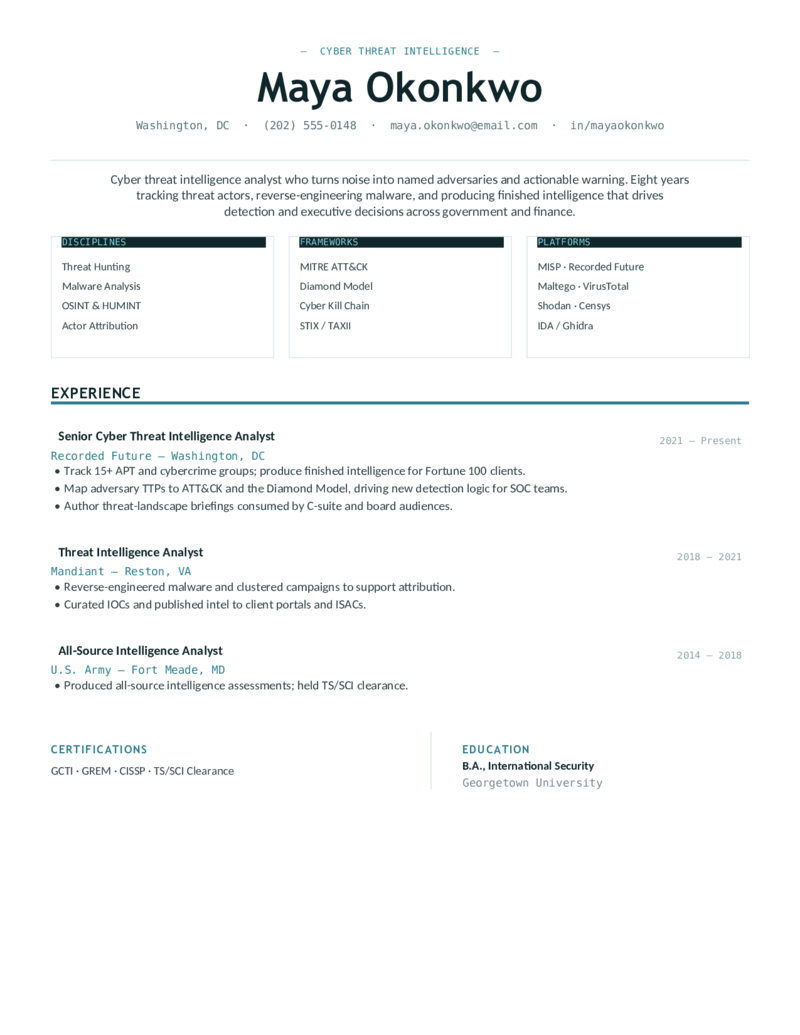
A centered nameplate with an intel-matrix grid (disciplines, frameworks, platforms) for cyber threat intelligence analysts. MITRE ATT&CK, the Diamond Model, malware analysis, and actor attribution.
Cloud / DevSecOps
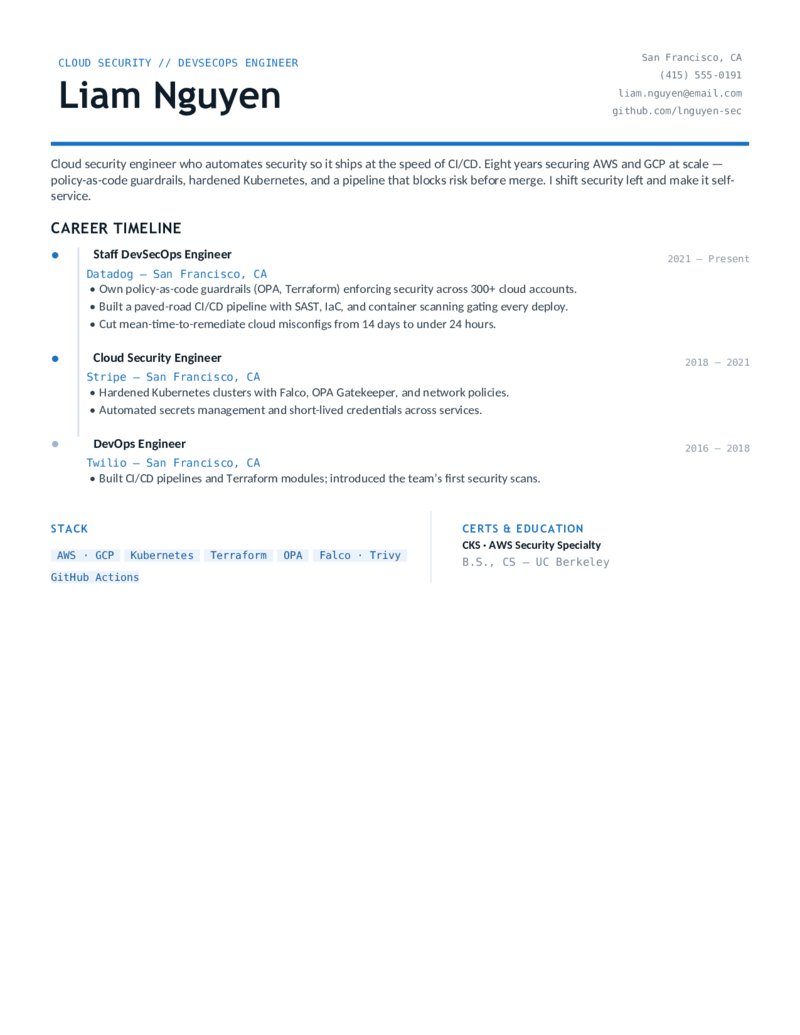
A vertical career-timeline layout for cloud security and DevSecOps engineers — policy-as-code guardrails, hardened Kubernetes, and a CI/CD pipeline that blocks risk before merge. AWS/GCP, Terraform, OPA.
What to include

What goes on a cybersecurity resume.

Cybersecurity hiring screens hard on certifications and demonstrated, hands-on skill. Put the things a security hiring manager and the ATS look for where they’ll be seen — which is exactly what these templates do:

  • Certifications, up top. Security+, CySA+, CISSP, OSCP, CEH, CISM, CCSP — full name and year, ordered by relevance to the role. In this field certs often carry as much weight as a degree.
  • Tooling & frameworks. The stack you actually use — SIEM/EDR (Splunk, Sentinel, CrowdStrike), Burp Suite, Nmap, Metasploit — plus frameworks like MITRE ATT&CK, NIST, and ISO 27001. These are the exact keywords parsers match against.
  • Quantified impact. Reduce risk, detect a threat, or prove compliance with a number — “cut mean-time-to-detect 72%,” “triaged 1,700+ alerts a month,” “passed every audit with zero major findings.”
  • Labs & projects when you’re new. No experience yet? A dedicated Labs & Projects section — a home SOC lab, TryHackMe/HackTheBox, CTFs, detections mapped to ATT&CK — is the strongest substitute for work history.

Pivoting in? Reframe IT, networking, or military experience around defense — monitoring, hardening, access reviews, and risk. If your work is really building software rather than securing it, the software engineer templates may fit better.

Make it yours

Fill it in and apply.

  1. Click Open in Google Docs to copy it into your Drive, or Download Word for the .docx.
  2. Lead with your certifications and tooling — Security+, CISSP, OSCP, SIEM, MITRE ATT&CK — and fill the stat line with real numbers.
  3. Mirror the job posting’s keywords exactly — SIEM, incident response, vulnerability management, threat detection — so the ATS scores you.
  4. Keep it to one page; export a PDF to send and a Word copy for ATS portals.
Common questions

Cybersecurity resume FAQ

How do I write a cybersecurity resume with no experience?
Lead with a skills and certifications block above education, then add a "Labs & Projects" section showing hands-on work — TryHackMe/HackTheBox rooms, CTFs, a home lab, or a SIEM/detection project. Frame each with a tool used and a measurable outcome (e.g., "triaged 50+ simulated SIEM alerts") so a recruiter sees applied skill, not just coursework.
Can I get a cybersecurity job with no degree?
Yes — in this field certifications and demonstrated hands-on skill often outweigh a degree. Put Security+ (the recognized entry baseline) front and center, list a home lab and projects, and use a clean ATS template so the skills and cert keywords parse correctly.
Which certifications should I put on a cybersecurity resume?
List the full certification name and the year earned, ordered by relevance to the role: Security+ or CySA+ for entry-level/SOC, OSCP/CEH for pentest, CISSP/CISM for senior and leadership, CCSP for cloud, and CISA or ISO 27001 Lead Auditor for GRC. Include "in progress" certs too — recruiters credit them.
SOC analyst vs. security engineer vs. penetration tester — which template do I use?
A SOC analyst resume centers on monitoring, SIEM/EDR triage, and incident response; a security engineer resume centers on building and hardening systems, automation, and architecture; a pentester resume centers on offensive tooling (Burp Suite, Metasploit, Nmap), findings, and OSCP/CEH. Pick the layout that matches the role and mirror that job posting's language.
How do I put a home lab or TryHackMe on my cybersecurity resume?
Create a dedicated "Labs & Projects" section and give each entry a title, the tools used, and what you accomplished — e.g., "Built a home SOC lab (Splunk, Sysmon, pfSense) and wrote detections mapped to MITRE ATT&CK." This is the strongest substitute for work experience when you're breaking in.
Are these cybersecurity resume templates ATS-friendly?
Yes — every template uses standard headings and a clean, single-page layout that applicant tracking systems parse cleanly, and downloads in Word (.docx) and Google Docs. Mirror the job posting's keywords (SIEM, incident response, vulnerability management, Security+) in your skills section to score higher.

Cybersecurity resume templates · Updated June 2026

Keep going

More resume templates.

Related
Software Engineer Resumes
If you build software rather than secure it — or you're an AppSec engineer coming from a dev background — the software engineer layouts foreground shipping and systems.
Open
Related
Executive & CEO Resumes
For security leadership — CISO, VP of Security, and director roles — where the story is strategy, budget, and risk at the board level rather than hands-on tooling.
Open
Pair it
Cover Letter Templates
Add a short cover letter that restates your strongest certs, your hands-on wins, and why you want to defend this particular org.
Open