Apollo's Templates
HomeBusinessTimesheet TemplatesGoogle Docs
The word-processor versions

10 Google Docs Timesheet Templates

Every timesheet in the library as a one-click Google Docs copy — for the workplaces that live in Docs the way others live in Word. Click, make a copy, and the document lands in your Drive: editable tables, your company name a keystroke away, printable under any header. Fair warning from the makers: Docs doesn't calculate — when you want hours and pay computed while you type, the same layouts live one page over as Google Sheets.

Copies, not downloads

Ten documents, one click each.
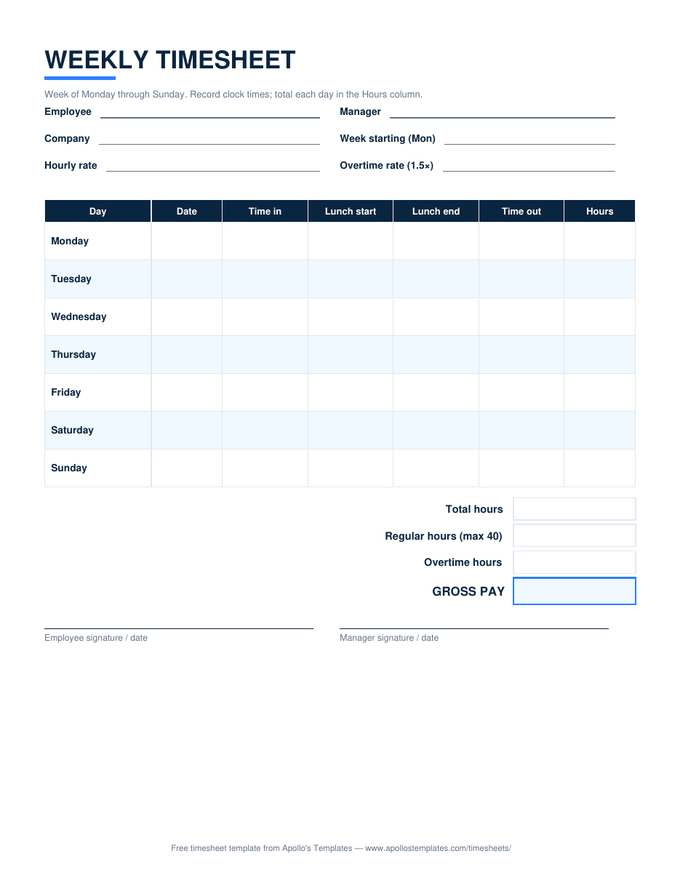
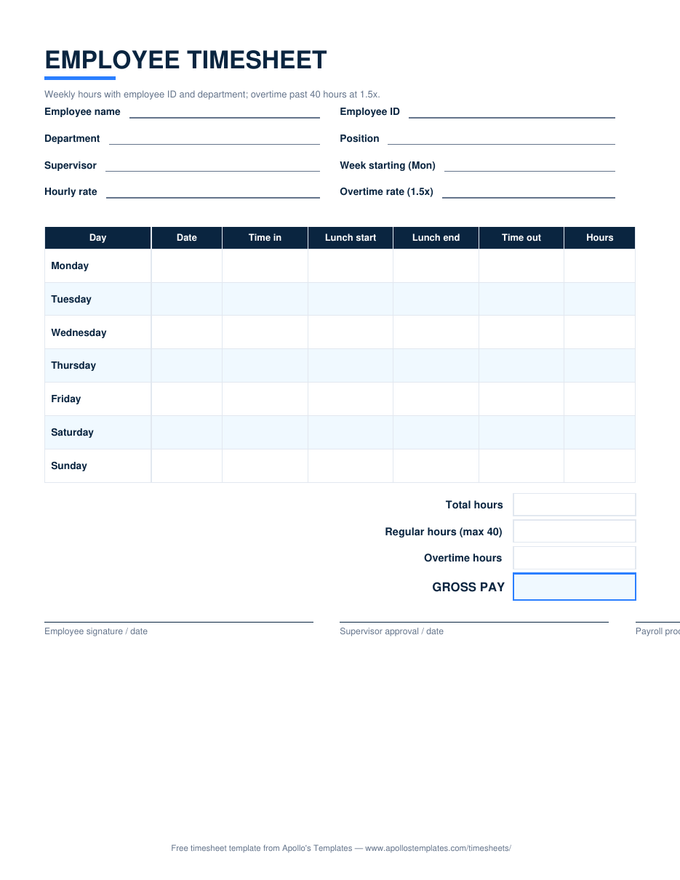
Weekly timesheet with daily in, out, and lunch columns, an automatic 40-hour overtime split, and gross pay

Weekly — with lunch columns

The full weekly grid as a Docs table: seven days, lunch tracking, both signature lines.
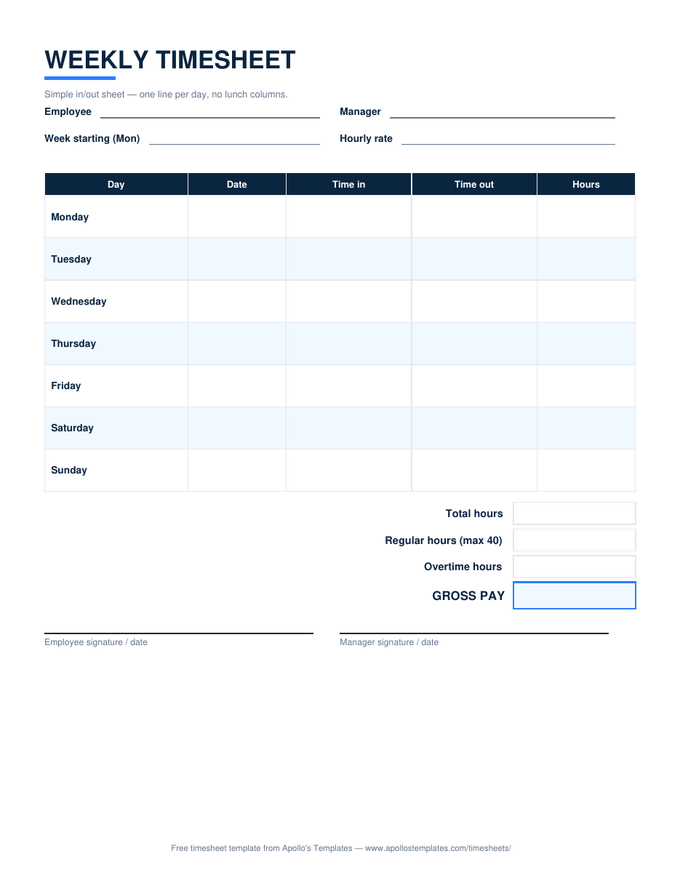
Simple weekly timesheet with one row per day, daily hours, and a week total — no overtime or pay columns

Weekly — simple in/out

Day, date, in, out, hours — the minimal week for paid-break workplaces.
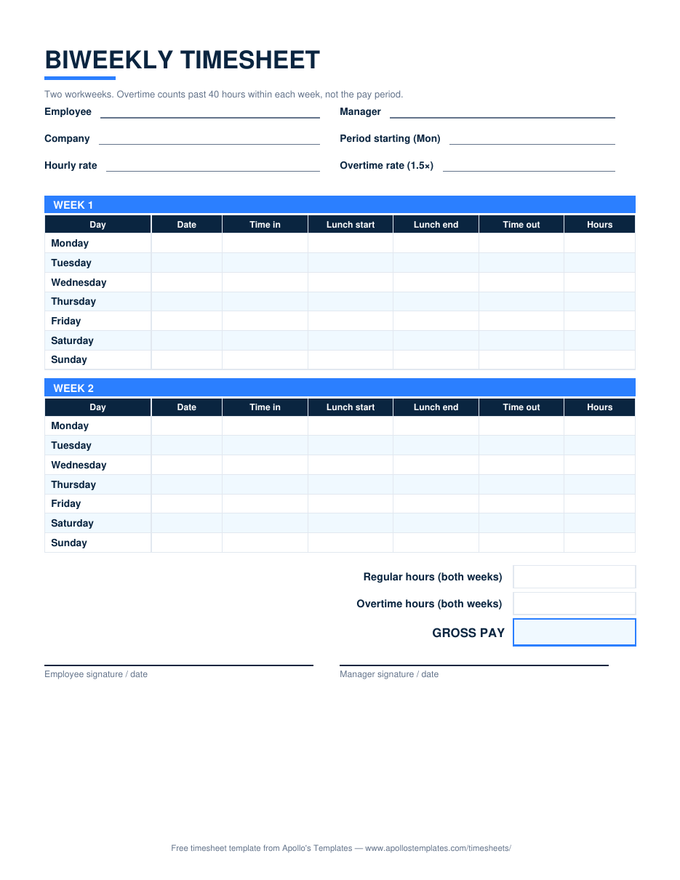
Biweekly timesheet with two week blocks, lunch-break columns, per-workweek overtime subtotals, and period pay

Biweekly — two week blocks

Both workweeks with their own subtotal rows, then the pay-period summary.
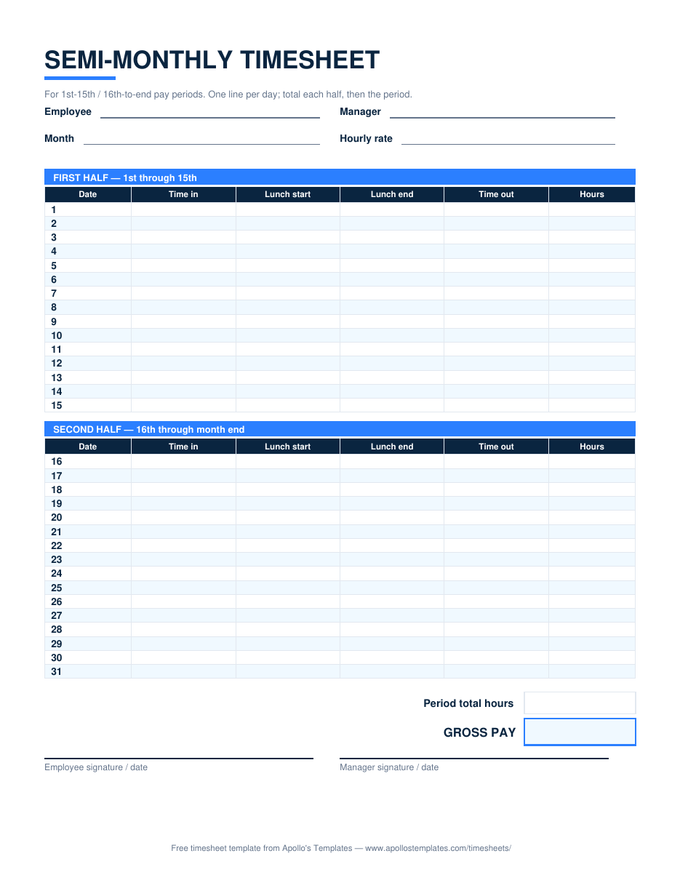
Semi-monthly timesheet with self-dating 1st-to-15th and 16th-to-end blocks and hours and pay totals

Semi-monthly — 1st–15th / 16th–end

Both half-month blocks with day numbers pre-typed, for twice-a-month paydays.
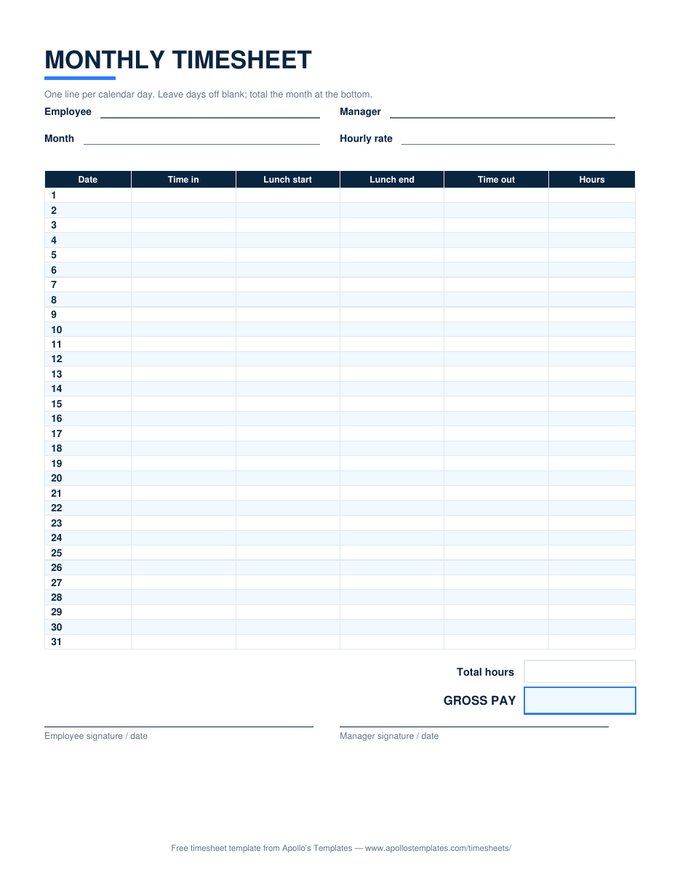
Monthly timesheet with 31 dated rows on one page, self-adjusting for short months, plus totals and gross pay

Monthly — 31-row grid

The whole month as one compact table — delete the rows short months don't use.
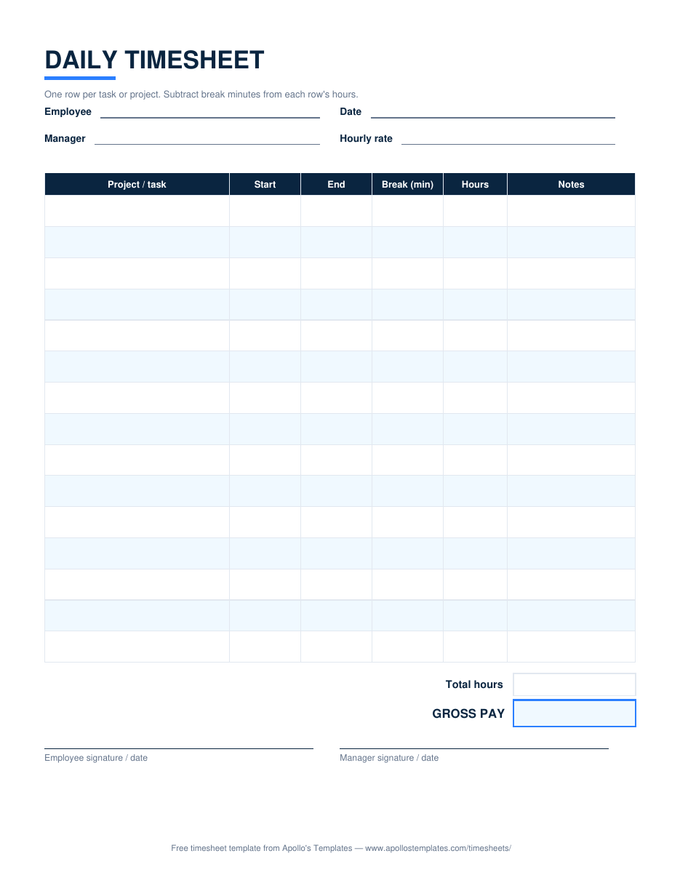
Daily timesheet with per-task rows for start, end, break minutes, computed hours, and notes

Daily — per-task rows

Task, start, end, break, hours, notes — add or delete rows like any Docs table.
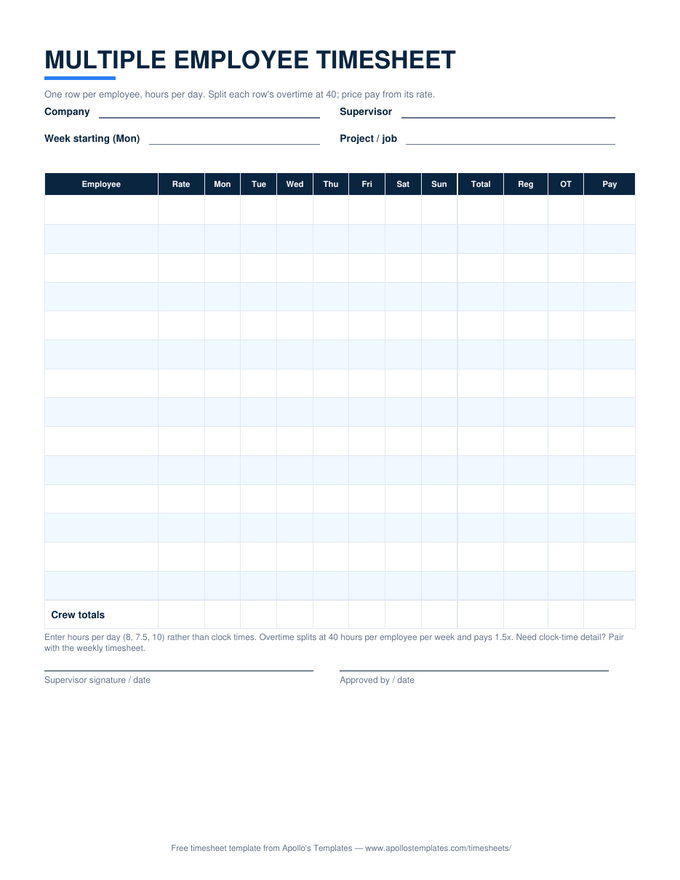
Multiple-employee timesheet with the crew's week in rows, hours per day, and overtime and pay per employee

Multiple employee — crew grid

One row per employee, hours per day — share a copy with the whole crew's supervisor.
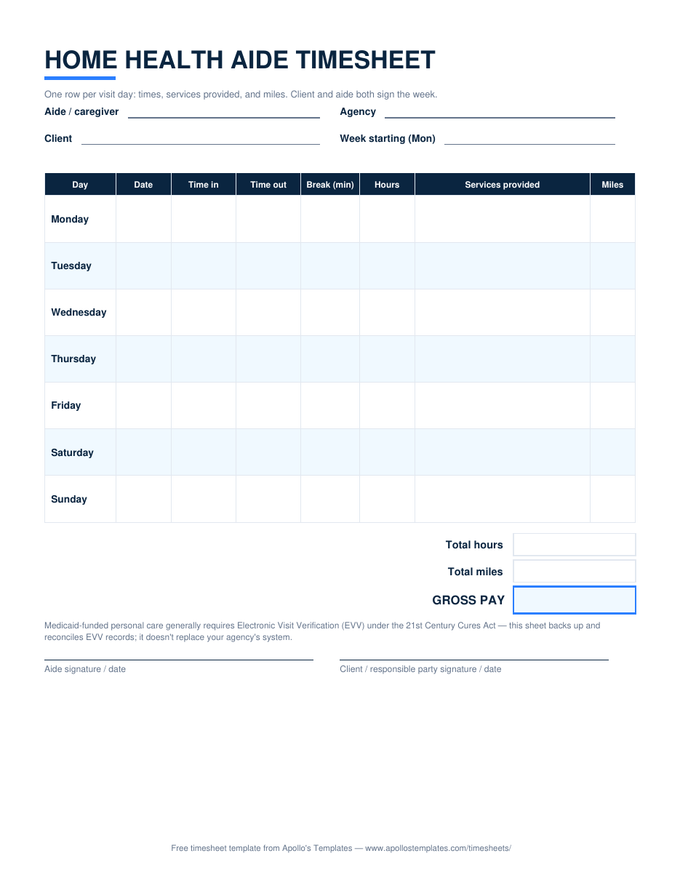
Home care timesheet with visit times, services provided, miles driven, and client and aide signature lines

Home health aide — visit sheet

Visit times, services, and miles, with the client and aide signature pair.
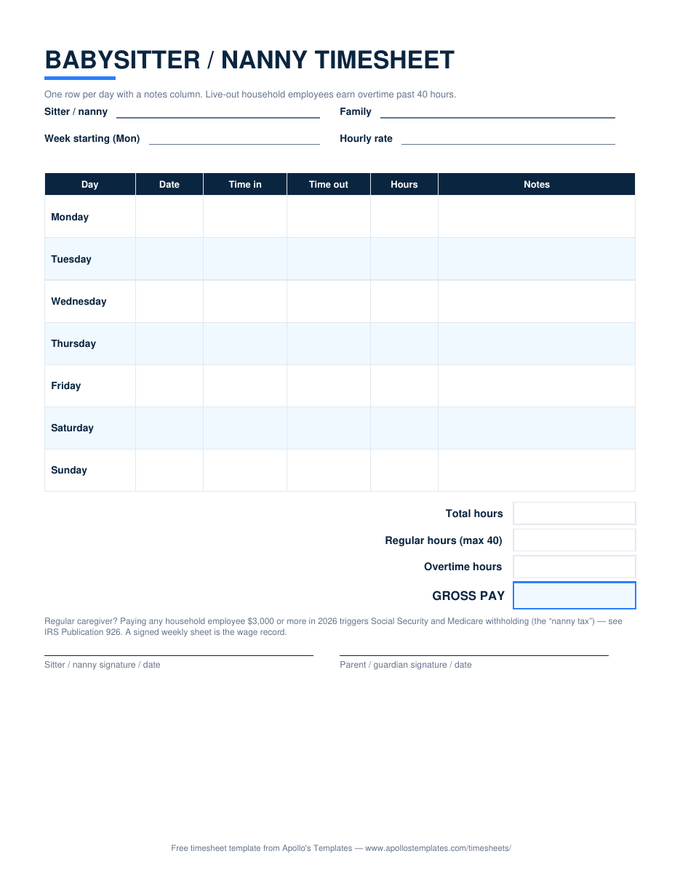
Babysitter timesheet with daily times, a notes column, overtime past 40 hours, and parent and sitter signature lines

Babysitter / nanny — with notes

Daily in/out with a notes column and both signature lines.
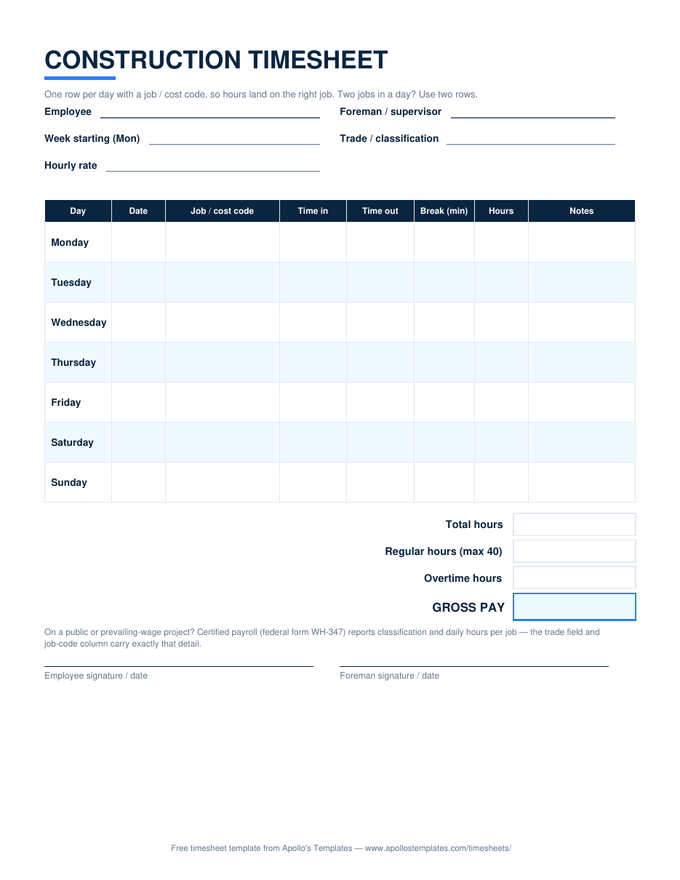
Construction timesheet with daily rows, a job and cost code column, break minutes, and overtime at 40 hours

Construction — job-coded days

The job-site week as a Docs table, trade field and job codes included.
Docs vs Sheets

Pick by what the timesheet has to do.

The same Google account gives you two ways to hold a timesheet, and they aren’t interchangeable. A Sheets copy is a calculator: clock times in, hours and overtime and gross pay out, live, from any device. A Docs copy is stationery: a clean document that takes your letterhead, prints predictably, and reads like the personnel paperwork it usually gets filed with.

Most workplaces that ask for “the Google Docs version” want the stationery job — an editable, brandable, printable sheet — and that’s what these are. If halfway through you discover you wanted the calculator after all, the Google Sheets versions are the identical layouts with the math turned on.

The math-enabled twin
Google Sheets Timesheets
Identical layouts with live formulas — hours, overtime, and pay compute as you type.
Open
Offline, same tables
Timesheets for Word
The .docx originals these Docs copies are converted from.
Open
Start here
All Timesheet Templates
The whole library — every period, every format — on one page.
Browse

Frequently asked questions

Google Docs or Google Sheets — which should I use for a timesheet?
Sheets, if you want the math done for you — our Google Sheets versions calculate hours, overtime, and pay as you type, and Docs tables calculate nothing. Docs earns its place for a different job: documents that read as documents. If the timesheet gets pasted into a report, printed under a company header, or filled in as prose-adjacent paperwork rather than computed, the Docs version behaves the way word-processor people expect. Honest summary: Sheets for arithmetic, Docs for formatting — and both links live on every card in this library.
What happens when I click “Open in Google Docs”?
Google shows a Make-a-copy page for that template; one click puts a fully editable duplicate in your own Drive. The master stays read-only on our side, your copy is private to you, and we never see it. You'll need a Google account signed in — that's Google's requirement for copying, not ours — and any free Gmail qualifies.
How do I edit the tables — add rows, change columns, put my company name on it?
Like any Google Docs table. Click into the last cell and press Tab to add a row; right-click for column operations; type over the title block to add your company name. The layouts convert from our Word masters, so the structure is ordinary table formatting — no text boxes, no content controls, nothing fragile. Once it's customized, use File → Make a copy to stamp out fresh weeks from your own master.
Can several people fill in one shared Docs timesheet?
Technically yes — Docs is collaborative — but share deliberately. The pattern that stays legible is one document per employee per period, shared with the approver, rather than a communal doc everyone types into. For genuinely shared crew tracking, the multiple-employee sheet works better in its Google Sheets form, where each row's totals compute; the Docs version of that grid is best as the print-and-sign copy.
Updated through September 2026